Article
Managed File Transfer Exploits: Here to Stay?
Arete Analysis
Cybersecurity Trends
Threat Actors
Cybercriminals are actively exploiting recently disclosed vulnerabilities in two prominent Managed File Transfer (MFT) products. Initially discovered by cybersecurity researchers, CVE-2025-11371 is an unauthenticated Local File Inclusion vulnerability in Gladinet’s MFT product, CentreStack. This vulnerability ultimately enables an exploit chain allowing remote code execution (RCE) that was patched by Gladinet earlier this year (CVE-2025-30406).
Meanwhile, Fortra confirmed the targeting of a vulnerability, CVE-2025-10035, in its GoAnywhere MFT product. Although the extent of this latest campaign is unknown, researchers have observed ongoing exploitation of the vulnerability by a threat group known for deploying Medusa ransomware. The vulnerability also results in RCE due to improper deserialization.
Both vendors have patched these vulnerabilities in their product’s latest version.
What’s Notable and Unique
The recent attacks against Gladinet CentreStack are the second concerted effort this year to exploit vulnerabilities in this product. This speaks to threat actors’ perceived value of the source and the associated data. Given the access to sensitive data and broad reach within the network that generally accompany MFT systems, it’s easy to see why cybercriminals continue to return to this product.
Although patches for both CentreStack and GoAnywhere MFT have been released, Arete recommends that organizations continue to proactively hunt for any suspicious activity involving these products. In recent years, cybercriminals have heavily targeted and leveraged MFT software in their operations. Arete does not foresee any near-term deviation in this trend.
Analyst Comments
The activity described in this article is far from novel and in no way isolated. This summer, security researchers warned of notable surges in scanning activity targeting the well-known (and previously exploited) MFT software, MOVEit. CrushFTP and Cleo’s LexiCom, VLTransfer, and Harmony products have also received attention from threat actors this year. Although MFT products are powerful tools for a business, they also present an enticing target for cybercriminals and should be evaluated and deployed with care and closely monitored. Arete has responded to several incidents in which MFT software was utilized by the threat actor. Cybercriminals view these platforms not only as a way to access sensitive data, but also as an ideal vector for initial entry into a network, making continued exploitation likely for the foreseeable future.
Sources
Active Exploitation of Gladinet CentreStack and Triofox Local File Inclusion Flaw (CVE-2025-11371)
Investigating active exploitation of CVE-2025-10035 GoAnywhere Managed File Transfer vulnerability
Fortra cops to exploitation of GoAnywhere file-transfer service defect
Deserialization Vulnerability in GoAnywhere MFT’s License Servlet
Threat Advisory: Oh No Cleo! Cleo Software Actively Being Exploited in the Wild
MOVEit Transfer Faces Increased Threats as Scanning Surges and CVE Flaws Are Targeted
Back to Blog Posts

Report
Arete's 2025 Annual Crimeware Report
Harness Arete’s unique data and expertise on extortion and ransomware to inform your response to the evolving threat landscape.
Article
FortiGate Exploits Enable Network Breaches and Credential Theft
A recent security report indicates that threat actors are actively exploiting FortiGate Next-Generation Firewall (NGFW) appliances as initial access vectors to compromise enterprise networks. The activity leverages recently disclosed vulnerabilities or weak credentials to gain unauthorized access and extract configuration files, which often contain sensitive information, including service account credentials and detailed network topology data.
Analysis of these incidents shows significant variation in attacker dwell time, ranging from immediate lateral movement to delays of up to two months post-compromise. Since these appliances often integrate with authentication systems such as Active Directory and Lightweight Directory Access Protocol (LDAP), their compromise can grant attackers extensive access, substantially increasing the risk of widespread network intrusion and data exposure.
What’s Notable and Unique
The activity involves the exploitation of recently disclosed security vulnerabilities, including CVE-2025-59718, CVE-2025-59719, and CVE-2026-24858, or weak credentials, allowing attackers to gain administrative access, extract configuration files, and obtain service account credentials and network topology information.
In one observed incident, attackers created a FortiGate admin account with unrestricted firewall rules and maintained access over time, consistent with initial access broker activity. After a couple of months, threat actors extracted and decrypted LDAP credentials to compromise Active Directory.
In another case, attackers moved from FortiGate access to deploying remote access tools, including Pulseway and MeshAgent, while also utilizing cloud infrastructure such as Google Cloud Storage and Amazon Web Services (AWS).
Analyst Comments
Arete has identified multiple instances of Fortinet device exploitation for initial access, involving various threat actors, with the Qilin ransomware group notably leveraging Fortinet device exploits. Given their integration with systems like Active Directory, NGFW appliances remain high-value targets for both state-aligned and financially motivated actors. In parallel, Arete has observed recent dark web activity involving leaked FortiGate VPN access, further highlighting the expanding risk landscape. This aligns with the recent reporting from Amazon Threat Intelligence, which identified large-scale compromises of FortiGate devices driven by exposed management ports and weak authentication, rather than vulnerability exploitation. Overall, these developments underscore the increasing focus on network edge devices as entry points, reinforcing the need for organizations to strengthen authentication, restrict external exposure, and address fundamental security gaps to mitigate the risk of widespread compromise.
Sources
FortiGate Edge Intrusions | Stolen Service Accounts Lead to Rogue Workstations and Deep AD Compromise

Article
Vulnerability Discovered in Anthropic’s Claude Code
Security researchers discovered two critical vulnerabilities in Anthropic's agentic AI coding tool, Claude Code. The vulnerabilities, tracked as CVE-2025-59536 and CVE-2026-21852, allowed attackers to achieve remote code execution and to compromise a victim's API credentials. The vulnerabilities exploit maliciously crafted repository configurations to circumvent control mechanisms. It should be noted that Anthropic worked closely with the security researchers throughout the process, and the bugs were patched before the research was published.
What’s Notable and Unique
The configuration files .claude/settings.json and .mcp.json were repurposed to execute malicious commands. Because the configurations could be applied immediately upon starting Claude Code, the commands ran before the user could deny permissions via a dialogue prompt, or they bypassed the authentication prompt altogether.
.claude/settings.json also defines the endpoint for all Claude Code API communications. By replacing the default localhost URL with a URL they own, an attacker could redirect traffic to infrastructure they control. Critically, the authentication traffic generated upon starting Claude Code included the user's full Anthropic API key in plain text and was sent before the user could interact with the trust dialogue.
Restrictive permissions on sensitive files could be bypassed by simply prompting Claude Code to create a copy of the file's contents, which did not inherit the original file's permissions. A threat actor using a stolen API key could gain complete read and write access to all files within a workspace.
Analyst Comments
The vulnerabilities and attack paths detailed in the research illustrate the double-edged nature of AI tools. The speed, scale, and convenience characteristics that make AI tools attractive to developer teams also benefit threat actors who use them for nefarious purposes. Defenders should expect adversaries to continue seeking ways to exploit configurations and orchestration logic to increase the impact of their attacks. Organizations planning to implement AI development tools should prioritize AI supply-chain hygiene and CI/CD hardening practices.
Sources
Caught in the Hook: RCE and API Token Exfiltration Through Claude Code Project Files | CVE-2025-59536 | CVE-2026-21852
Article
Ransomware Trends & Data Insights: February 2026
After a slight lull in January, Akira and Qilin returned to dominating ransomware activity in February, collectively accounting for almost half of all engagements that month. The rest of the threat landscape remained relatively diverse, with a mix of persistent threats like INC and PLAY, older groups like Cl0p and LockBit, and newer groups like BravoX and Payouts King. Given current trends, the first quarter of 2026 will likely remain relatively predictable, with the top groups from the second half of 2025 continuing to operate at fairly consistent levels month to month.
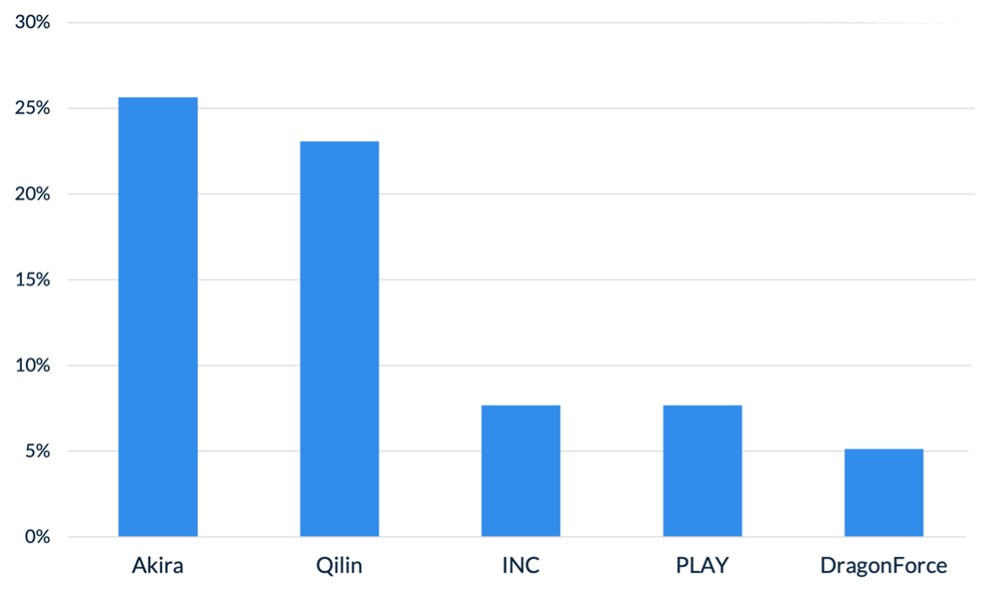
Figure 1. Activity from the top 5 threat groups in February 2026
Throughout the month of February, analysts at Arete identified several trends behind the threat actors perpetrating cybercrime activities:
In February, Arete observed Qilin actively targeting WatchGuard Firebox devices, especially those vulnerable to CVE-2025-14733, to gain initial access to victim environments. CVE-2025-14733 is a critical vulnerability in WatchGuard Fireware OS that allows a remote, unauthenticated threat actor to execute arbitrary code. In addition to upgrading WatchGuard devices to the latest Firebox OS version, which patches the bug, administrators are urged to rotate all shared secrets on affected devices that may have been compromised and may be used in future campaigns.
Reports from February suggest that threat actors are increasingly exploring AI-enabled tools and services to scale malicious activities, demonstrating how generative AI is being integrated into both espionage and financially motivated threat operations. The Google Threat Intelligence Group indicated that state-backed threat actors are leveraging Google’s Gemini AI as a force multiplier to support all stages of the cyberattack lifecycle, from reconnaissance to post-compromise operations. Separate reporting from Amazon Threat Intelligence identified a threat actor leveraging commercially available generative AI services to conduct a large-scale campaign against FortiGate firewalls, gaining access through weak or reused credentials protected only by single-factor authentication.
The Interlock ransomware group recently introduced a custom process-termination utility called “Hotta Killer,” designed to disable endpoint detection and response solutions during active intrusions. This tool exploits a zero-day vulnerability (CVE-2025-61155) in a gaming anti-cheat driver, marking a significant adaptation in the group’s operations against security tools like FortiEDR. Arete is actively monitoring this activity, which highlights the growing trend of Bring Your Own Vulnerable Driver (BYOVD) attacks, in which threat actors exploit legitimate, signed drivers to bypass and disable endpoint security controls.
Sources
Arete Internal