Article
US Sanctions Grinex Crypto Exchange
Arete Analysis
Cybersecurity Trends

On August 14, 2025, the US Treasury Department announced sanctions against the spiritual successor to Garantex, the Grinex crypto exchange. Following law enforcement action against Garantex in March 2025, Grinex was created by Garantex employees to support sanctions evasion efforts. Subsequently, Grinex has become a hot spot for illicitly obtained funds from ransomware, extortion, and other fraudulent activities.
Multi-Step Process
The disruptions of Grinex and Garantex took years to execute and occurred over multiple phases of sanctions and law enforcement actions.
Phase 1 – Initial Sanctions against Garantex
In April 2022, the US Treasury Department sanctioned Estonia-based crypto exchange Garantex. This came after Estonia revoked Garantex’s license in February 2022 due to a lack of anti-money laundering/know-your-customer (AML/KYC) policies. At the time of the sanctions announcement, the Office of Foreign Assets Control (OFAC) assessed Garantex to have facilitated more than $100 million USD in illicit transactions. Interestingly, these sanctions did not inhibit Garantex from continuing their operations in providing cover for criminals and sanctioned customers of the exchange.
However, the sanctions did impact the ransomware landscape. Previously used by big-name ransomware groups such as Conti, LockBit, and Ryuk, the exchange was largely no longer a viable option for groups hoping to stay in business and evade additional law enforcement scrutiny. Groups that continued to utilize the sanctioned exchange or decided to use it later often earned themselves a one-way ticket to organizations’ no-pay lists and became a target for future law enforcement takedowns. Notably, 8Base ransomware was added to Arete’s internal no-pay list in September 2023 following an identified transaction to Garantex. 8Base was then taken down by a law enforcement action in February of 2025.
Phase 2 – Law Enforcement Attempts to Dismantle Garantex
Fast-forward to March 2025, when law enforcement agencies led by the US Secret Service attempted to disrupt the sanctioned crypto exchange by seizing Garantex’s primary domain and over $26 million in cryptocurrency assets. Unfortunately, the operation didn’t entirely disrupt the exchange and led to the unveiling of Grinex, often referred to as Garantex 2.0, later that month. Grinex began serving as the nefarious new arm of Garantex, and operators almost immediately began routing illicit funds through the new exchange.
Phase 3 – US Treasury Sanctions Grinex
This brings us to August 14th, when the US Treasury announced sanctions against the newly formed Grinex crypto exchange, three Garantex executives, and the A7A5 stablecoin, which is discussed in the next section. Currently, Grinex remains operational, and Arete is monitoring for use of the exchange as part of ransomware groups money laundering efforts.
But Wait, There’s More
The A7A5 stablecoin cryptocurrency is designed to track 1:1 with the Russian Ruble and appeared to be transferring funds from Garantex in January 2025, indicating the desire to create a sanction-resistant asset even before the disruption. The A7A5 coin, launched behind a veil of shell companies based in Kyrgyzstan, was adopted as an efficient sanctions evasion tool for individuals looking to cash out their illicitly obtained funds.
Analyst Comments
The identification and subsequent sanctions of Grinex and the A7A5 stablecoin significantly impinge upon cybercriminals’ ability to launder funds. Sanctions announcements especially impact ransomware groups, as many incident response firms, especially ones registered as money services businesses (MSBs), will not facilitate payments to groups using sanctioned infrastructure. The unsealing of indictments against the Garantex leadership and increased spotlight on the use of the A7A5 stable coin as a sanctions evasion tool allow organizations additional opportunities to monitor sanctions exposure and prohibit funds from moving to sanctioned entities. Arete cautions that new money laundering techniques designed to evade sanctions are likely to emerge in the future as cybercriminals continuously evolve their tactics in this space.
Sources
Back to Blog Posts

Article
FortiBleed Campaign Linked to INC and Lynx Ransomware Operations
Researchers have linked the FortiBleed credential-harvesting campaign to the INC and Lynx ransomware-as-a-service (RaaS) operations, establishing a direct connection between large-scale FortiGate credential theft and subsequent ransomware deployment. The attribution is based on a variety of factors, including an operator observed managing negotiation panels for both ransomware groups, notable overlap between FortiBleed victim data and subsequent ransomware targets, and internal infrastructure exposing attack workflows. The campaign is estimated to have targeted more than 430,000 internet-facing FortiGate devices, resulting in administrative access to hundreds of organizations.
What’s Notable and Unique
Researchers identified a shared operator actively managing negotiation panels for both the INC and Lynx ransomware groups, providing rare operational evidence linking the two RaaS operations beyond infrastructure or malware similarities.
Analysis of the exposed infrastructure revealed a structured ransomware operation with dedicated roles for access acquisition, victim management, negotiations, and technical support, reflecting an organized ransomware-as-a-service (RaaS) model rather than an ad hoc criminal group.
The operation reportedly integrates artificial intelligence into multiple stages of the attack lifecycle, including vulnerability research, penetration testing, attack automation, and ransomware development, demonstrating the increasing adoption of AI to enhance offensive capabilities.
Mitigations
Organizations should assume that exposed or previously compromised FortiGate credentials may be leveraged for ransomware deployment and immediately reset administrative and VPN credentials while enforcing multi-factor authentication (MFA) for all privileged access. Security teams should ensure that FortiGate appliances are fully patched, restrict management interfaces to trusted networks, and audit administrative accounts and firewall configurations for unauthorized changes. Organizations should also monitor for anomalous authentication activity, hunt for published indicators of compromise (IOCs), and review VPN and firewall logs for signs of unauthorized access. Maintaining centralized logging and a well-practiced incident response process can help detect and contain attacks before they progress to lateral movement or ransomware deployment.
Analyst Comments
The attribution of FortiBleed to the INC and Lynx ransomware operations reinforces the growing convergence between credential-harvesting campaigns and ransomware deployment, highlighting the role of initial access operations in modern RaaS ecosystems. The relationship between INC and Lynx also aligns with Arete's previous research, which identified a shared malware lineage. INC Ransom, first observed in 2023, was later leaked or sold, enabling code reuse by other threat actors. Lynx, which emerged in 2024, is widely regarded as an evolution of the INC codebase. Sinobi ransomware, identified in 2025, shares near-identical binaries and infrastructure, and approximately 99% code similarity with Lynx. Further details on the code correlation between INC, Lynx, and Sinobi are available in Arete's 2025 Annual Report.
Sources
Is FortiBleed Linked to INC and Lynx Ransomware?
FortiBleed credential-theft campaign linked to Lynx ransomware
FortiBleed Unmasked: A Joint Operation by Lynx and INC Ransomware Groups
FortiBleed Credential Theft Campaign Attributed to INC and Lynx Ransomware Groups

Article
Ransomware Trends & Data Insights: June 2026
Although Akira was once again the most active ransomware threat in June, activity remained relatively distributed among multiple threat groups, with 17 unique threat groups observed throughout the month. Along with Akira, Qilin and INC Ransom remained active and were among the top five most active threat groups observed in June. Several new threat actors also emerged during the month, including KryBit, Settra, and Icarus.
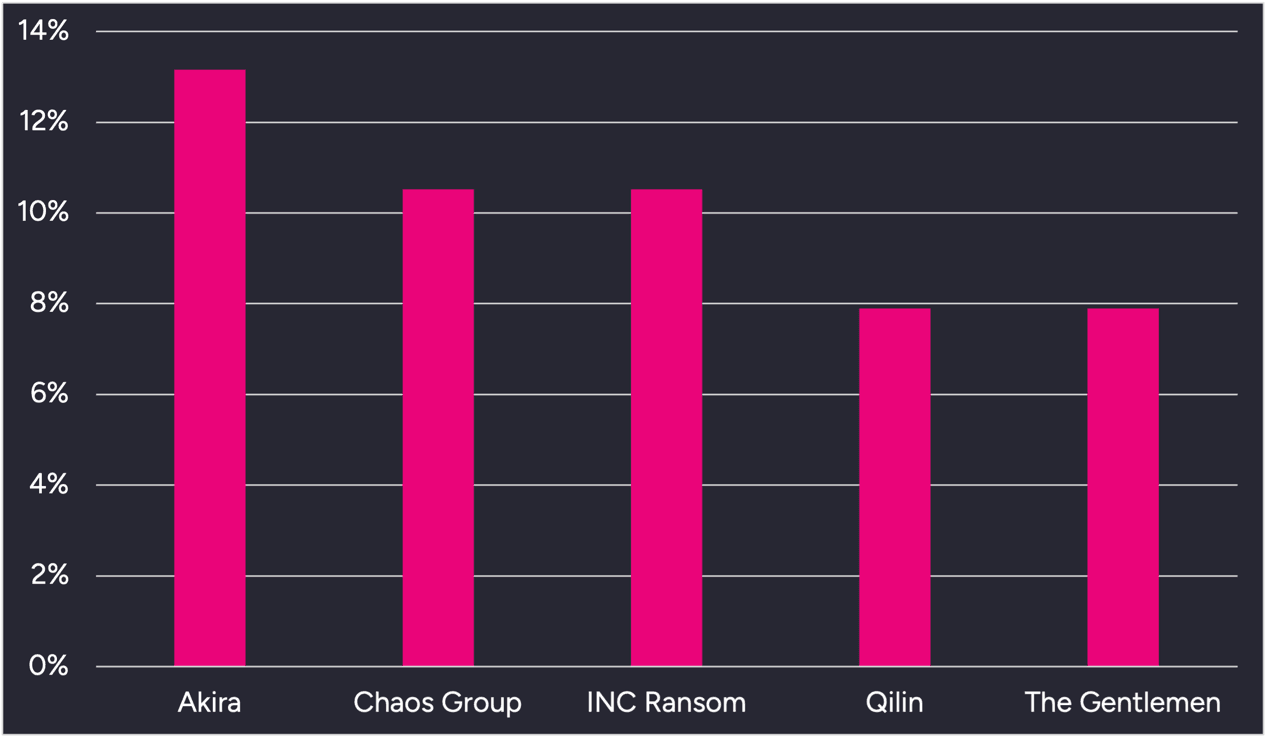
Figure 1. Activity from the top 5 threat groups in June 2026
Throughout the month, analysts at Arete identified several trends behind the threat actors perpetrating cybercrime activities:
In June, a threat actor calling themselves Icarus compromised and exfiltrated data from customers of the market intelligence platform Klue. Klue later confirmed the security incident, which involved attackers stealing OAuth tokens used to connect to customers' Salesforce environments, and reported that the threat actor was deleting the data stolen from affected Klue customers. In an odd twist, reports emerged of a second threat actor claiming to have compromised Icarus's infrastructure and attempting to re-extort Klue's customers. Regardless, the Klue breach highlights the growing threat of software-as-a-service (SaaS) supply chain compromises, particularly those exploiting OAuth tokens and trusted integrations to bypass traditional security controls.
In mid-June, security researchers identified a large-scale credential-harvesting and valid account abuse campaign dubbed “FortiBleed” that systematically targets internet-facing Fortinet FortiGate firewalls and SSL-VPN gateways, relying heavily on automated password spraying and configuration exfiltration rather than vulnerability exploitation. The scale of exposure and attack activity has been significant and globally distributed, with attackers collecting the login credentials of over 86,000 FortiGate devices across 194 countries. There is no singular ‘fix’ to mitigate the database exposure, and it is important that organizations work with their security teams, incident response providers, and other stakeholders to review environments holistically and monitor for signs of potentially unauthorized activity.
Multiple threat groups continue to leverage vulnerable drivers to bypass endpoint detection and response (EDR) solutions in a technique known as Bring Your Own Vulnerable Driver (BYOVD). Arete has observed Akira and DragonForce using the technique in multiple engagements, and The Gentlemen ransomware-as-a-service (RaaS) has also been observed using what researchers are calling "GentleKiller", a framework consisting of multiple variants that leverage vulnerable drivers and EDR-disabling utilities to target a wide range of endpoint security products.
Sources
Arete Internal

Article
Update on FortiBleed Credential Exposure
Last week, security researchers identified a large-scale credential-harvesting and valid account abuse campaign dubbed “FortiBleed” that systematically targets internet-facing Fortinet FortiGate firewalls and SSL-VPN gateways. The campaign relies heavily on automated password spraying and configuration exfiltration rather than vulnerability exploitation.
Attackers first scan for exposed FortiGate devices and rank targets based on revenue. SSH brute-force attacks are used against admin accounts to gain initial access.
Following initial access, operators deploy stealthy packet-sniffing capabilities and establish external listening posts to receive harvested credentials and session data in near real time.
Observed post-exploitation activity strongly indicates pre-positioning for broader enterprise compromise, including lateral movement and potential ransomware deployment.
The scale of exposure and attack activity has been significant and globally distributed. The campaign has been ongoing since at least February 2026, with attackers collecting the login credentials of over 86,000 FortiGate devices across 194 nations.
How Arete Can Help
Arete continues to monitor this campaign, utilizing our extensive experience in detection, threat hunting, and attack surface review to look for indications of unauthorized activity related to this database exposure. Additional information regarding important considerations, containment and credential compromise mitigation actions, and additional hardening recommendations can be found in Arete’s FortiBleed Advisory.
Sources
FortiBleed: SOCRadar’s Investigation into 86,644 Compromised Fortinet Firewalls
FortiBleed Attackers Turn Firewalls Into Credential Stealers as Heists Persist
FortiBleed: The Most Detailed Breakdown Yet of an Active Russian Credential-Harvesting Operation
Hackers Using FortigateSniffer Tool That Turns Compromised Firewalls Into Password Collectors

Article
Europol Disrupts AudiA6 Crypto Laundering Service
European authorities have dismantled AudiA6, a major cryptocurrency laundering service linked to ransomware groups and broader cybercriminal networks. Between 2022 and 2025, the platform is believed to have processed over €336 million in illicit funds, enabling threat actors to obscure financial trails and monetize cybercrime proceeds. Its operators are also suspected of running Dark2Web, a dark web forum that facilitated collaboration, services, and connections among cybercriminals globally. This development underscores the expanding role of sophisticated, large-scale cryptocurrency laundering services in sustaining the cybercrime economy, enabling threat actors to obscure illicit funds and evade regulatory controls.
What’s Notable and Unique
Following law enforcement disruption of Cryptex and Garantex, AudiA6 emerged as another platform involved in financial activities linked to ransomware groups. Investigators believe that AudiA6 became a central hub for cybercriminals seeking to launder stolen digital assets while obscuring the transaction trail from authorities.
On June 10, 2026, a coordinated operation resulted in two arrests in Georgia, the dismantling of key infrastructure (30+ servers, 25 domains), the freezing or seizure of over €778,000 in crypto, and the takedown of the AudiA6 and Dark2Web platforms.
Analyst Comments
Ransomware groups and cybercriminal networks are increasingly leveraging sophisticated techniques, including chain-hopping, decentralized exchanges, and mixer-as-a-service platforms, to rapidly move illicit cryptocurrency across multiple blockchains, effectively obscuring transaction trails. Concurrently, the widespread use of fraudulent exchange accounts, mule wallets, and privacy-enhancing tools has elevated cryptocurrency laundering to a core enabler of the cybercrime ecosystem, allowing actors to bypass anti-money-laundering controls at scale. This investigation identified over 6,000 KYC records linked to money-mule accounts, many of which were tied to Russian-speaking intermediaries specifically recruited to facilitate the movement of illicit proceeds. These threat actors systematically used both commercial and domain-controlled email services to establish mule accounts across multiple cryptocurrency platforms. Collectively, these findings underscore the growing scale, coordination, and professionalization of cryptocurrency-enabled crime, highlighting the critical need for sustained, intelligence-led, and internationally coordinated efforts to disrupt these evolving financial ecosystems.
Sources
Ransomware gangs cut off from EUR 336 million ‘AudiA6’ crypto laundering pipeline