Article
Remote Access and IoT Search Engines
Arete Analysis

Recently, Arete Incident Response Tiger Teams (“Arete IR”) have responded to an increased volume of ransomware incidents involving the Sodinikibi, Phobos, and Dharma ransomware variants. The threat actors deploying these variants are known to use anti-forensics techniques to hide their tracks. Once access is gained, they usually delete artifacts which aid cyber investigators with reconstructing steps taken by the threat actors, revealing important information pertaining to the root cause for the computer security event. In most cases, Arete was able to recover critical artifacts to forensically reconstruct the various attacks to identify a single entry point consistent across the three variants: Remote Desktop.
Requirements Businesses have a need to enable workers to access files and business resources remotely from home, hotels, or business relationships. The cheapest way for businesses to allow remote access is to “expose” the Remote Desktop Protocol (“RDP”) to the public internet. The business’ firewall configuration is altered to allow inbound connectivity to the default port 3389, and any connections to that port are automatically forwarded to a specific computer on the network, which is usually a terminal services server. Using only an Internet Protocol (“IP”) address, anyone can attempt to connect to the RDP service.
Limitations on Protocol and Service Most businesses who implement remote access via RDP aren’t aware of the limitations of the service nor do they implement intrusion detection and prevention services. Lastly, many don’t require multi-factor authentication. The downside to allowing any connection into a network is exactly that: any connection can be allowed into the network. This connection can be from anywhere, at any time, for any reason and with any number of authentication attempts. The RDP service itself doesn’t monitor for bad credential combinations and automatically disable or block connection attempts. Port forwarding on firewalls doesn’t inspect the inbound traffic either. Essentially, once a port is exposed to the public internet, anyone, anywhere, can try an unlimited number of usernames and passwords to gain access to that system. Since any number of combinations can be attempted, this makes the configuration vulnerable to credential stuffing, dictionary, and brute force attacks.
Crime of Opportunity Quite often during our investigations, clients ask “was this a targeted attack or a crime of opportunity?” Nine out of 10 times, it’s a crime of opportunity. Then the follow up question “Why us?” Well, for starters, it’s your configuration. These threat actors have their attack mechanics down to a series of steps: 1. Identify target 2. Gain access to target 3. Cover tracks 4. Deploy ransomware 5. Repeat
While they most likely aren’t outright targeting your organization directly, they may be targeting exposed services which link them to your organization.
Internet of Things (IoT) Search Engines
Google, Bing, and DuckDuckGo are three very popular search engines. They’re used to find all sorts of text information or images. These search engines aren’t designed to identify specific computers or services across the world. Rather a different set of search engines can be used to find computers that are connected directly to the internet along with their IP addresses and any other information about the computer involving their geo location, running services, and protocol history. Use caution when visiting these sites as unintended side effects can occur.
https://zoomeye.org
These sites can be used by anyone, anonymously, to identify internet attached devices, the services they’re running and any other information the IoT crawlers can index. The anonymous feature is obtained via the IoT indexer by allowing anyone to query the index stored by the IoT search engine, instead of scanning the node directly. Essentially, this search engine is the phone book, allowing anyone to find street addresses by person’s names or people by street addresses.
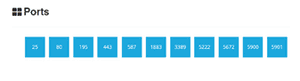
A search for “port:3389”, which is the default port for RDP services, can return several million devices. Again, this isn’t real time information because the query is run against the index of the IoT search engine. Once an IP address is identified, additional steps would be needed to test if the IP address is online. Additionally, the resulting information can be filtered by organization, operating system, and country.
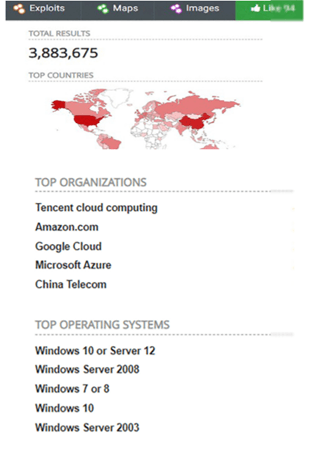
Reviewing the results, there’s approximately 1,060 IP addresses that are detected as the Windows 2003 operating system. At face value, this is extremely alarming because Windows 2003 was discontinued during July of 2015. Microsoft officially stopped supporting the operating system as well as providing security updates. Given the information returned from shodan.io, businesses are still relying on it as a means for remote connectivity. Again, these results would need to be qualified as online and available. Regardless, the number is still alarming.
Attack Methodologies
After the threat actor identifies a target, any number of steps can be performed to initiate an attack. Typically, the threat actor will profile the target to gain as much information as possible in order to increase the success of the attack. Profiling can occur in any of the following ways:
Verifying the IP address is online and attempting to brute force access automatically.
Attempting to resolve the IP address to a domain name or company name in order to:
Construct phishing emails for obtaining credentials.
Employ social engineering of employees for obtaining credentials
Research running services against known vulnerabilities to identify pre-built payloads to exploit the services.
Whichever approach the threat actor takes, there’s a good chance they will be successful with gaining unauthorized access to your network.
Preventative Actions
While it’s a waiting game to become the next victim, there are steps you can take to mitigate or prolong falling prey to these threat actor methodologies. Successful mitigation of unauthorized access can be achieved through the proper implementation of layered computer and network security controls. The following steps, while not exhaustive, can be taken to mitigate the exposure of services used by your organization.
Enable Multi-Factor Authentication (“MFA”) on any third party accounts or remote access on any third party accounts or remote access accounts. accounts.
Disable RDP services and port forwarding on firewalls.
Implement VPN services to remotely connect to your organization’s network or leverage to your organization’s network or leverage remote
connection technologies that remote connection technologies that support MFA. support MFA.
Research open source intelligence to develop a public footprint of your organization. a public footprint of your organization.
Train employees on social engineering and phishing email tactics and techniques. phishing email tactics and techniques.
Purchase a cyber insurance policy and familiarize yourself with the preferred vendors yourself with the preferred vendors within your policy. within your policy.
Build a close working relationship with a cyber advisory company.
Back to Blog Posts

Article
Payouts King Utilizes QEMU Emulator to Bypass EDR
Researchers recently identified threat actor campaigns leveraging QEMU, a free open-source virtual machine (VM) emulator, to evade endpoint security solutions. Since QEMU acts as a VM within the target environment, endpoint detection tools cannot scan inside the emulator or detect any malicious files or payloads QEMU contains. Although threat actors have been utilizing QEMU maliciously since 2020, recent activity is attributed to the Payouts King ransomware group and a cluster of threat actors believed to be initial access brokers who have also been exploiting the CitrixBleed2 vulnerability CVE-2025-5777.
What’s Notable and Unique
Payouts King has been observed deploying QEMU since November and uses the VM to create a reverse SSH backdoor to evade detection and install various tools, including Rclone, Chisel, and BusyBox.
In a separate campaign, threat actors are exploiting CVE-2025-5777, a Citrix NetScaler vulnerability that allows attackers to bypass authentication. Once they’ve gained initial access, the threat actors use QEMU to deploy tools inside the VM, which are then used to steal credentials, identify Kerberos usernames, perform Active Directory reconnaissance, and set up FTP servers for staging or data exfiltration.
Analyst Comments
Threat actors continue to focus their efforts on defense evasion, often leveraging legitimate, easily accessible tools such as QEMU. The continued use of QEMU by multiple threat actors highlights the effectiveness of these tactics and the difficulty in detecting and defending against them. To counter this campaign, organizations should proactively monitor for unauthorized QEMU installations, abnormal scheduled tasks, and port forwarding rules.
Sources
QEMU abused to evade detection and enable ransomware delivery

Article
Microsoft Teams Continues to be Leveraged in Social Engineering Attacks
Microsoft warns that threat actors are increasingly abusing Microsoft Teams and relying on legitimate tools to gain access and conduct lateral movement within enterprise networks. The threat actors impersonate IT or helpdesk staff to contact employees via cross-tenant chats and trick them into granting remote access for data theft. Microsoft has observed multiple intrusions with a similar attack chain that utilized commercial remote management software, like Quick Assist and the Rclone utility, to transfer files to an external cloud storage service. This tactic, notably associated with Black Basta and Cactus ransomware operations in late 2024 and early 2025, appears to have resurfaced, with similar activity more recently observed in intrusions linked to the Akira and Payouts King ransomware groups.
What’s Notable and Unique
Initial access is achieved by leveraging external collaboration features in Microsoft Teams to allow impersonation of internal support personnel, tricking users into bypassing security warnings. This reflects abuse of legitimate functionality rather than exploitation of a Microsoft Teams vulnerability.
Following initial access, attackers conduct rapid reconnaissance using Command Prompt and PowerShell to assess privileges, domain membership, and opportunities for lateral movement. Persistence is maintained through Windows Registry modifications, after which attackers leveraged WinRM for lateral movement, targeting domain-joined systems and high-value assets, including domain controllers.
Malicious payloads were staged in user-writable directories and executed through DLL side-loading via trusted, signed applications, enabling covert code execution while blending with legitimate activity. Additional remote management tools were also deployed to support broader access, while Rclone or similar utilities were used to stage and exfiltrate sensitive data to external cloud storage.
Analyst Comments
This activity highlights how modern threat actors can leverage trusted collaboration workflows, remote management tools, and stealthy exfiltration techniques to conduct intrusions through a combination of social engineering and misuse of legitimate functionality. Effective defense depends on layered mitigations that combine identity controls, restricted remote administration, endpoint hardening, network protections, and user awareness measures to disrupt attacker activity at multiple stages of the intrusion lifecycle. To mitigate the risk of this and similar campaigns, users should treat external Teams contacts as untrusted by default, and administrators should restrict or closely monitor remote assistance tools while limiting WinRM usage to controlled systems.
Sources
Cross‑tenant helpdesk impersonation to data exfiltration: A human-operated intrusion playbook
Microsoft: Teams increasingly abused in helpdesk impersonation attacks
Payouts King Takes Aim at the Ransomware Throne

Article
Phishing-as-a-Service Evolves with Venom
“Whaling” has taken on a new meaning with a highly targeted phishing campaign active from November 2025 through March 2026, aimed exclusively at senior executives from more than 20 industries. The campaign, dubbed VENOM, is a phishing-as-a-service (PhaaS) platform that combines advanced evasion capabilities with immediate persistence of targeted executives. The initial phish impersonates an internal SharePoint document notification and uses embedded QR codes to convince victims to shift to unmanaged mobile devices to bypass corporate security controls. VENOM aims to establish persistence immediately by either registering a new MFA device or retaining long-lived refresh tokens, allowing threat actors to maintain access even after password resets or other base-level remediation efforts.
What’s Notable and Unique
This campaign is unique in its targeted nature of the PhaaS platform rather than broad, sweeping attempts. The threat actors behind VENOM create convincing phishing emails that impersonate SharePoint activity using the victim’s own domain, company name, and even fabricated email threads. These convincing social engineering tactics, combined with the specific targeting of executives, make this an effective capability for cybercriminals.
VENOM operates as a closed-access system, with full adversarial support, but has no public visibility on the dark web or from security researchers. The service likely operates on an invite-only basis, unlike most PhaaS platforms, which typically seek to have as many paying customers as possible. This, among other items such as the sophisticated evasion techniques, indicates a higher degree of sophistication than most other PhaaS offerings.
Either through MFA enrollment or Microsoft Device Code abuse, the threat actor forces the victim to aid them in establishing persistence early in the attack lifecycle. These tactics result in either valid tokens or an additional MFA login method controlled by the threat actor, meaning typical password resets alone are not effective against this technique. Administrators would be required to explicitly revoke sessions and token grants to mitigate the threat actors’ persistence.
Analyst Comments
Oftentimes, MFA is viewed as a one-stop shop to cybersecurity, but tactics such as this show how threat actors can bypass MFA, or worse, use it to establish persistence. Ultimately, this campaign highlights how modern attacks increasingly abuse legitimate authentication workflows rather than attempting to defeat them outright. Defenses that rely solely on MFA without other security posturing, such as continuous session monitoring, token revocation, and identity logging, can leave organizations vulnerable. As attackers shift toward token theft and device trust abuse, incident response and identity security strategies must evolve accordingly.
Sources
Meet VENOM: The PhaaS Platform That Neutralizes MFA

Article
Threat Actors Continue to Leverage BYOVD Technique
Multiple ransomware operations have recently been observed leveraging the Bring Your Own Vulnerable Driver (BYOVD) technique to disable endpoint security controls prior to ransomware deployment. Notably, the Qilin ransomware group commonly leverages a malicious msimg32.dll file loaded via DLL side-loading, along with vulnerable drivers including rwdrv.sys and hlpdrv.sys, to gain kernel-level access and disable security processes. Similarly, Warlock ransomware has been observed exploiting the vulnerable NSecKrnl.sys driver to bypass security controls. The use of BYOVD has also been observed across ransomware campaigns associated with Akira, INC, Medusa, and other threat actors.
What’s Notable and Unique
The Qilin ransomware group employs a sophisticated multi-stage infection chain, leveraging DLL side-loading (msimg32.dll) to execute malicious payloads directly in memory and evade traditional file-based detection. In DLL side-loading, a threat actor tricks a program into loading a malicious dynamic link library. The malware escalates privileges and uses signed but vulnerable drivers (rwdrv.sys and hlpdrv.sys) to bypass security controls, access system memory, and systematically disable endpoint defenses by terminating security processes and disabling monitoring callbacks at the kernel level.
Akira ransomware operators have also exploited the rwdrv.sys and hlpdrv.sys drivers. Additionally, Arete has observed threat actors leveraging multiple other drivers, including the vulnerable TrueSight.sys, to bypass security controls.
Meanwhile, Warlock ransomware operators disguised malicious activity by renaming rclone.exe to TrendSecurity.exe to appear legitimate. The file functioned as a loader, exploiting the vulnerable NSecKrnl.sys driver to disable security processes, while Group Policy Objects (GPOs) were leveraged to systematically disable security controls across the environment.
Analyst Comments
The BYOVD technique, employed by multiple known ransomware operators, reflects a broader shift toward pre-encryption defense evasion, including suppression of Windows telemetry, removal of monitoring callbacks, and abuse of legitimately signed but vulnerable drivers. This technique enables threat actors to evade detection, maintain persistence for extended periods, and maximize the operational impact of ransomware deployment across compromised environments. Organizations should implement strict driver control policies, such as Microsoft’s Vulnerable Driver Blocklist and application control mechanisms. Additionally, enforcing least privilege access, enabling multi-factor authentication (MFA), maintaining up-to-date patching, and continuously monitoring for anomalous driver and kernel-level activity can further reduce the risk of such attacks.
Sources
Qilin EDR killer infection chain
Web Shells, Tunnels, and Ransomware: Dissecting a Warlock Attack