Article
Recent Sanctions Reveal LockBit and Evil Corp Links
Threat Actors
Combating Ransomware

On October 1st, the US Department of the Treasury’s Office of Foreign Assets Control sanctioned seven individuals for their association with the Evil Corp cybercriminal group. On the same day, the UK’s National Crime Agency (NCA) revealed that one of the sanctioned members of Evil Corp, Aleksandr Ryzhenkov, also operated as an affiliate of LockBit’s Ransomware-as-a-Service (RaaS) organization. During his time within LockBit, Ryzhenkov was responsible for over 60 LockBit builds and attempted to extort over $100 million from victims.
Effects of Operation Chronos
This new information tying Ryzhenkov to LockBit resulted from data obtained during Operation Chronos, the NCA-led international law enforcement operation that initially disrupted LockBit in February of this year. In addition to the sanctions released on October 1st, the NCA released additional information about the effects of Operation Chronos and its disruption to LockBit.
According to the NCA, LockBit has had limited operational capabilities and a reduced number of attacks since February. Additionally, LockBit lost affiliates to other RaaS groups and has duplicated or fabricated new victims on its data leak site in an effort to inflate the appearance of its victim count.
Operation Chronos resulted in several international arrests. In August, two individuals were arrested in the UK for suspected connections to LockBit affiliates and money laundering. In the same month, a suspected LockBit developer was arrested in France. Another individual suspected to be one of the main facilitators of LockBit’s infrastructure was also arrested in Spain.
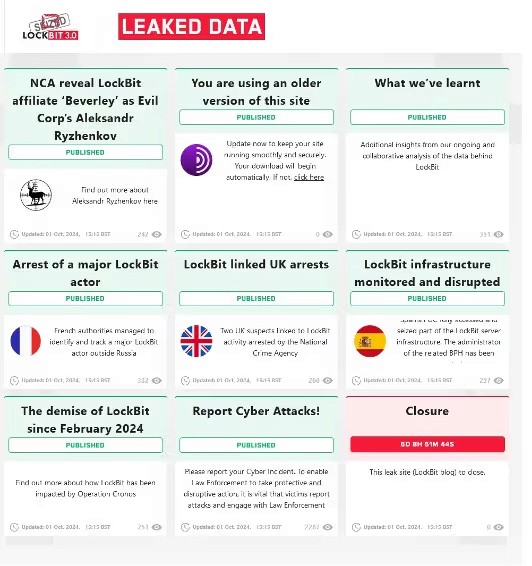
Figure 1. Former LockBit leak site with new information cards from law enforcement posted on October 1st, 2024. (Source: Arete)
Analyst Comments
While Evil Corp is no stranger to sanctions, the latest wave highlights the continued and targeted efforts of law enforcement toward individuals responsible for large-scale cybercriminal activity. However, while increased sanctions activity evidences the tireless work of law enforcement eliminating or disrupting key players in the cybercrime ecosystem, individuals like Ryzhenkov prove cybercriminals go down swinging- moving to other ransomware groups or starting new ones when their previous ventures fail.
Sources
Back to Blog Posts

Article
FortiBleed Campaign Remains Active
The FBI and Secret Service recently warned that the FortiBleed credential-harvesting campaign remains an active threat targeting internet-facing Fortinet FortiGate firewalls and secure socket layer (SSL) virtual private network (VPN) gateways. The agencies report that attackers continue to scan internet-exposed Fortinet firewalls using previously obtained credentials. This has reinforced assessments made by other security researchers, who have stated that “FortiBleed should be treated as an active access operation, not as a one-time credential leak.”
What’s Notable and Unique
FortiBleed, active since February 2026, begins with widespread reconnaissance to identify internet-facing FortiGate firewalls and SSL-VPN services. Once potential targets are identified, operators attempt to gain initial access through credential stuffing, password spraying, and dictionary attacks using previously compromised credentials.
Following successful access, the attackers deploy the Go-based FortigateSniffer tool on compromised appliances. The tool leverages native FortiOS diagnostic functionality to passively intercept authentication traffic across 24 protocols, enabling the collection of cleartext credentials and password hashes passing through the device.
Successfully recovered credentials are reused to expand access, including Active Directory enumeration, Kerberos validation, SMB authentication, and network share discovery, enabling threat actors to move deeper into the victim environment.
Reporting indicates that initial access brokers (IABs) leveraging the FortiBleed attack chain have facilitated access for downstream ransomware operations, including the INC Ransom/Lynx and Payload ransomware groups. This aligns with Arete’s observations of ransomware groups, including INC, Qilin, and DragonForce, targeting Fortinet FortiGate and VPN infrastructure as an initial access vector.
Remediation
Organizations should restrict internet-facing FortiGate management interfaces, rotate administrative and VPN credentials, review local and privileged accounts, and enforce MFA for remote access. If a potential compromise is detected, organizations should isolate affected systems, conduct threat hunting to determine the scope and identify compromised accounts and devices, and preserve relevant logs and artifacts. Organizations should also report the incident to appropriate authorities and implement targeted eviction measures based on identified threat actor activity.
Analyst Comments
FortiBleed represents an ongoing access-enablement threat, rather than a one-time credential exposure. The campaign’s ability to harvest, validate, and reuse credentials can provide sustained access to victim environments and create opportunities for downstream ransomware activity. Organizations with suspected FortiGate exposure should treat the activity as a potential active compromise and investigate for persistent access, compromised accounts, and lateral movement.
Sources
FortiBleed Operations Continue Targeting Exposed Systems Leading to Reports of Lockouts
FBI Warns FortiBleed Remains Active After Amassing 86,644 Fortinet Device Credentials

Article
Threat Actors Exploiting Critical FortiMail Zero-Day Vulnerability
Fortinet has disclosed a critical vulnerability in FortiMail, tracked as CVE-2026-104286, that is currently being exploited as a zero-day in the wild. The flaw, which carries a Critical CVSS score of 9.8, affects the FortiMail management interface and can allow unauthenticated attackers to write arbitrary files to affected systems, potentially leading to unauthorized code execution and full system compromise. Fortinet has confirmed active exploitation and urged customers to implement mitigations immediately while awaiting security updates.
What’s Notable and Unique
The vulnerability stems from improper restriction of file paths combined with improper neutralization of NULL byte characters. An unauthenticated attacker can exploit the flaw via specially crafted HTTP or HTTPS requests to write arbitrary files on the underlying operating system.
Organizations running FortiMail 7.2 can remediate the vulnerability by upgrading to 7.4 or newer. For customers using affected FortiMail 7.4, 7.6, and 8.0 versions, fixes have not yet been released. However, Fortinet has confirmed that the issue will be addressed in the upcoming 7.4.9, 7.6.7, and 8.0.2 releases.
Until the patched versions become available, Fortinet recommends mitigating risk by disabling the Identity-Based Encryption (IBE) feature. As an additional safeguard, administrators should restrict access to the FortiMail management interface, either by removing internet exposure altogether or limiting access to trusted internal networks only. The advisory also includes log entries that administrators can use to identify potentially compromised appliances.
The U.S. Cybersecurity and Infrastructure Security Agency (CISA) has added CVE-2026-104286 to its Known Exploited Vulnerabilities (KEV) catalog and directed federal agencies to perform forensic triage and mitigation by October 4th.
Analyst Comments
Impacted organizations should review their FortiMail instances to ensure there are no unauthorized logins, examine device settings, evaluate all configurations as potentially compromised, and carry out the necessary recovery procedures. Defenders should immediately implement Fortinet's recommended mitigations, review systems for IOC matches, and prepare to deploy the forthcoming security updates as soon as they become available. It is strongly advised that all enterprises assess their setups to reduce risk, as protecting publicly accessible management interfaces is a fundamental security best practice.
Sources
Improper limitation of a pathname to a restricted directory

Article
Ransomware Trends & Data Insights: September 2026
The Akira ransomware group re-emerged as the most active ransomware threat observed by Arete in September. Overall activity remained relatively distributed among multiple threat groups, with 29 unique groups observed throughout the month. Alongside Akira, INC Ransom and the relatively new Storm group were among the three most active threat actors observed in September. Several new threat groups also emerged during the month, including Hades Team, Shiba, and Vortex (which is suspected to be part of the cluster of threat actors affiliated with the former BlackFile group).

Throughout the month, analysts at Arete identified several trends behind the threat actors perpetrating cybercrime activities:
In September 2026, the ShinyHunters threat group escalated its extortion activity by publicly targeting both the Clop ransomware group and the FBI. The group claimed to have breached and defaced Clop’s infrastructure, demanding an eight-figure ransom, while separately alleging the theft of sensitive FBI-related data and demanding the retraction of statements made in a prior public advisory. In both incidents, ShinyHunters employed similar pressure tactics, including website defacements, repeated public postings, and threats of data disclosure.
ClickFix attacks remained prevalent in September 2026, with ransomware groups including Qilin, Helix, and The Gentlemen leveraging ClickFix lures to facilitate PowerShell-based payload execution and initial access. The technique continues to evolve, combining social engineering with legitimate tools and services to enable compromise and evade detection.
September 2026 saw continued activity from the former BlackFile extortion ecosystem. BlackFile, a data theft and extortion operation active since at least October 2025, rebranded as Redact in May 2026, and since appears to have broken off into several affiliated brands, including Pink, Helix, Falcon, Cinder, and potentially Vortex. During September, some affiliates publicly disputed these associations and claimed to operate independently. However, the coordinated timing, messaging, and near-identical nature of these statements support the assessment that these groups remain part of a broader interconnected ecosystem operating under shared objectives or coordination.

Article
Attack Patterns in Settra Incidents
Recent Settra ransomware incidents demonstrate a consistent operational pattern involving compromised credentials, VPN access, and the deployment of ransomware executables tailored to victim environments. Researchers have observed Settra naming ransomware executables after the targeted organization's domain while following similar attack sequences across multiple intrusions. Arete has also identified overlapping tactics, techniques, and tools in Settra engagements observed from June to August, including the use of MeshAgent for remote access and Bring Your Own Vulnerable Driver (BYOVD) techniques to weaken endpoint security controls.
What’s Notable and Unique
Settra operators have been observed naming ransomware executables after the victim organization's domain, creating a direct association between the payload and the targeted environment.
Initial access vectors have included targeting exposed VPN infrastructure and the use of compromised credentials, reducing the need for traditional exploitation of vulnerabilities.
Arete observed MeshAgent in multiple Settra engagements, which provides threat actors with a mechanism for remote access and continued activity within compromised environments.
Settra engagements have also included Bring Your Own Vulnerable Driver (BYOVD) activity, which can be used to bypass or impair security controls by abusing legitimate but vulnerable drivers.
Analyst Comments
Recent Settra activity demonstrates how ransomware operators can combine credential-based access, remote management tooling, and security control evasion techniques to establish and maintain access before ransomware deployment. The repeated use of similar tools and operational patterns across incidents provides useful detection opportunities for defenders. Organizations should closely monitor VPN authentication activity, unusual use of compromised credentials, unexpected MeshAgent deployment, ransomware executables with victim-specific naming conventions, and suspicious driver activity associated with attempts to disable or bypass endpoint security controls.
Arete’s MDR practice detects Settra’s full attack chain, with special attention to the staging of BYOVD activity for defense evasion. However, for us to detect it, SentinelOne needs to be fully deployed across an environment. To support organizations with full deployment, Arete offers SentinelOne Deployment Assistance. This service is designed to ensure that SentinelOne is deployed across all eligible endpoints, eliminating coverage gaps that could otherwise expose the organization to ransomware, malware, credential theft, and other advanced threats. Through endpoint discovery, inventory reconciliation, and deployment assistance, Arete helps organizations achieve comprehensive protection and maximize the effectiveness of their SentinelOne investment. Contact clientcares@areteir.com to learn more.
Sources
Ready, Settra, Go: New Settra Ransomware Variant Deploys MeshAgent RMM