Article
Cybersecurity Trends: What We Saw in 2020, What We Expect to See in 2021
Cybersecurity Trends

Where change seems a constant, perhaps the biggest and most surprising cybersecurity issue of 2020 was a lack of change. But before we get to that, let’s look at some other key cybersecurity trends.
A continued rise in ransomware attacks
Kidnapping data and holding networks hostage remains a lucrative “business.” In the past year, the number of groups exfiltrating data for double extortion schemes has risen from two to 27.
With so many new entrants on the playing field, it may not come as much of a surprise that Arete saw the number of cases involving data exfil increase by a factor of six from Q4 2019 to Q4 2020.
As data exfiltration became a “common norm” by mid-2020, cyber burglars started to pay closer attention to the data they stole. It was a calculated move that often paid off.
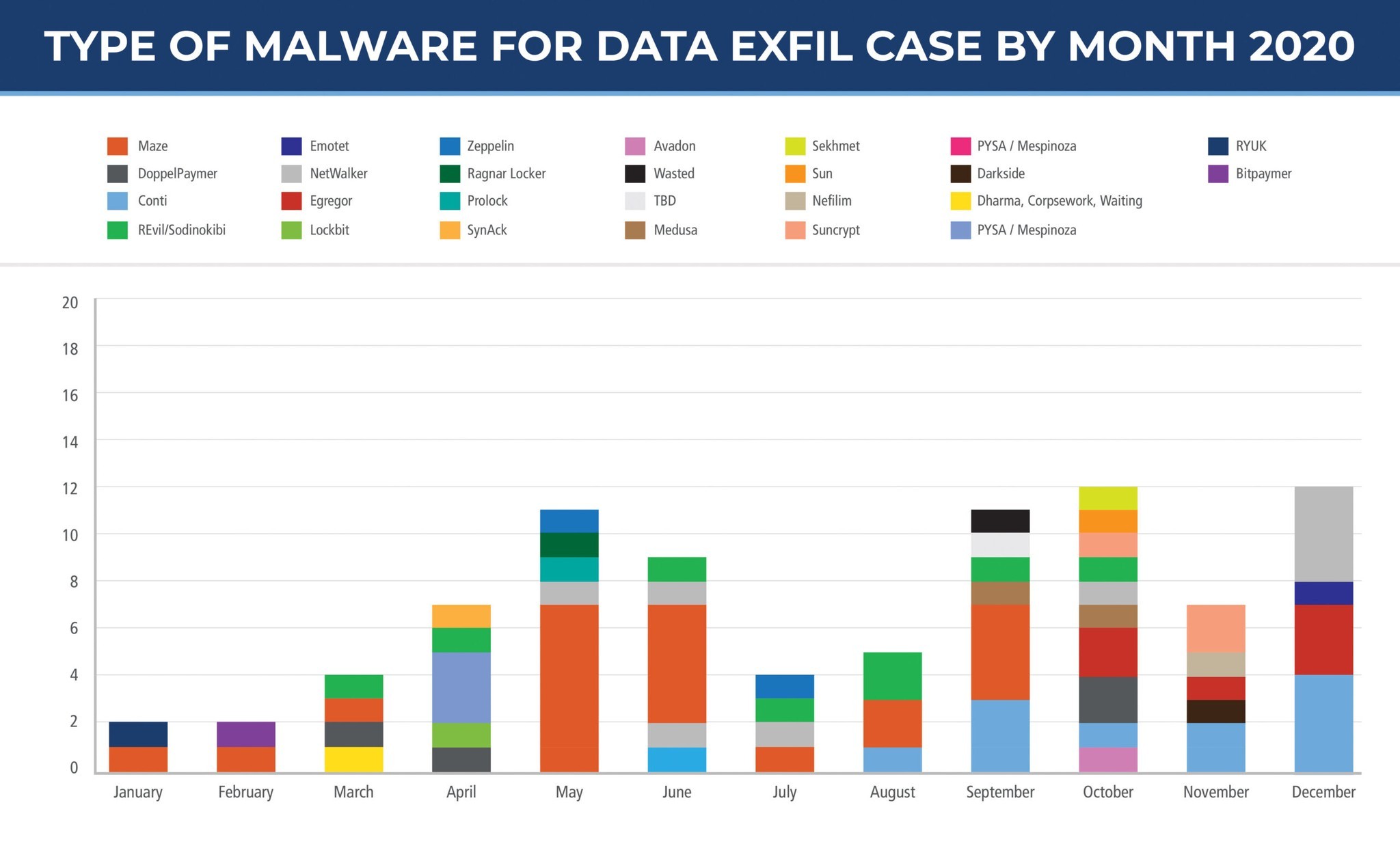
After exfiltrating and encrypting a company’s data, they not only demanded ransoms for decryption, but also applied additional pressure for payments by threatening to sell or post the stolen information to leak sites, also referred to as “double-extortion.” Quite often, in either a blog post or during ransomware negotiations, they would provide specific files — which may have contained social security numbers, credit card information, or even, GDPR-regulated information on EU citizens — as “proof of exfiltration.”
While Maze successfully blazed the leak-site “shaming” trail back in 2019, multiple variants followed suit. By late summer 2020, the trend had evolved even further. Smaller variants were teaming with larger groups to reap the benefits of hosting files on established blog sites.
Big or small, all companies live or die by their reputation. If a single negative online review can get customers second-guessing, imagine the potential damage when a company needs to notify its customers of the theft and sale of their personally identifiable information (PII).
And sure, ransomware attacks on larger companies may get more press coverage, but it’s especially noteworthy that threat actors are increasingly targeting small- to medium-sized businesses (SMBs). According to ConnectWise’s “The State of SMB Cybersecurity in 2020” report, 55 percent of SMBs experienced a cyberattack in 2020. At Arete, we saw attacks on SMBs increase by a factor of three over the course of the year.
In 2021, there’s little doubt these numbers will continue to rise. We can expect threat actors to continue to focus on unpatched, under-secured SMB networks — especially as it’s no secret that the SMB market lacks the resources to pour into cybersecurity to protect the perimeter.
Often, these businesses don’t even have IT staff let alone the in-house security skills to defend against these types of threats. In short, they’re sitting ducks, hamstrung for many reasons, not least of which is an inability to make timely, informed decisions. Attackers know all of this, and they exploit weaknesses primarily for monetary gain.
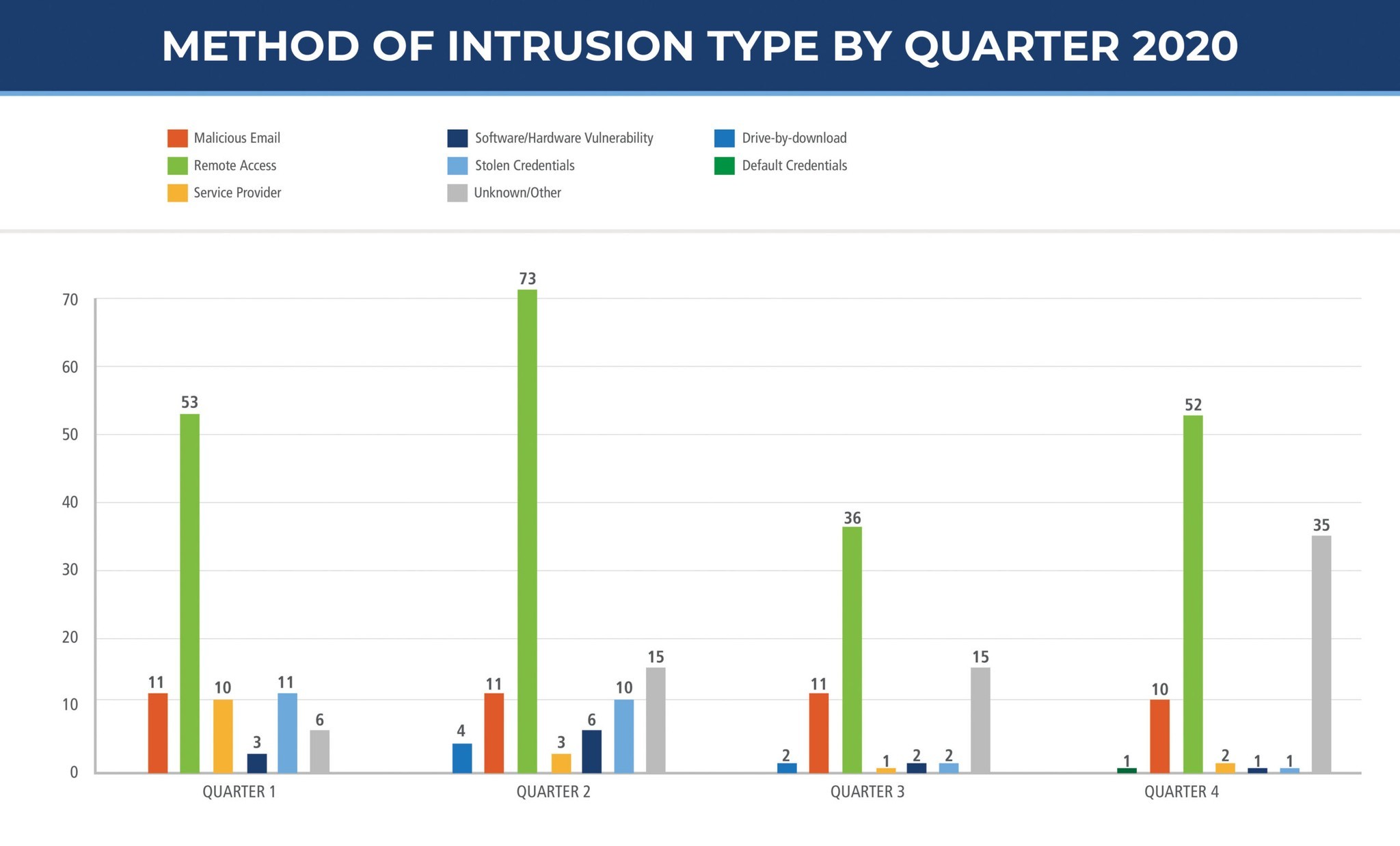
Remote access compromises more than doubled
The COVID-19 pandemic certainly added its own twist to cybersecurity. With government mandates to shutter physical offices, many organizations had to adapt quickly to connect their workforce remotely. For some, this meant upgrading their VPN appliances. For others, it required implementing net-new remote access.
In both scenarios, the haste of implementation and upgrades created a metaphorical candy store for cybercriminals to ransack. Loads of misconfigurations, disabling of multifactor authentication (MFA) services, and phishing attacks added to the stress of an already chaotic time. For example, in the cases Arete worked last year, more than 90 percent of clients did not have MFA in place.
For SMBs, average ransom demands tripled, and payments doubled last year. In 2021, we expect more of the same. Ransomware groups will continue to increase attacks on the SMB market while also raising ransom demands and joining forces with other cybercrime groups to wreak maximum damage.
Threat actors stole and publicly released private red team tools
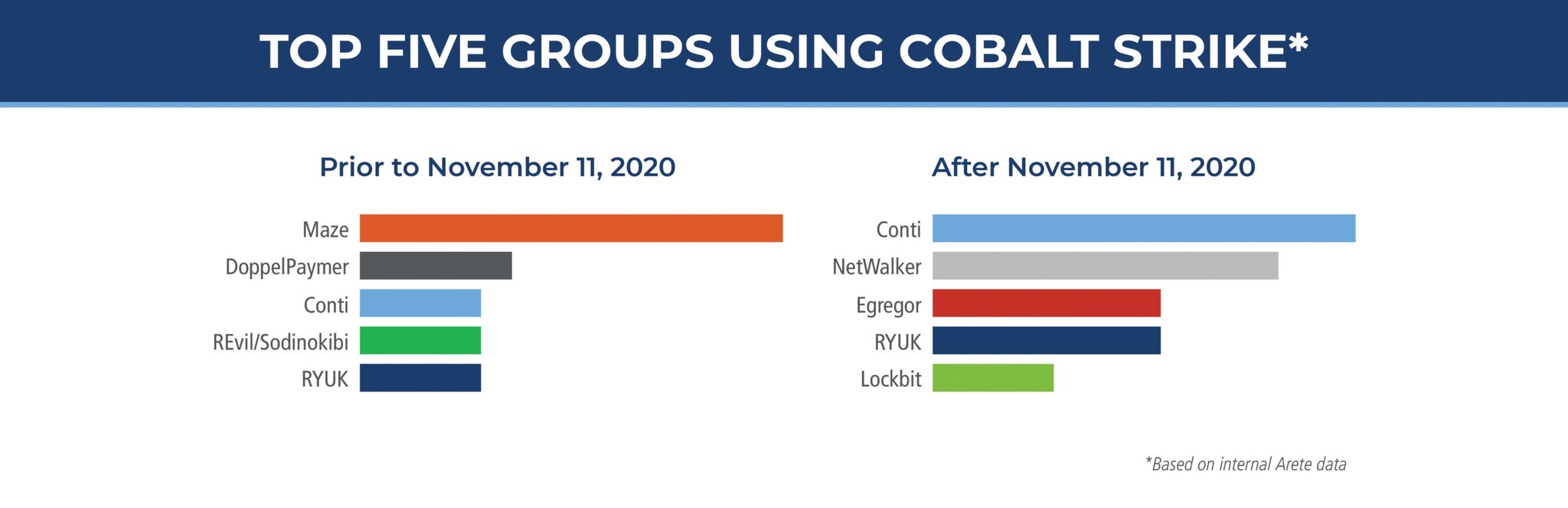
On November 11, 2020, Bleeping Computer published an article stating that someone had allegedly stolen and leaked the source code for the popular post-exploitation framework Cobalt Strike. The leak was identified from a GitHub account, which anyone could access and download.
Cobalt Strike itself is designed with optimum stealth. Essentially, when the program runs on an endpoint, it loads into the computer’s memory and “calls home” (aka beacons). When the command-and-control (C2) server establishes a connection, the attacker can perform any number of actions on the infected system without leaving much, if any, trace of activity.
Cobalt Strike’s stealth evades a large majority of AV products and even, some EDR solutions; and because forensic data is not captured when attackers use Cobalt Strike, it’s difficult to recreate their activity. Arete has observed attackers leveraging Cobalt Strike to move laterally within the environment, establish persistence, harvest credentials, and exfiltrate data.
An interesting observation and point of correlation: Since the source code was posted publicly, downloads from GitHub were anonymous. However, it’s also important to note that while many popular groups — such as Maze (no longer operating), Wasted Locker, Egregor, and Conti — leveraged Cobalt Strike prior to November 11, 2020, Lockbit emerged as the only group that did not leverage it prior to November 11. Given the publicity and strength of Cobalt Strike, we can expect to see wider adoption and use of the post-exploitation framework throughout 2021.
It’s common knowledge that many organizations purchase cyber insurance policies; and now, cyber thieves will explicitly look to target such organizations. On the off chance they find and steal cyber policies, they can use that information to set the ransom price accordingly — and they don’t care how new a policy is. If they obtain an older policy, they most likely know that the monetary coverage amount should still apply, which can then make ransom negotiations that much more difficult.
Most will state up front, “We know the coverage limit is $1 million and we won’t accept less than $900,000. You can use the remaining $100,000 for your legal fees.” The problem with these kinds of assumptions is that, nearly 100 percent of the time, they’re incorrect. Threat actors have minimal understanding of the insurance business and how to read policies. The reality is that there is very little money left to play with.
This trend will continue in 2021, with these groups increasing pressure on victim organizations by searching for sensitive information and cyber policies and contacting and harassing victims or clients of victims via phone or email.
A bigger issue for SMBs: overall cybersecurity
Though ransomware will continue to plague SMBs, these types of attacks are just a symptom of the market’s overall cybersecurity issues. Consequently, because so many SMBs lack security resources, it may be time for them to consider outsourcing. Managed detection and response (MDR) services can offer a cost-effective option that would allow them to re-focus on their core competencies while leaving defense to those with the requisite skills and experience.
At Arete, if we’ve heard it once, we’ve heard it a thousand times. Incident after incident, it’s the same story. A client calls about a breach and as soon as we hear what security products and configurations are in place, we know their next words before they can say them. The “script” goes something like this:
VICTIM
IT received a call that our sales team couldn’t access their email. When IT logged into the Exchange server, they found all the files with a random extension and a readme.txt ransom note.
ARETE
Do you have RDP enabled for external access? Essentially, if I were working from home, could I use RDP to connect to the network? Also, is the file extension different on every system? Does the readme note contain a reference to TOR browser?
VICTIM
Yes. Yes, to all.
ARETE
That’s most likely Sodinokibi ransomware. We will confirm it once we receive the ransom note.
To be frank, we haven’t seen any real change in most points of entry or password usage, not only in 2020, but since the 90s. It’s time to rewrite the script. Most SMB IT technology implementations date back to the early 2000s, and the market hasn’t seen the need to upgrade or enhance security since. RDP is one of the easiest remote access technologies to implement, yet the hardest to secure. Without SMBs putting an emphasis on security, “technologies from the 90s” will continue to be used — and exploited.
Too often, companies with thousands of endpoints will not have an endpoint detection and response (EDR) solution. They may have the latest security technologies in place, but ones that threat actors easily bypass. The toughest aspect of having a threat actor bypass a security product is explaining to clients that the relabeling of their antivirus (AV) product to an endpoint product was just marketing. An AV product isn’t tamperproof. And once attackers gain domain or local administrator privileges, they will disrupt the AV service, unloading virus definitions, disabling the service, whitelisting a folder where they plan to store their tools, and even, uninstalling the product.
By contrast, a true EDR tool will not hook into Active Directory and can’t be uninstalled, disabled, or unloaded by a domain administrator. Rather, only the central console can control the EDR tool. If you’re having doubts about that last statement, take a look at Gartner’s Peer Insights on EDR tools. The reviews may surprise you.
Cybersecurity requires more than technology
The right technology is crucial and can give you a leg up, but it doesn’t replace the experience, talent, and know-how to implement that technology. Again, service delivery will become increasingly important in 2021. In this regard, companies need to: 1) establish and follow the proper protocols in response to attacks; and 2) never cease to innovate and become more relentless in leveraging early warning systems, utilizing threat intelligence, and integrating automation.
A consistent commonality across SMBs is that, while they have successful businesses, they lack documented policy specifically around disaster recovery, responding to computer security events, and general security-leading practices. Managed service providers can work with SMBs to build and enhance security-focused programs to mitigate threats against their organizations. They can apply knowledge they’ve gained from the large Fortune 500 company engagements into a practical format that is easily integrated into SMB business operations.
What’s more, managed services providers should work with their industry partners, current clients, and former clients to “pulse check” the security landscape to identify common challenges — like the need for faster access to intelligence and faster identification and remediation of threats. They should also be able to integrate open-source intelligence with security know-how to deliver actionable information. For example, when mass access or major vulnerabilities are posted to hacker forums, it’s critical to work with partners to respond, threat hunt, and secure client networks before threat actors can exploit access.
Stronger government focus on cyberattacks
Between the COVID-19 pandemic, ransomware groups’ change of tactics, techniques, and procedures (TTPs), and their increased awareness of stolen data, 2020 was a year ripe with challenges.
In 2021, while we’re likely to see more new challenges, we can also expect to see a stronger government focus on cyberattacks, specifically ransomware. We will also see greater government engagement with municipalities, school districts, and healthcare organizations to prevent cyberattacks on these critical services.
Just as Arete IR is trying to stop cyberattacks from occurring, the Cybersecurity and Infrastructure Security Agency (CISA) recently rolled out a new campaign to help grow awareness and fight the increasing ransomware threat. CISA’s intention is to reduce or outright prevent ransomware attacks by equipping organizations with the necessary knowledge and expertise to detect cyberattacks earlier.
In short, a glimmer of hope for better days ahead.
Back to Blog Posts

Article
FortiBleed Campaign Remains Active
The FBI and Secret Service recently warned that the FortiBleed credential-harvesting campaign remains an active threat targeting internet-facing Fortinet FortiGate firewalls and secure socket layer (SSL) virtual private network (VPN) gateways. The agencies report that attackers continue to scan internet-exposed Fortinet firewalls using previously obtained credentials. This has reinforced assessments made by other security researchers, who have stated that “FortiBleed should be treated as an active access operation, not as a one-time credential leak.”
What’s Notable and Unique
FortiBleed, active since February 2026, begins with widespread reconnaissance to identify internet-facing FortiGate firewalls and SSL-VPN services. Once potential targets are identified, operators attempt to gain initial access through credential stuffing, password spraying, and dictionary attacks using previously compromised credentials.
Following successful access, the attackers deploy the Go-based FortigateSniffer tool on compromised appliances. The tool leverages native FortiOS diagnostic functionality to passively intercept authentication traffic across 24 protocols, enabling the collection of cleartext credentials and password hashes passing through the device.
Successfully recovered credentials are reused to expand access, including Active Directory enumeration, Kerberos validation, SMB authentication, and network share discovery, enabling threat actors to move deeper into the victim environment.
Reporting indicates that initial access brokers (IABs) leveraging the FortiBleed attack chain have facilitated access for downstream ransomware operations, including the INC Ransom/Lynx and Payload ransomware groups. This aligns with Arete’s observations of ransomware groups, including INC, Qilin, and DragonForce, targeting Fortinet FortiGate and VPN infrastructure as an initial access vector.
Remediation
Organizations should restrict internet-facing FortiGate management interfaces, rotate administrative and VPN credentials, review local and privileged accounts, and enforce MFA for remote access. If a potential compromise is detected, organizations should isolate affected systems, conduct threat hunting to determine the scope and identify compromised accounts and devices, and preserve relevant logs and artifacts. Organizations should also report the incident to appropriate authorities and implement targeted eviction measures based on identified threat actor activity.
Analyst Comments
FortiBleed represents an ongoing access-enablement threat, rather than a one-time credential exposure. The campaign’s ability to harvest, validate, and reuse credentials can provide sustained access to victim environments and create opportunities for downstream ransomware activity. Organizations with suspected FortiGate exposure should treat the activity as a potential active compromise and investigate for persistent access, compromised accounts, and lateral movement.
Sources
FortiBleed Operations Continue Targeting Exposed Systems Leading to Reports of Lockouts
FBI Warns FortiBleed Remains Active After Amassing 86,644 Fortinet Device Credentials

Article
Threat Actors Exploiting Critical FortiMail Zero-Day Vulnerability
Fortinet has disclosed a critical vulnerability in FortiMail, tracked as CVE-2026-104286, that is currently being exploited as a zero-day in the wild. The flaw, which carries a Critical CVSS score of 9.8, affects the FortiMail management interface and can allow unauthenticated attackers to write arbitrary files to affected systems, potentially leading to unauthorized code execution and full system compromise. Fortinet has confirmed active exploitation and urged customers to implement mitigations immediately while awaiting security updates.
What’s Notable and Unique
The vulnerability stems from improper restriction of file paths combined with improper neutralization of NULL byte characters. An unauthenticated attacker can exploit the flaw via specially crafted HTTP or HTTPS requests to write arbitrary files on the underlying operating system.
Organizations running FortiMail 7.2 can remediate the vulnerability by upgrading to 7.4 or newer. For customers using affected FortiMail 7.4, 7.6, and 8.0 versions, fixes have not yet been released. However, Fortinet has confirmed that the issue will be addressed in the upcoming 7.4.9, 7.6.7, and 8.0.2 releases.
Until the patched versions become available, Fortinet recommends mitigating risk by disabling the Identity-Based Encryption (IBE) feature. As an additional safeguard, administrators should restrict access to the FortiMail management interface, either by removing internet exposure altogether or limiting access to trusted internal networks only. The advisory also includes log entries that administrators can use to identify potentially compromised appliances.
The U.S. Cybersecurity and Infrastructure Security Agency (CISA) has added CVE-2026-104286 to its Known Exploited Vulnerabilities (KEV) catalog and directed federal agencies to perform forensic triage and mitigation by October 4th.
Analyst Comments
Impacted organizations should review their FortiMail instances to ensure there are no unauthorized logins, examine device settings, evaluate all configurations as potentially compromised, and carry out the necessary recovery procedures. Defenders should immediately implement Fortinet's recommended mitigations, review systems for IOC matches, and prepare to deploy the forthcoming security updates as soon as they become available. It is strongly advised that all enterprises assess their setups to reduce risk, as protecting publicly accessible management interfaces is a fundamental security best practice.
Sources
Improper limitation of a pathname to a restricted directory

Article
Ransomware Trends & Data Insights: September 2026
The Akira ransomware group re-emerged as the most active ransomware threat observed by Arete in September. Overall activity remained relatively distributed among multiple threat groups, with 29 unique groups observed throughout the month. Alongside Akira, INC Ransom and the relatively new Storm group were among the three most active threat actors observed in September. Several new threat groups also emerged during the month, including Hades Team, Shiba, and Vortex (which is suspected to be part of the cluster of threat actors affiliated with the former BlackFile group).

Throughout the month, analysts at Arete identified several trends behind the threat actors perpetrating cybercrime activities:
In September 2026, the ShinyHunters threat group escalated its extortion activity by publicly targeting both the Clop ransomware group and the FBI. The group claimed to have breached and defaced Clop’s infrastructure, demanding an eight-figure ransom, while separately alleging the theft of sensitive FBI-related data and demanding the retraction of statements made in a prior public advisory. In both incidents, ShinyHunters employed similar pressure tactics, including website defacements, repeated public postings, and threats of data disclosure.
ClickFix attacks remained prevalent in September 2026, with ransomware groups including Qilin, Helix, and The Gentlemen leveraging ClickFix lures to facilitate PowerShell-based payload execution and initial access. The technique continues to evolve, combining social engineering with legitimate tools and services to enable compromise and evade detection.
September 2026 saw continued activity from the former BlackFile extortion ecosystem. BlackFile, a data theft and extortion operation active since at least October 2025, rebranded as Redact in May 2026, and since appears to have broken off into several affiliated brands, including Pink, Helix, Falcon, Cinder, and potentially Vortex. During September, some affiliates publicly disputed these associations and claimed to operate independently. However, the coordinated timing, messaging, and near-identical nature of these statements support the assessment that these groups remain part of a broader interconnected ecosystem operating under shared objectives or coordination.

Article
Attack Patterns in Settra Incidents
Recent Settra ransomware incidents demonstrate a consistent operational pattern involving compromised credentials, VPN access, and the deployment of ransomware executables tailored to victim environments. Researchers have observed Settra naming ransomware executables after the targeted organization's domain while following similar attack sequences across multiple intrusions. Arete has also identified overlapping tactics, techniques, and tools in Settra engagements observed from June to August, including the use of MeshAgent for remote access and Bring Your Own Vulnerable Driver (BYOVD) techniques to weaken endpoint security controls.
What’s Notable and Unique
Settra operators have been observed naming ransomware executables after the victim organization's domain, creating a direct association between the payload and the targeted environment.
Initial access vectors have included targeting exposed VPN infrastructure and the use of compromised credentials, reducing the need for traditional exploitation of vulnerabilities.
Arete observed MeshAgent in multiple Settra engagements, which provides threat actors with a mechanism for remote access and continued activity within compromised environments.
Settra engagements have also included Bring Your Own Vulnerable Driver (BYOVD) activity, which can be used to bypass or impair security controls by abusing legitimate but vulnerable drivers.
Analyst Comments
Recent Settra activity demonstrates how ransomware operators can combine credential-based access, remote management tooling, and security control evasion techniques to establish and maintain access before ransomware deployment. The repeated use of similar tools and operational patterns across incidents provides useful detection opportunities for defenders. Organizations should closely monitor VPN authentication activity, unusual use of compromised credentials, unexpected MeshAgent deployment, ransomware executables with victim-specific naming conventions, and suspicious driver activity associated with attempts to disable or bypass endpoint security controls.
Arete’s MDR practice detects Settra’s full attack chain, with special attention to the staging of BYOVD activity for defense evasion. However, for us to detect it, SentinelOne needs to be fully deployed across an environment. To support organizations with full deployment, Arete offers SentinelOne Deployment Assistance. This service is designed to ensure that SentinelOne is deployed across all eligible endpoints, eliminating coverage gaps that could otherwise expose the organization to ransomware, malware, credential theft, and other advanced threats. Through endpoint discovery, inventory reconciliation, and deployment assistance, Arete helps organizations achieve comprehensive protection and maximize the effectiveness of their SentinelOne investment. Contact clientcares@areteir.com to learn more.
Sources
Ready, Settra, Go: New Settra Ransomware Variant Deploys MeshAgent RMM