Article
Darkside Ransomware: Caviar Taste on Your Big-Game Budget
Arete Analysis

Summary
Explore Darkside ransomware, an operation utilizing sophisticated tactics to target high-revenue organizations. Arete’s threat intelligence data reveals high ransom demands, extensive business downtime, and universal data exfiltration.
By all appearances, the proprietors of Darkside ransomware mean business.
With their sights set on organizations with US$4M+ in revenue, they’re about high-value, big-game targets and they’ve got the skills and experience to bring in some big hauls.
The Darkside group demonstrates seasoned experience, polished business acumen, and an ability to quickly respond to both negative and positive stimuli within their sphere of market influence. They exhibit similarities to notable ransomware operations, such as LockBit and REvil, and they take an outwardly aggressive posture toward the security industry, taunting companies like BitDefender and Coveware.
Statistical data on Darkside ransomware from Arete engagements
The information below is based on Darkside events that the Arete IR team has investigated since November 2020. Our incident response and data analytics practices work together to track key data points and collect statistics on variants for every ransomware engagement.
Sectors of clients affected by this threat:
Professional Services | Manufacturing
Average Ransom Demand: US $6,527,402.02
Highest Ransom Demand: US $10,054,804
Lowest Ransom Demand: US$3,000,000
Average business downtime: 5 days
Data exfiltration observed in 100 percent of cases
Key observations
Based on the Arete Cyber Threat Intelligence (CTI) team’s assessments:
Darkside ransomware operators are likely conducting long-tail reconnaissance of the victim environment for up to two (2) weeks prior to deploying their payloads.
The earliest known point of malicious activity for a select event was noted when forensic discovery indicated installation of the MetaSploit framework on the victim’s domain controller fifteen (15) days prior to enterprise-wide, automated deployment of Darkside.
Yes, we expect Darkside to be big-game hunters. Forbes quoted them as saying they will target “only those who can afford to pay.” Their recruitment advertisements echo this assertion.
Darkside proprietors and operators come from an established pedigree.
They are transparent in their description of operational mistakes and they renumerate operators for lost revenue.
They taunt BitDefender and Coveware directly with aggressive and forthright assertions of their intent.
As recently as December 27, 2020, a Russian-speaking cybercriminal actor using the handle ‘darksupp’ invited media outlets and data recovery organizations to follow a new “Press Center” section at the Darkside “name-and-shame” leak site. Darksupp allegedly stated that this press center would enable media and recovery firms to ask questions about recent attacks while also giving recovery organizations access to a dedicated chat room, where they could enroll in a “loyalty program” for discounts on data decryption.
The group has underwritten their aspirations with a substantial surety bond (approx. US$350k) and assert that they are willing to increase their guarantee to inspire further confidence in the right partners.
Their first and now exclusive appearance on XSS (reboot of DamageLab) along with exploitation of their endorsements/acceptance from known Russian-speaking actors underpins the Arete CTI team’s current assessment of their maturity and client knowledge.
On November 10, 2020, a Russian-speaking cybercriminal actor using the handle ‘darksupp’ announced the launch of an official recruitment effort for affiliates to participate in the Darkside Ransomware-as-a-Service (RaaS) affiliate program.
Darksupp received a forum-public favorable review on XSS from actor Quake3 (aka LockBit), proprietor of the LockBit RaaS platform.
The proprietor(s) behind the ‘darksupp’ persona tout seasoned experience with and feature influence from notable ransomware operations, such as LockBit and REvil.
Darkside operator affiliates are likely using Whitebit (e.g., Whitebit[.]com) to cash out, given observed wallet transactions and ledger analysis by Arete.
Detailed information
On August 8, 2020, operators of the Darkside ransomware announced their malware in a press release on the dark web. They stated that they had created their ransomware because they could not find the perfect product for their needs and had made millions of dollars by partnering with other well-known ransomware groups. In the same release, they also said they would not be targeting the healthcare, education, non-profit, and government sectors.
On November 11, 2020, Darkside announced their RaaS model, inviting partners and affiliates to work with them. They also announced the development of a distributable data storage system, calling out the use of servers in Iran and unrecognized republics to prevent victim organizations from taking down their operations.
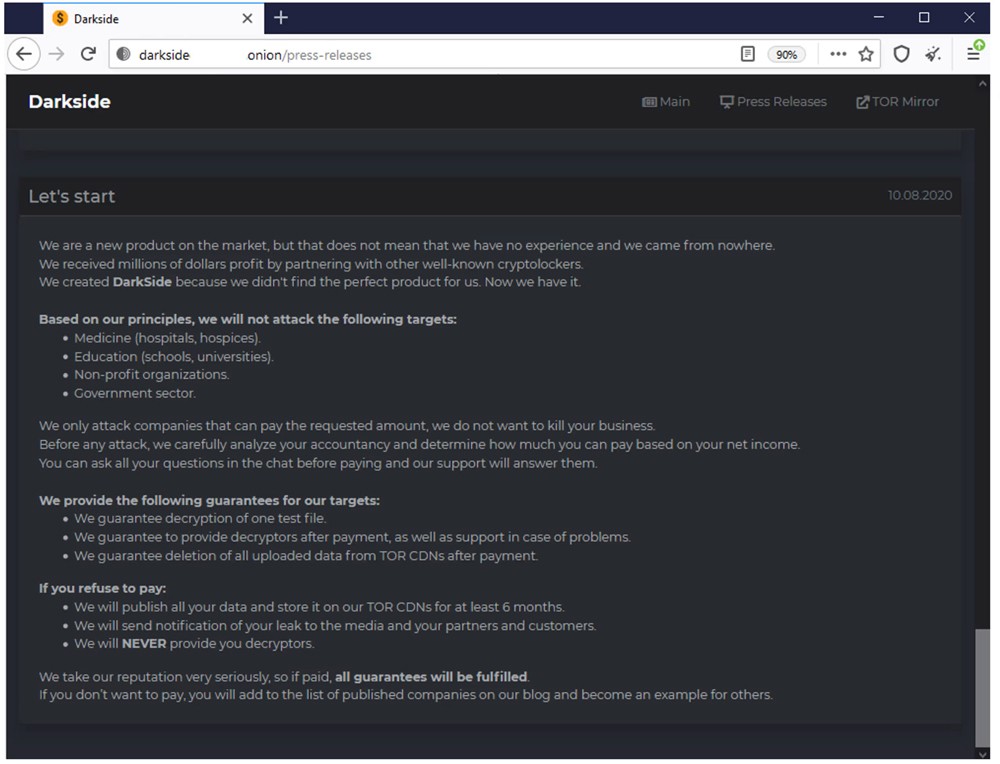
Figure 1. Darkside announces their service.
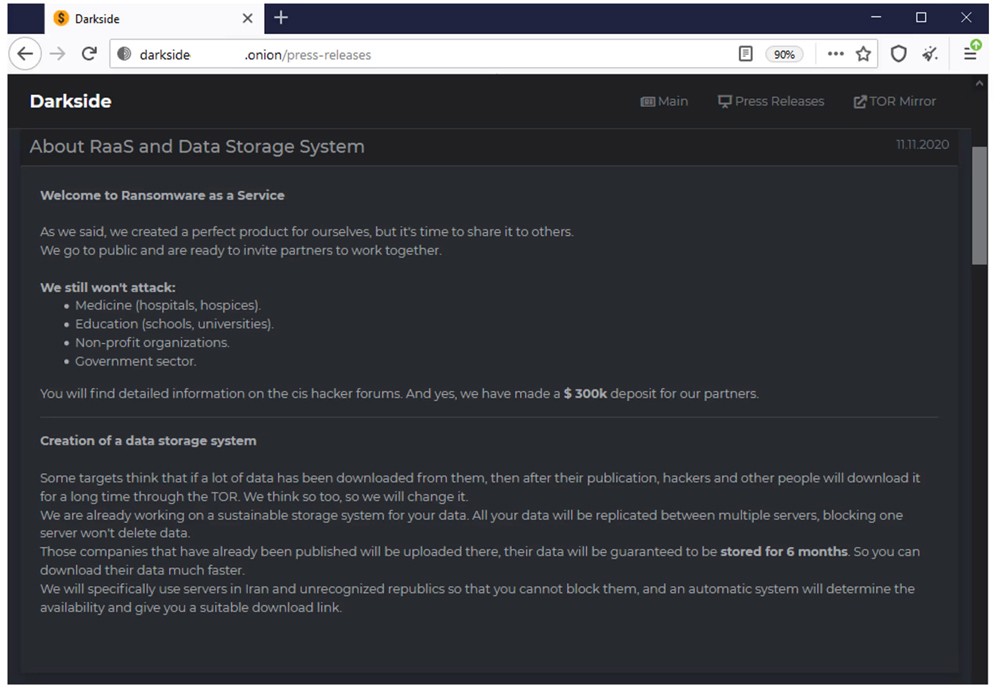
Figure 2. Darkside announcement of their RaaS product, distributed storage system, and invitation to partners and affiliates to work with them.
After this announcement, multiple news outlets began reporting that the group was using servers in sanctions countries like Iran. In response, the Darkside group updated their storage announcement on November 15, 2020, stating:
The storage system is still in the planning stages and has not yet launched.
They are not citizens of Iran, and leaked company data is not and will not be hosted in Iran.
They are still considering where to host the leaked data, but it would not be in a region on the sanctions list.
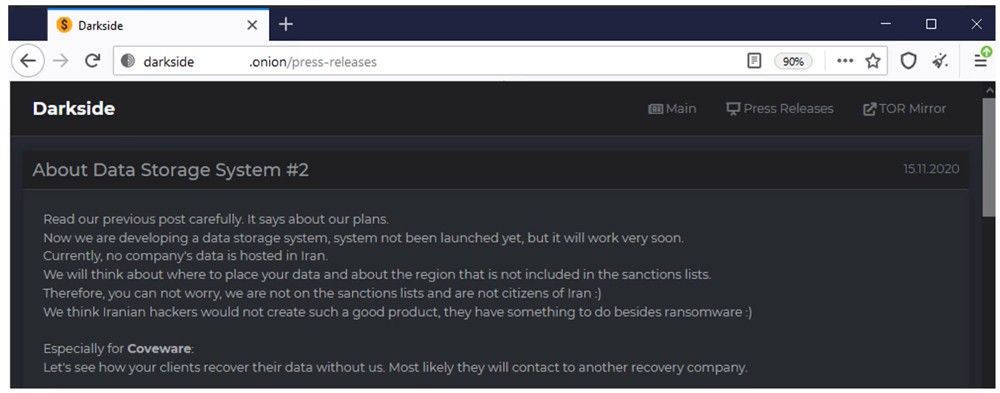
Figure 3. Darkside makes an updated announcement, that they will think where to host leaked data on servers that are not in sanctions countries.
The above business model makes total sense from the threat actors’ perspective. If the data were stored on servers in regions on the U.S. Treasury Department’s Office of Foreign Asset Control (OFAC) sanctions list, the actors would be unable to obtain ransom payments from victims.
The Arete CTI team and other researchers in the community found that the group has been advertising their services on well-known Russian hacker forums, with posts written in Russian.
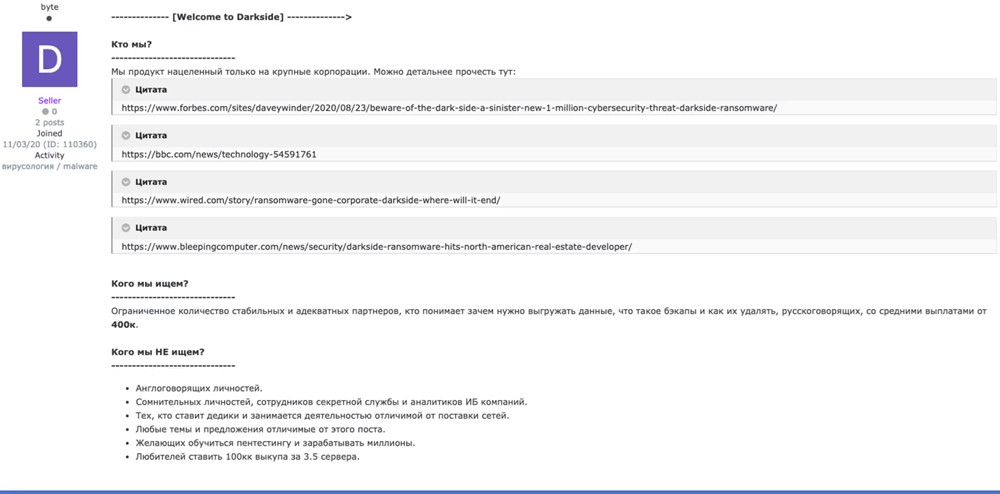
Figure 4. Darkside group advertising on a well-known hacking forum (Source: SentinelOne)
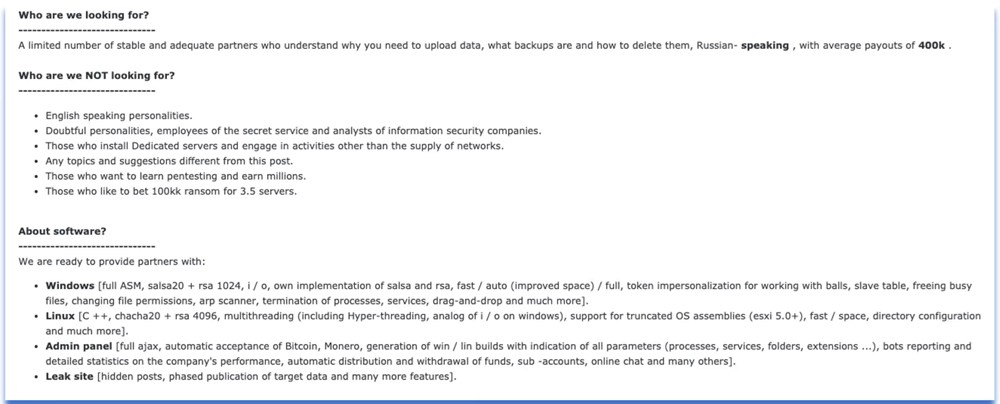
Figure 5. A Google translation of Darkside advertisement on a well-known Russian hacking forum (Source: SentinelOne)
Based on language analysis, a native Russian-language speaker wrote the posts. What’s more, the group’s ransomware is designed to avoid infecting systems in Commonwealth of Independent States (CIS) countries, including Russia. In the past, other Eastern European threat actor groups have done the same to try to avoid getting in trouble with local law enforcement agencies. The Arete CTI team also conducted blockchain analysis of previous ransom payments and did not find any ties between sanctioned entities/money service businesses (MSBs) and Darkside money-laundering operations.
As leaders in the community and especially in the current COVID-19 climate, we need to join forces to properly inform the public without causing worldwide panic and help ensure our clients’ quick recovery from attacks and return to normal business operations. If a company were to make a rash decision about ransom payments based on negligent reporting, it could prevent file restoration and ultimately, shutter a business and cost employees their livelihood.
Darkside high-level technical overview
While tactics, techniques, and procedures (TTPs) may vary amongst operators, it’s important to note that Darkside caters to semi-exclusive affiliates, likely of Russian or Eastern European origin. They likely pool their technical experience — both successes and failures — from this exclusive cultural enclave to orchestrate their intrusions and execute on their objective as outlined below:
Darkside ransomware is primarily geared toward Windows systems, however, the proprietor ‘darksupp’ claims the ability to develop payloads that also target Linux OS variants.
We have observed the builder module screens for the control panel, and we are aware of the existence of Linux ELF-executable payloads. We assess this to be true, with high confidence.
Given observed use of MetaSploit and potentially other Offensive Security Tool (OST) frameworks — always contingent on operator/affiliate preference — it’s likely that Darkside ransomware operators leverage these same tools to enumerate vulnerabilities of victim networks, where externally facing systems of interest are exposed, to establish initial access.
We observed actors pivoting from having Administrator RDP sessions on the Domain Controller, to accessing another privileged account to access a file server. Thus, it’s highly likely that their two weeks in the environment afforded them precision-targeting abilities. They took their time hunting.
On November 25, 2020, ‘darksupp’ claimed to have launched a content delivery network (CDN) for storing and delivering compromised data exfiltrated from victims of Darkside ransomware. The actor also claimed to be developing a second version of the ransomware and intends to provide support for distribution using dynamic-link library (.dll) and PowerShell scripts (.ps1) for deployment.
We have observed Darkside operators manually enumerating and exfiltrating data using a combination of RDP access and their own copy of QTBrowser, 7zip. This culminates in a direct upload of files to both PrivatLab and MegaUpload cloud hosting, under cover of Web/HTTPS sessions, which are difficult to sift in many cases for less mature organizations. \
This manual methodical exfiltration occurred over the span of several hours.
7zip archives were named after data/folder names enumerated and temporarily stored in root temp directory (e.g., C:Temp, C:Temp1, C:Temphr{archive}.7z).
We observed Darkside payload (e.g., azure_agent.exe.exe) staged on the domain controller in a network-shareable folder (e.g., C:WindowsIMEazure), followed by the establishment of a scheduled task (e.g., WindowsSYSVOLdomainPolicies{L0NGMGU1D}UserPreferencesScheduledTasks) set with Group Policy and instructing hosts to obtain and execute the payload. This resulted in a fully automated enterprise-wide deployment less than 24 hours after data was exfiltrated.
Security Recommendations
Implement a sophisticated endpoint detection and response (EDR) solution that will rely on behavior analysis — not just malware signatures — and have tamper-proof capabilities.
Implement multifactor authentication (MFA).
Implement an email security solution to detect and protect against known and unknown threats.
Hunt for unusual remote desktop protocol (RDP) connections.
Use Group Policy Software Restriction Policies (SRP) to prevent users from executing Windows executable filetypes (e.g., .exe, .dll, .hta, .bat, .scr) from the AppDataLocalTemp path of Office365, Microsoft Word, Excel, and Outlook. Alternatively, also inspect C:Users[current user]AppDataRoamingMicrosoft as it’s another popular method that achieves the same results.
Implement and regularly test an off-site backup solution.
Appendix
Indicator | Role |
|---|---|
C:\Windows\IME\azure | File path of DC where Darkside payload was staged. |
F:\temp | File path of staged 7zip archives (.7z) prior to exfiltration |
F:\temp1 | File path of staged 7zip archives (.7z) prior to exfiltration |
F:\temphr | File path of staged 7zip archives (.7z) prior to exfiltration |
Windows\SYSVOL\domain\Policies\{LONGMGU1D}\User\Preferences\ScheduledTasks | Path of Scheduled Task on Domain Controller for deployment of Darkside payload via Group Policy. |
Indicator | Role |
|---|---|
azure_agent.exe.exe | Darkside Payload |
README.3a43168b.TXT | Darkside Ransomware Note – README.{random_string}.TXT |
enc.exe | Darkside Payload |
idfoodsf.exe | Darkside Payload |
Indicator | Role |
|---|---|
6d134cdf470f03707ad481b617e67b9018f92f72a0e2fb3e6cc9f2ab17ac1439 | Darkside Payload |
06cfe7f5d88e2f7adda6d8333ca8b302debb22904c68a942188be5730e9b3c8 | Darkside Payload |
243dff0fc80a049f4fb3729f8b8def0fce29768f345c88ee1069e22b0ae60 | Darkside Payload |
0839aabe5fd63b16844a27b3c586c02a044d119010a1a40ee4035501c34eae0d | Darkside Payload |
Indicator | Role |
|---|---|
www[.]privatelab[.]com | Manual Data Exfiltration – Cloud Upload |
www[.]mega[.]nz | Manual Data Exfiltration – Cloud Upload |
Bitcoin Wallet Address
bc1qkk8z69uxkrxdeuwlkvlk89p7qnr6cefa4aeq7p
Leak Site
hxxps://Darksidedxcftmqa[.]onion
Complete advertisement from the Darkside group on a popular Russian hacking forum (Full translation from Russian to English)
————- [Welcome to Darkside] ————–> Кто мы? ——————————
Мы продукт нацеленный только на крупные корпорации. Можно детальнее прочесть тут: https://www.forbes.com/sites/daveywinder/2020/08/23/beware-of-the-dark-side-a-sinister-new-1-million-cybersecurity-threat-Darkside-ransomware/ https://bbc.com/news/technology-54591761https://www.wired.com/story/ransomware-gone-corporate-Darkside-where-will-it-end/ https://www.bleepingcomputer.com/news/security/Darkside-ransomware-hits-north-american-real-estate-developer/
Кого мы ищем?
——————————
Ограниченное количество стабильных и адекватных партнеров, кто понимает зачем нужно выгружать данные, что такое бэкапы и как их удалять, русскоговорящих, со средними выплатами от 400к. Кого мы НЕ ищем?
——————————
Англоговорящих личностей.
Сомнительных личностей, сотрудников секретной службы и аналитиков ИБ компаний.
Тех, кто ставит дедики и занимается деятельностью отличимой от поставки сетей.
Любые темы и предложения отличимые от этого поста.
Желающих обучиться пентестингу и зарабатывать миллионы.
Любителей ставить 100кк выкупа за 3.5 сервера.
О софте?
——————————
Мы готовы предоставить партнерам:
Windows [full ASM, salsa20 + rsa 1024, i/o, собственная реализация salsa и rsa, fast / auto (улучшенный space) / full, имперсонализация токена для работы с шарами, раб столом, освобождение занятых файлов, изменение прав на файлы, arp scanner, завершения процессов, сервисов, drag-and-drop и много другого].
Linux [C++, chacha20 + rsa 4096, многопоточен (в том числе Hyper-threading, аналог i/o на windows), поддержка урезанных сборок ос (esxi 5.0+), fast / space, настройка каталогов и много другого].
Админ панель [full ajax, автоматический прием Bitcoin, Monero, генерация win / lin билдов с указанием всех параметров (процессы, сервисы, папки, расширения…), отстук ботов и детальная статистика по результативности компании, автоматическое распределение и вывод средств, саб–аккаунты, онлайн чат и множество другого].
Leak site [скрытые посты, поэтапная публикация данных таргета и еще множество функционала].
Все решения уже проверены и доделаны, мы сами работаем своим софтом и не писали его на продажу / аренду, в отличие от многих продуктов.То чего нам не хватало в работе с другими партнерскими программами — мы реализовали у себя.
Правила?
——————————
Следующие сферы запрещены:
– Медицина (Больницы, госпитали).
– Образование (Университеты, школы).
– Государственный сектор (муниципалитеты, любые гос органы).
– Некоммерческие организации (благотворительные фонды, ассоциации).Запрещены любые действия, которые наносят репутационный урон имиджу продукта.
Запрещена любая работа по СНГ (в том числе Грузии, Украине).
Запрещена передача аккаунта третьим лицами.
Какой процент?
——————————
От 25% до 10%. В софте динамическая система рейта. Чем больше выплата, тем меньше % партнерки и наоборот.Так же возможен стабильный рейт, это обсуждается. Как попасть?
——————————
Пройти собеседование, показать свою работу и выплаты, ответить на необходимые вопросы.Но для начала написать в ЛС. При этом указать:
Свой опыт работы.
С какими партнерскими программами работали.
Диапазон сумм выкупа. Минимум, максимум, средняя.
Работаете сами или в команде.
TOX или jabber.
Если вам не ответили, то вы не подошли, спамить в теме не нужно.
Рассматриваем ли мы доступы в сети?
——————————
Да, USA от 400kk, с предложениями можно отписать в ЛС, написав сайт, сферу деятельности компании и контакт. Если компания интересна – с вами свяжутся. Какие гарантии?
——————————
Депозит в 20 BTC (~305k на момент написания) на xss.is. Если у вас будут супер предложения, мы с удовольствием его поднимем, вплоть до 1кк и более.
Translation to English:
Who are we looking for?
——————————
A limited number of stable and adequate partners who understand the importance of exfiltrating data, awareness of backups and how to delete them, Russian-speaking, with average payouts of 400k.
Who are we NOT looking for?
——————————
English-speaking personalities.
Suspicious individuals, employees of the secret service and analysts of information security companies.
Those who only setup RDP access or do other things other than deploy on networks.
Any topics and suggestions different from this post.
Those who want to learn pen-testing and earn millions.
Those who think they can demand US$100M in ransom for 3.5 servers. About software?
——————————
We are ready to provide partners with:
Windows payloads [full ASM (assembly language), I/O, custom implementation of the Salsa20 and RSA-1024 ciphers, fast / automated / full encryption, token impersonation for accessing shared network drives, process termination to encrypt open files, file permission modification, ARP scanning tool, the drag-and-drop UI/UX features, and much more)
Linux payloads [C++, ChaCha20 + RSA-4096, multithreading (including hyper-threading, an analogue of the Windows I/O system), support of stripped-down OS versions (ESXI 5.0 and up), fast [encryption] / space [overwrite], catalog adjustment, and many other things].
Admin panel [ajax, automatic transaction processing for Bitcoin, Monero, generation of Windows/Linux builds with selectable parameters (processes, services, folders, and extensions), bots will report detailed statistics on the company’s performance, ability to create sub-accounts, online chat and much more].
Leak site [ability to hide posts, allows for detailed disclosures of compromised data, and much more]. All solutions have been tested and we work with our own software and did we did not produce it simply for sale/rent, unlike many products. In our program, we’ve implemented everything we wanted, but did not find in other affiliate programs.
Rules?
——————————
The following areas are prohibited:
Healthcare (clinics and hospitals).
Education (universities and schools).
The public sector (municipal services and public agencies).
Non-profit organizations (charitable foundations and associations).
Any actions that can damage the product reputation are prohibited.
Do not target systems in the CIS (this includes Georgia and Ukraine).
Sharing accounts is not allowed.
What’s the percentage/share of profits?
——————————
From 25% to 10%. The software has a dynamic rate system. The higher the payout, the lower the% of the affiliate program and vice versa.
A stable rate is also possible, this is being discussed.
How to get?
——————————
Pass an interview, show your work and payments, answer the necessary questions. First, send us a message. Indicate:
Your previous experience.
What other programs you’ve worked.
Your range of previous closed payments; minimum, maximum, average.
Your preferences on working alone or with a team.
Provide your TOX or Jabber contact.
If we don’t answer you, then you weren’t the right fit, don’t spam us about it in the topic thread. Will we consider network accesses?
——————————
Sure, provided it’s a U.S. company with US$400M+ in revenue.
Solicit your offer for consideration; provide company website, line of business, and your contact details. If we’re interested, we’ll contact you.
What guarantees?
——————————
We made a deposit of 20 BTC (~ 305,000 USD) with forum escrow at XSS. If you make an awesome partnership proposal, we may raise that deposit to 1M+ to instill further confidence.
——————————
Note: Edited for clarity and readability
Back to Blog Posts

Article
FortiBleed Campaign Remains Active
The FBI and Secret Service recently warned that the FortiBleed credential-harvesting campaign remains an active threat targeting internet-facing Fortinet FortiGate firewalls and secure socket layer (SSL) virtual private network (VPN) gateways. The agencies report that attackers continue to scan internet-exposed Fortinet firewalls using previously obtained credentials. This has reinforced assessments made by other security researchers, who have stated that “FortiBleed should be treated as an active access operation, not as a one-time credential leak.”
What’s Notable and Unique
FortiBleed, active since February 2026, begins with widespread reconnaissance to identify internet-facing FortiGate firewalls and SSL-VPN services. Once potential targets are identified, operators attempt to gain initial access through credential stuffing, password spraying, and dictionary attacks using previously compromised credentials.
Following successful access, the attackers deploy the Go-based FortigateSniffer tool on compromised appliances. The tool leverages native FortiOS diagnostic functionality to passively intercept authentication traffic across 24 protocols, enabling the collection of cleartext credentials and password hashes passing through the device.
Successfully recovered credentials are reused to expand access, including Active Directory enumeration, Kerberos validation, SMB authentication, and network share discovery, enabling threat actors to move deeper into the victim environment.
Reporting indicates that initial access brokers (IABs) leveraging the FortiBleed attack chain have facilitated access for downstream ransomware operations, including the INC Ransom/Lynx and Payload ransomware groups. This aligns with Arete’s observations of ransomware groups, including INC, Qilin, and DragonForce, targeting Fortinet FortiGate and VPN infrastructure as an initial access vector.
Remediation
Organizations should restrict internet-facing FortiGate management interfaces, rotate administrative and VPN credentials, review local and privileged accounts, and enforce MFA for remote access. If a potential compromise is detected, organizations should isolate affected systems, conduct threat hunting to determine the scope and identify compromised accounts and devices, and preserve relevant logs and artifacts. Organizations should also report the incident to appropriate authorities and implement targeted eviction measures based on identified threat actor activity.
Analyst Comments
FortiBleed represents an ongoing access-enablement threat, rather than a one-time credential exposure. The campaign’s ability to harvest, validate, and reuse credentials can provide sustained access to victim environments and create opportunities for downstream ransomware activity. Organizations with suspected FortiGate exposure should treat the activity as a potential active compromise and investigate for persistent access, compromised accounts, and lateral movement.
Sources
FortiBleed Operations Continue Targeting Exposed Systems Leading to Reports of Lockouts
FBI Warns FortiBleed Remains Active After Amassing 86,644 Fortinet Device Credentials

Article
Threat Actors Exploiting Critical FortiMail Zero-Day Vulnerability
Fortinet has disclosed a critical vulnerability in FortiMail, tracked as CVE-2026-104286, that is currently being exploited as a zero-day in the wild. The flaw, which carries a Critical CVSS score of 9.8, affects the FortiMail management interface and can allow unauthenticated attackers to write arbitrary files to affected systems, potentially leading to unauthorized code execution and full system compromise. Fortinet has confirmed active exploitation and urged customers to implement mitigations immediately while awaiting security updates.
What’s Notable and Unique
The vulnerability stems from improper restriction of file paths combined with improper neutralization of NULL byte characters. An unauthenticated attacker can exploit the flaw via specially crafted HTTP or HTTPS requests to write arbitrary files on the underlying operating system.
Organizations running FortiMail 7.2 can remediate the vulnerability by upgrading to 7.4 or newer. For customers using affected FortiMail 7.4, 7.6, and 8.0 versions, fixes have not yet been released. However, Fortinet has confirmed that the issue will be addressed in the upcoming 7.4.9, 7.6.7, and 8.0.2 releases.
Until the patched versions become available, Fortinet recommends mitigating risk by disabling the Identity-Based Encryption (IBE) feature. As an additional safeguard, administrators should restrict access to the FortiMail management interface, either by removing internet exposure altogether or limiting access to trusted internal networks only. The advisory also includes log entries that administrators can use to identify potentially compromised appliances.
The U.S. Cybersecurity and Infrastructure Security Agency (CISA) has added CVE-2026-104286 to its Known Exploited Vulnerabilities (KEV) catalog and directed federal agencies to perform forensic triage and mitigation by October 4th.
Analyst Comments
Impacted organizations should review their FortiMail instances to ensure there are no unauthorized logins, examine device settings, evaluate all configurations as potentially compromised, and carry out the necessary recovery procedures. Defenders should immediately implement Fortinet's recommended mitigations, review systems for IOC matches, and prepare to deploy the forthcoming security updates as soon as they become available. It is strongly advised that all enterprises assess their setups to reduce risk, as protecting publicly accessible management interfaces is a fundamental security best practice.
Sources
Improper limitation of a pathname to a restricted directory

Article
Ransomware Trends & Data Insights: September 2026
The Akira ransomware group re-emerged as the most active ransomware threat observed by Arete in September. Overall activity remained relatively distributed among multiple threat groups, with 29 unique groups observed throughout the month. Alongside Akira, INC Ransom and the relatively new Storm group were among the three most active threat actors observed in September. Several new threat groups also emerged during the month, including Hades Team, Shiba, and Vortex (which is suspected to be part of the cluster of threat actors affiliated with the former BlackFile group).

Throughout the month, analysts at Arete identified several trends behind the threat actors perpetrating cybercrime activities:
In September 2026, the ShinyHunters threat group escalated its extortion activity by publicly targeting both the Clop ransomware group and the FBI. The group claimed to have breached and defaced Clop’s infrastructure, demanding an eight-figure ransom, while separately alleging the theft of sensitive FBI-related data and demanding the retraction of statements made in a prior public advisory. In both incidents, ShinyHunters employed similar pressure tactics, including website defacements, repeated public postings, and threats of data disclosure.
ClickFix attacks remained prevalent in September 2026, with ransomware groups including Qilin, Helix, and The Gentlemen leveraging ClickFix lures to facilitate PowerShell-based payload execution and initial access. The technique continues to evolve, combining social engineering with legitimate tools and services to enable compromise and evade detection.
September 2026 saw continued activity from the former BlackFile extortion ecosystem. BlackFile, a data theft and extortion operation active since at least October 2025, rebranded as Redact in May 2026, and since appears to have broken off into several affiliated brands, including Pink, Helix, Falcon, Cinder, and potentially Vortex. During September, some affiliates publicly disputed these associations and claimed to operate independently. However, the coordinated timing, messaging, and near-identical nature of these statements support the assessment that these groups remain part of a broader interconnected ecosystem operating under shared objectives or coordination.

Article
Attack Patterns in Settra Incidents
Recent Settra ransomware incidents demonstrate a consistent operational pattern involving compromised credentials, VPN access, and the deployment of ransomware executables tailored to victim environments. Researchers have observed Settra naming ransomware executables after the targeted organization's domain while following similar attack sequences across multiple intrusions. Arete has also identified overlapping tactics, techniques, and tools in Settra engagements observed from June to August, including the use of MeshAgent for remote access and Bring Your Own Vulnerable Driver (BYOVD) techniques to weaken endpoint security controls.
What’s Notable and Unique
Settra operators have been observed naming ransomware executables after the victim organization's domain, creating a direct association between the payload and the targeted environment.
Initial access vectors have included targeting exposed VPN infrastructure and the use of compromised credentials, reducing the need for traditional exploitation of vulnerabilities.
Arete observed MeshAgent in multiple Settra engagements, which provides threat actors with a mechanism for remote access and continued activity within compromised environments.
Settra engagements have also included Bring Your Own Vulnerable Driver (BYOVD) activity, which can be used to bypass or impair security controls by abusing legitimate but vulnerable drivers.
Analyst Comments
Recent Settra activity demonstrates how ransomware operators can combine credential-based access, remote management tooling, and security control evasion techniques to establish and maintain access before ransomware deployment. The repeated use of similar tools and operational patterns across incidents provides useful detection opportunities for defenders. Organizations should closely monitor VPN authentication activity, unusual use of compromised credentials, unexpected MeshAgent deployment, ransomware executables with victim-specific naming conventions, and suspicious driver activity associated with attempts to disable or bypass endpoint security controls.
Arete’s MDR practice detects Settra’s full attack chain, with special attention to the staging of BYOVD activity for defense evasion. However, for us to detect it, SentinelOne needs to be fully deployed across an environment. To support organizations with full deployment, Arete offers SentinelOne Deployment Assistance. This service is designed to ensure that SentinelOne is deployed across all eligible endpoints, eliminating coverage gaps that could otherwise expose the organization to ransomware, malware, credential theft, and other advanced threats. Through endpoint discovery, inventory reconciliation, and deployment assistance, Arete helps organizations achieve comprehensive protection and maximize the effectiveness of their SentinelOne investment. Contact clientcares@areteir.com to learn more.
Sources
Ready, Settra, Go: New Settra Ransomware Variant Deploys MeshAgent RMM