Article
LockBit Claims to Have U.S. Federal Reserve Data
Arete Analysis

On Tuesday, June 25, LockBit posted the U.S. Federal Reserve to its data leak site (DLS). In the post, the group claims to have stolen 33 terabytes of data and criticized those supposedly negotiating on behalf of the Federal Reserve. Thus far, the group has only posted 21 links containing data belonging to Evolve Bank & Trust, a separate financial institution that was issued an enforcement action by the Federal Reserve Board earlier this month for “deficiencies in the bank’s anti-money laundering, risk management, and consumer compliance programs.”
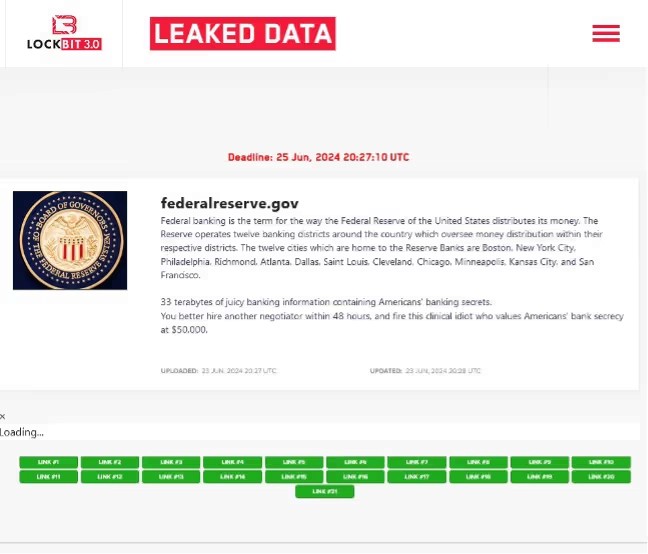
Figure 1. Post of the Federal Reserve from LockBit’s DLS (Source: Arete)
Analyst Comments
At this time, it is unknown whether the leaked data actually came from a breach of the Federal Reserve or if LockBit is fabricating the source of the data. While it is possible that more data will be leaked eventually, it currently seems more likely that LockBit is inflating its capabilities to garner attention in the wake of law enforcement disruptions. This wouldn’t be the first time LockBit used its DLS to draw attention and appear more active; just last month, 68 of the “new” victims posted to the LockBit DLS were determined to be old victims that the group reposted. Although LockBit continues operations, law enforcement actions and sanctions against the group’s leader caused significant disruptions, and it is likely that LockBit will continue testing tactics as the group struggles to stay in the spotlight and maintain relevance in the current ransomware landscape.
Sources
Back to Blog Posts

Article
Arete Life
At Arete, we encourage our team members to pursue excellence in their careers while finding meaningful ways to serve and give back to their communities.
Arns pursued an education and career in cybersecurity with the goal of supporting individuals and organizations during difficult times. Arns has carried this spirit of service and generosity into the rest of his life as well, partnering with Arete to support the education of students in his home country of Haiti.

Podcast
Faster Threats, Smarter Defense: Getting Back to Cybersecurity Basics
Cyber threats are evolving in speed, scale, and complexity, requiring organizations to continuously evaluate emerging risks and adapt to build resilience.
In this episode of Bytes of Insight, Jacqueline Pasker, Arete’s Regional Vice President of Sales, Kellyn Wagner Ramsdell, Arete’s Senior Director of Cyber Intelligence and Forensics, and Matthieu Chan Tsin, Senior Vice President and General Manager of Cowbell Resiliency Services, explore the evolving cyber threat landscape, the role of AI, and how organizations can respond through actionable threat intelligence, stronger security practices, and a disciplined approach to emerging risks.

Article
Anubis Utilizing Custom Backdoor and BYOVD Tools in Attacks
In October, researchers observed the Anubis ransomware group using a new custom backdoor named Lindnor, which masqueraded as a Chrome component and VMware file and sent the process ID, operating system version, file path, computer name, username, domain, and logon server to a command-and-control (C2) server. Threat actors dropped multiple executables to help terminate security services, along with five publicly known vulnerable drivers. They also installed the legitimate remote access tool AnyDesk and a separate tool to run it in Safe Mode, likely to maintain access when security software was not fully running.
Arete recently observed Anubis using similar tools and tactics, in particular Bring Your Own Vulnerable Driver (BYOVD) techniques and AnyDesk for remote access, alongside PowerShell-based loaders to support defense evasion, privilege escalation, and malicious payload execution.
Analyst Comments
The observed activity reflects an evolving, multi-stage intrusion approach focused on establishing persistent access, evading security controls, and enabling follow-on malicious activity. Notably, the deployment of custom backdoors such as Lindnor indicates a shift toward more tailored tooling designed to maintain covert access. BYOVD techniques and PowerShell-based loaders have also been observed facilitating defense evasion and ultimately executing malicious binary payloads. Collectively, these activities demonstrate increasingly sophisticated tradecraft focused on persistent access and circumventing endpoint security controls.
Sources
New Lindnor Backdoor and Glut of Security Killers Used in Ransomware Attack on U.S. Org

Article
Ransomware Trends & Data Insights: October 2026
Although Akira once again emerged as the most active ransomware group in October, overall ransomware and extortion activity was not dominated by any single threat group and instead remained widely distributed among a variety of threat actors, continuing the trend that began around August. Arete identified 31 unique named threat groups in October, the most observed in a single month so far in 2026. In addition to Akira, Settra, and The Gentlemen were among the three most active groups. Several new threat actors also emerged, including BYOD, Kubera Team, QWCrypt, AoQin, Emperador, Osiris Team, and Cinder, with Cinder assessed as possibly part of a threat actor cluster affiliated with the former BlackFile group.

Figure 1. Activity from the top 10 threat groups in October 2026
Throughout the month, analysts at Arete identified several trends behind the threat actors perpetrating cybercrime activities:
PHP2Shell emerged as one of the most significant threats in October, with increasing exploitation of the critical PHP vulnerabilities CVE-2026-109618 and CVE-2026-109619. Other notable vulnerabilities included CVE-2026-104286 affecting FortiMail, and CVE-2026-102255, a critical pre-authentication Server-Side Request Forgery (SSRF) vulnerability affecting SonicWall SMA1000 appliances, highlighting continued threat actor interest in internet-facing enterprise infrastructure.
International law enforcement operations against cybercriminal groups continued to make headlines in October. German authorities announced the arrest of 28-year-old Russian national Vladimir K., suspected of being a senior operator within the Qilin Ransomware-as-a-Service (RaaS) group. Separately, the FBI arrested an individual with suspected links to ShinyHunters, adding to recent law enforcement activity targeting ransomware and extortion groups, including the disruption of KillSec. While Vladimir K.’s arrest has not yet had a notable impact on Qilin’s operational activity, it could provide law enforcement with greater insight into the group’s infrastructure and affiliate network, potentially supporting further disruption efforts.
In early October, “The Luna Moth Files” exposed several files containing alleged internal communications associated with Luna Moth, also known as Silent Ransom Group, revealing insights into the group’s social engineering, data extortion, and victim negotiation operations. However, several claims remain unverified, and the exposure has not notably disrupted the group’s activity thus far, as it was among the top threat actors Arete observed throughout the month.
Sources
Arete Internal