Article
Managed File Transfer Exploits: Here to Stay?
Arete Analysis
Cybersecurity Trends
Threat Actors
Cybercriminals are actively exploiting recently disclosed vulnerabilities in two prominent Managed File Transfer (MFT) products. Initially discovered by cybersecurity researchers, CVE-2025-11371 is an unauthenticated Local File Inclusion vulnerability in Gladinet’s MFT product, CentreStack. This vulnerability ultimately enables an exploit chain allowing remote code execution (RCE) that was patched by Gladinet earlier this year (CVE-2025-30406).
Meanwhile, Fortra confirmed the targeting of a vulnerability, CVE-2025-10035, in its GoAnywhere MFT product. Although the extent of this latest campaign is unknown, researchers have observed ongoing exploitation of the vulnerability by a threat group known for deploying Medusa ransomware. The vulnerability also results in RCE due to improper deserialization.
Both vendors have patched these vulnerabilities in their product’s latest version.
What’s Notable and Unique
The recent attacks against Gladinet CentreStack are the second concerted effort this year to exploit vulnerabilities in this product. This speaks to threat actors’ perceived value of the source and the associated data. Given the access to sensitive data and broad reach within the network that generally accompany MFT systems, it’s easy to see why cybercriminals continue to return to this product.
Although patches for both CentreStack and GoAnywhere MFT have been released, Arete recommends that organizations continue to proactively hunt for any suspicious activity involving these products. In recent years, cybercriminals have heavily targeted and leveraged MFT software in their operations. Arete does not foresee any near-term deviation in this trend.
Analyst Comments
The activity described in this article is far from novel and in no way isolated. This summer, security researchers warned of notable surges in scanning activity targeting the well-known (and previously exploited) MFT software, MOVEit. CrushFTP and Cleo’s LexiCom, VLTransfer, and Harmony products have also received attention from threat actors this year. Although MFT products are powerful tools for a business, they also present an enticing target for cybercriminals and should be evaluated and deployed with care and closely monitored. Arete has responded to several incidents in which MFT software was utilized by the threat actor. Cybercriminals view these platforms not only as a way to access sensitive data, but also as an ideal vector for initial entry into a network, making continued exploitation likely for the foreseeable future.
Sources
Active Exploitation of Gladinet CentreStack and Triofox Local File Inclusion Flaw (CVE-2025-11371)
Investigating active exploitation of CVE-2025-10035 GoAnywhere Managed File Transfer vulnerability
Fortra cops to exploitation of GoAnywhere file-transfer service defect
Deserialization Vulnerability in GoAnywhere MFT’s License Servlet
Threat Advisory: Oh No Cleo! Cleo Software Actively Being Exploited in the Wild
MOVEit Transfer Faces Increased Threats as Scanning Surges and CVE Flaws Are Targeted
Back to Blog Posts
Article
Ransomware Trends & Data Insights: February 2026
After a slight lull in January, Akira and Qilin returned to dominating ransomware activity in February, collectively accounting for almost half of all engagements that month. The rest of the threat landscape remained relatively diverse, with a mix of persistent threats like INC and PLAY, older groups like Cl0p and LockBit, and newer groups like BravoX and Payouts King. Given current trends, the first quarter of 2026 will likely remain relatively predictable, with the top groups from the second half of 2025 continuing to operate at fairly consistent levels month to month.
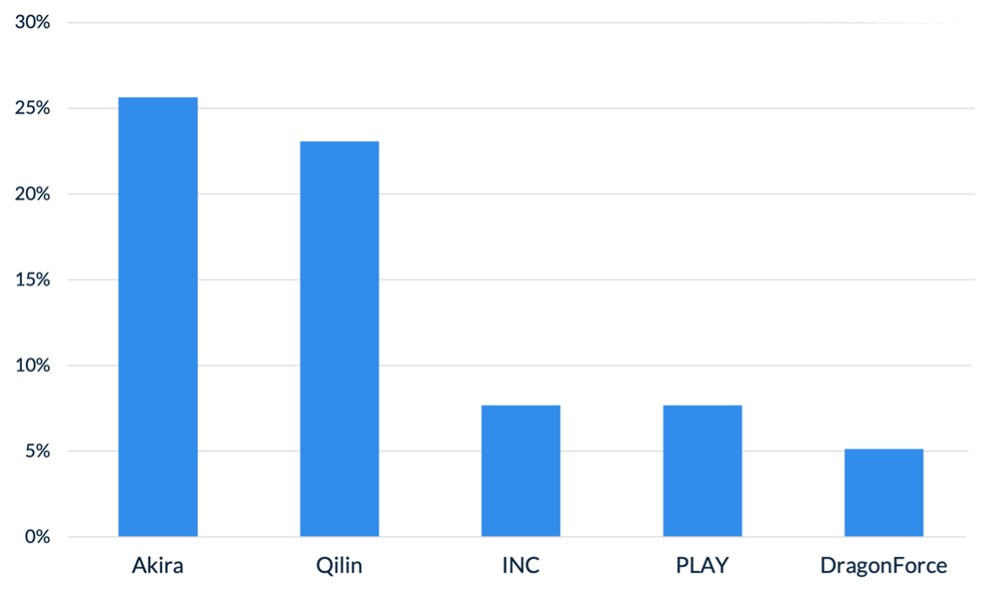
Figure 1. Activity from the top 5 threat groups in February 2026
Throughout the month of February, analysts at Arete identified several trends behind the threat actors perpetrating cybercrime activities:
In February, Arete observed Qilin actively targeting WatchGuard Firebox devices, especially those vulnerable to CVE-2025-14733, to gain initial access to victim environments. CVE-2025-14733 is a critical vulnerability in WatchGuard Fireware OS that allows a remote, unauthenticated threat actor to execute arbitrary code. In addition to upgrading WatchGuard devices to the latest Firebox OS version, which patches the bug, administrators are urged to rotate all shared secrets on affected devices that may have been compromised and may be used in future campaigns.
Reports from February suggest that threat actors are increasingly exploring AI-enabled tools and services to scale malicious activities, demonstrating how generative AI is being integrated into both espionage and financially motivated threat operations. The Google Threat Intelligence Group indicated that state-backed threat actors are leveraging Google’s Gemini AI as a force multiplier to support all stages of the cyberattack lifecycle, from reconnaissance to post-compromise operations. Separate reporting from Amazon Threat Intelligence identified a threat actor leveraging commercially available generative AI services to conduct a large-scale campaign against FortiGate firewalls, gaining access through weak or reused credentials protected only by single-factor authentication.
The Interlock ransomware group recently introduced a custom process-termination utility called “Hotta Killer,” designed to disable endpoint detection and response solutions during active intrusions. This tool exploits a zero-day vulnerability (CVE-2025-61155) in a gaming anti-cheat driver, marking a significant adaptation in the group’s operations against security tools like FortiEDR. Arete is actively monitoring this activity, which highlights the growing trend of Bring Your Own Vulnerable Driver (BYOVD) attacks, in which threat actors exploit legitimate, signed drivers to bypass and disable endpoint security controls.
Sources
Arete Internal

Article
ClickFix Campaign Delivers Custom RAT
Security researchers identified a sophisticated evolution of the ClickFix campaign that aims to compromise legitimate websites before delivering a five-stage malware chain, culminating in the deployment of MIMICRAT. MIMICRAT is a custom remote access trojan (RAT) written in the C/C++ programming language that offers various capabilities early in the attack lifecycle. The attack begins with victims visiting compromised websites, where JavaScript plugins load a fake Cloudflare verification that tricks users into executing a malicious PowerShell script, further displaying the prominence and effectiveness of ClickFix and its user interaction techniques.
Not Your Average RAT
MIMICRAT displays above-average defense evasion and sophistication, including:
A five-stage PowerShell sequence beginning with Event Tracing for Windows and Anti-Malware Scan Interface bypasses, which are commonly used in red teaming for evading detection by EDR and AV toolsets.
The malware later uses a lightweight scripting language that is scripted into memory, allowing malicious actions without files that could easily be detected by an EDR tool.
MIMICRAT uses malleable Command and Control profiles, allowing for a constantly changing communication infrastructure.
The campaign uses legitimate compromised infrastructure, rather than attacker-owned tools, and is prepped to use 17 different languages, which increases global reach and defense evasion.
Analyst Comments
The ClickFix social engineering technique remains an effective means for threat actors to obtain compromised credentials and initial access to victim environments, enabling them to deploy first-stage malware. Coupled with the sophisticated MIMICRAT RAT, the effectiveness of this campaign could increase. Arete will continue monitoring for changes to the ClickFix techniques, the deployment of MIMICRAT in other campaigns, and other pertinent information relating to the ongoing campaign.
Sources
MIMICRAT: ClickFix Campaign Delivers Custom RAT via Compromised Legitimate Websites

Article
Threat Actors Leveraging Gemini AI for All Attack Stages
State-backed threat actors are leveraging Google’s Gemini AI as a force multiplier to support all stages of the cyberattack lifecycle, from reconnaissance to post-compromise operations. According to the Google Threat Intelligence Group (GTIG), threat actors linked to the People’s Republic of China (PRC), Iran, North Korea, and other unattributed groups have misused Gemini to accelerate target profiling, synthesize open-source intelligence, identify official email addresses, map organizational structures, generate tailored phishing lures, translate content, conduct vulnerability testing, support coding tasks, and troubleshoot malware development. Cybercriminals are increasingly exploring AI-enabled tools and services to scale malicious activities, including social engineering campaigns such as ClickFix, demonstrating how generative AI is being integrated into both espionage and financially motivated threat operations.
What’s Notable and Unique
Threat actors are leveraging Gemini beyond basic reconnaissance, using it to generate polished, culturally nuanced phishing lures and sustain convincing multi-turn social engineering conversations that minimize traditional red flags.
In addition, threat actors rely on Gemini for vulnerability research, malware debugging, code generation, command-and-control development, and technical troubleshooting, with PRC groups emphasizing automation and vulnerability analysis, Iranian actors focusing on social engineering and malware development, and North Korean actors prioritizing high-fidelity target profiling.
Beyond direct operational support, adversaries have abused public generative AI platforms to host deceptive ClickFix instructions, tricking users into pasting malicious commands that deliver macOS variants of ATOMIC Stealer.
AI is also being integrated directly into malware development workflows, as seen with CoinBait’s AI-assisted phishing kit capabilities and HonestCue’s use of the Gemini API to dynamically generate and execute in-memory C# payloads.
Underground forums show strong demand for AI-powered offensive tools, with offerings like Xanthorox falsely marketed as custom AI but actually built on third-party commercial models integrated through open-source frameworks such as Crush, Hexstrike AI, LibreChat-AI, and Open WebUI, including Gemini.
Analyst Comments
The increasing misuse of generative AI platforms like Gemini highlights a rapidly evolving threat landscape in which state-backed and financially motivated actors leverage AI as a force multiplier for reconnaissance, phishing, malware development, and post-compromise operations. At the same time, large-scale model extraction attempts and API abuse demonstrate emerging risks to AI service integrity, intellectual property, and the broader AI-as-a-Service ecosystem. While these developments underscore the scalability and sophistication of AI-enabled threats, continued enforcement actions, strengthened safeguards, and proactive security testing by providers reflect ongoing efforts to mitigate abuse and adapt defenses in response to increasingly AI-driven adversaries.
Sources
GTIG AI Threat Tracker: Distillation, Experimentation, and (Continued) Integration of AI for Adversarial Use

Article
2025 VMware ESXi Vulnerability Exploited by Ransomware Groups
Ransomware groups are actively exploiting CVE‑2025‑22225, a VMware ESXi arbitrary write vulnerability that allows attackers to escape the VMX sandbox and gain kernel‑level access to the hypervisor. Although VMware (Broadcom) patched this flaw in March 2025, threat actors had already exploited it in the wild, and CISA recently confirmed that threat actors are exploiting CVE‑2025‑22225 in active campaigns.
What’s Notable and Unique
Chinese‑speaking threat actors abused this vulnerability at least a year before disclosure, via a compromised SonicWall VPN chain.
Threat researchers have observed sophisticated exploit toolkits, possibly developed well before public disclosure, that chain this bug with others to achieve full VM escape. Evidence points to targeted activity, including exploitation via compromised VPN appliances and automated orchestrators.
Attackers with VMX level privileges can trigger a kernel write, break out of the sandbox, and compromise the ESXi host. Intrusions observed in December 2025 showed lateral movement, domain admin abuse, firewall rule manipulation, and staging of data for exfiltration.
CISA has now added CVE-2025-22225 to its Known Exploited Vulnerabilities (KEV) catalog, underscoring ongoing use by ransomware attackers.
Analyst Comments
Compromise of ESXi hypervisors significantly amplifies operational impact, allowing access to and potential encryption of dozens of VMs simultaneously. Organizations running ESXi 7.x and 8.x remain at high risk if patches and mitigations have not been applied. Therefore, clients are recommended to apply VMware patches from VMSA‑2025‑0004 across all ESXi, Workstation, and Fusion deployments. Enterprises are advised to assess their setups in order to reduce risk, as protecting publicly accessible management interfaces is a fundamental security best practice.
Sources
CVE-2025-22225 in VMware ESXi now used in active ransomware attacks
The Great VM Escape: ESXi Exploitation in the Wild
VMSA-205-004: VMware ESXi, Workstation, and Fusion updates address multiple vulnerabilities (CVE-205-22224, CVE-2025-22225, CVE-2025-22226)