Article
Empowering Cybersecurity Career Advancement in India
At Arete

Companies around the world have long relied on India for cost-effective technical outsourcing. Thanks to the country’s abundance of highly trained technical talent, it’s been a successful support model. But like any successful business strategy, there’s always room for improvement. Particularly when it comes to security.
When NotPetya hit a few years ago, it should have been a global wake-up call. And now, if the SolarWinds attack has taught us anything, it’s that we can’t keep hitting the snooze button on cybersecurity. Like elsewhere, supply chain attacks — as well as ransomware and malware attacks — are a worrisome reality in India.
At Arete, we have an opportunity to tackle this challenge head-on and forge a new path — in a leading, not supporting role — to build strong, world-class defense capabilities for India’s businesses.
Homegrown Talent And Relationship Building
It all starts with developing talent. At Arete, we give our employees the tools to advance their careers in a direction that makes sense for them and the company — no matter their geographical location.
To help fulfill this mission, we are bringing our North American cyber career model to India. Our aim is to seed organic growth, build local capacity, and create more leadership opportunities in-country. We believe that employees should be empowered to grow their cyber careers beyond IT support roles, without feeling compelled to emigrate elsewhere.
Taking Technology Skills And Careers To The Next Level
It’s not necessary to know everything up front. Whether our employees begin in IT support, system administration, or digital forensics roles, Arete has programs designed to help them develop the cybersecurity skills they need to move from support to leadership roles.
We focus on an employee’s talents and interests, pair them with colleagues whose abilities complement theirs, and provide a framework for cross-functional collaboration that allows the whole team to build on one another’s strengths and learn new skills on the job.
Beyond Technical Skills: What Success Looks Like
Beyond the jumping-off point of technical degrees and certifications, it’s often the soft skills that will set an individual apart and above in this field. For success, a cybersecurity professional must possess a flexible mindset and the ability to adapt to changing situations, troubleshoot under pressure, and demonstrate tenacity through crises. They should also be able to proactively visualize attack vectors, high-value assets, layers of defense, and containment measures.
A well-rounded skill set will take you far. And whatever team you belong to at Arete, you can know your work will be generating data-driving intelligence that directly supports the discovery of brand-new indicators of compromise (IoCs). As your skill sets mature, you will be expected to assert yourself in what will often be actual business-saving endeavors throughout India. And you’ll be able to see how your threat hunts and searches for anomalous behavior and new activity will enable clients not only react to cyberattacks, but proactively stop them.
If you have a desire to help protect Indian businesses from corrupt cybercriminals, consider joining the Arete team in one of our currently open positions. Here, you’ll be surrounded by the best and brightest in the field. Professionals who can and will help you take your career to the highest level.
Back to Blog Posts

Article
Adversarial AI Evolves from Prompting to Autonomous Attack Workflows
Cybercriminals and state-linked threat actors are increasingly incorporating artificial intelligence (AI) into multiple stages of offensive operations. Rather than relying on AI only for content generation or research, threat actors are now consistently using it to support reconnaissance, vulnerability discovery, credential theft, malware development, social engineering, and activities following initial compromise. The growing use of automated and agent-based workflows is allowing adversaries to coordinate offensive malicious activities with less manual involvement, potentially increasing the speed, scale, and efficiency of future campaigns.
What’s Notable and Unique
In one observed campaign, threat actors used AI to plan, build, and conduct an automated credential-harvesting operation within just several hours, demonstrating how compromised infrastructure can be rapidly repurposed to support larger-scale malicious activity.
Arete has observed several threat groups using AI-assisted capabilities to facilitate the analysis of data obtained during exfiltration so far this year, including INC Ransom, FulcrumSec, and Settra.
Attackers are also attempting to reproduce proprietary AI capabilities. Large-scale automated prompting campaigns have been used to extract information about the behavior and capabilities of proprietary AI models. The use of numerous accounts and intermediary infrastructure can make these activities more difficult to identify and attribute.
Analyst Comments
AI is increasingly becoming an operational component in the threat landscape rather than simply a tool that improves attacker productivity. By connecting reconnaissance, development, credential operations, and other activities through automated workflows, threat actors can conduct campaigns more quickly and reduce reliance on continuous human input. This trend also impacts security requirements for organizations deploying AI technologies. AI models, development environments, cloud resources, identities, repositories, and automated workflows should increasingly be considered interconnected elements of the enterprise attack surface, and organizations should maintain visibility across these areas and ensure that security controls account for both conventional threats and AI-enabled attack techniques.
Sources
GTIG AI Threat Tracker: From Prompting to Autonomy – The Evolution of Adversarial AI

Article
Top 9 Security Controls for SMBs
In today’s complex cyber threat landscape, small and medium-sized businesses (SMBs) should implement a layered, multi-pronged approach to security. Here are some proven, effective controls to consider:
1. Implement MFA for All Users
Multi-factor authentication (MFA) is an effective and accessible way to protect sensitive data, comply with regulatory standards, and prevent unauthorized access to critical systems. By ensuring that users not only use a password but also a secure token, an organization can significantly reduce phishing attempts, credential stuffing attacks, and ransomware incidents. MFA should be enabled for email, VPN, and critical system access.
2. Update Patch Management Programs
A modern patching program should include policies and mechanisms to manage software updates in a timely manner. Patching efforts should address not just operating system updates, but also commonly utilized software within the environment. An active patching plan aims to reduce the mean time to patch and provide metrics on existing patch efforts. In the event of a high-severity vulnerability, a mature patching program should also be able to identify the risks and exposure for a given set of systems based on the average time to patch. This helps stakeholders make informed decisions when a new exploit is released.
3. Leverage a Properly Managed Endpoint Detection and Response (EDR) Tool
With real-time threat detection and advanced visibility, endpoint detection and response (EDR) solutions can enhance an organization’s ability to detect and investigate potential malicious activity, including ransomware, lateral movement, fileless attacks, and more. Effective management of EDR should include proper configuration, regular agent updates, and established procedures for responding to alerts.
4. Enhance EDR with Frontline Incident Intelligence
While EDR solutions are an important component of a security program, threat actors are continually adapting their techniques to evade detection, and as a result, standard detection methods may not always identify emerging threats or novel attack behaviors. To strengthen protection, organizations can supplement EDR tools with custom detection rules informed by incident response data. These rules can help identify indicators of compromise observed during cyber incidents, providing an additional layer of visibility beyond traditional detections.
Arete Bloktd℠ illustrates this approach by transforming threat intelligence and malware analysis into curated detection rules for EDR tools. Applying frontline intelligence to security tools can result in earlier detection, less investigative burden, and a more confident response.
5. Create and Continuously Test an Incident Response (IR) Plan
An incident response plan can help an organization effectively identify, respond to, and recover from a cybersecurity incident while minimizing disruption and downtime. An IR plan defines clear roles, escalation paths, communication strategies, and decision frameworks for both internal and external teams. To be effective, these plans should be regularly tested with post-incident reviews or tabletop exercises involving key stakeholders.
6. Maintain Encrypted and Tested Data Backups
In the case of a cyberattack, backups can help organizations maintain business continuity, support ransom negotiations with threat actors, and contribute to a timely and successful recovery. Encrypting backups makes it more difficult for threat actors to access or alter them, and regular testing ensures they remain accessible during a security incident.
7. Conduct Employee Security Awareness Training
Human error is a leading cause of cybersecurity incidents, and an organization’s employees are its first line of defense against cyber threats. Security awareness training reinforces the importance of data confidentiality, supports regulatory compliance, and helps employees recognize and understand red flags such as suspicious emails, malicious links, and social engineering attempts.
8. Assess and Address Existing Risk and Vulnerabilities
To maintain a proactive approach to risk management and improve resilience, organizations should regularly assess existing vulnerabilities through expert-led Vulnerability Assessments, Penetration Testing, and Threat Hunting Assessments. These exercises can help identify security gaps, support regulatory compliance, and prevent potential incidents. During remediation, prioritize high-impact vulnerabilities and make a plan for periodic assessments.
9. Apply Least-Privilege Access Controls
Employees should have access only to the systems, applications, and data necessary to perform their jobs. By removing unnecessary administrative privileges and regularly reviewing user permissions, organizations can reduce the risk of unauthorized access and limit the damage caused by compromised accounts or insider threats.
Organizations should regularly review their cybersecurity programs, stay informed about emerging threats, and evaluate whether their security controls are adapting to the evolving threat landscape.

Article
Ransomware Trends & Data Insights: August 2026
Although INC Ransom was the most active ransomware threat group observed in August 2026, overall activity remained relatively distributed across the threat landscape, with approximately 30 unique ransomware and extortion groups, including both established and newly emerged actors, observed during the month. Alongside INC Ransom, Storm, DragonForce, Qilin, and The Gentlemen were among the top five most active threat groups, underscoring the continued diversity and competitiveness of the ransomware ecosystem.
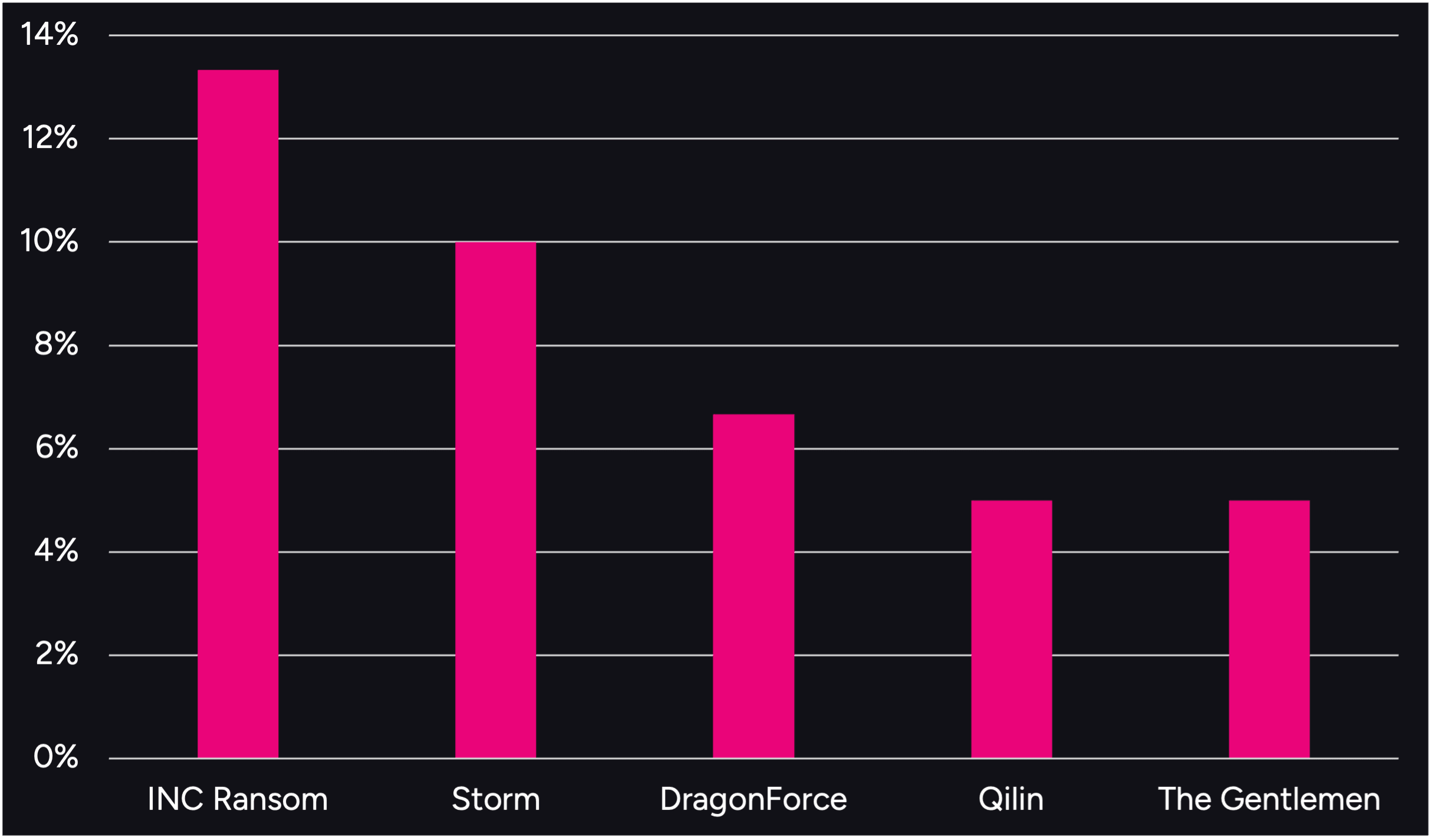
Figure 1. Activity from the top 5 threat groups in August 2026
Throughout the month, analysts at Arete identified several trends behind the threat actors perpetrating cybercrime activities:
August 2026 was a significant month for the emergence of new threat actors, with Arete identifying several previously untracked ransomware groups, including Storm, Dark Project, DireWolf, Morpheus, Orova, Spirals, Wallstreet Team, and Zawoo Team. This trend underscores the ongoing evolution of the threat landscape and the low barriers to entry for new cybercriminal operations.
Arete observed a continued use of AI-enabled capabilities across the ransomware ecosystem during August. Similar to Fulcrumsec and Setra, the newly emerged Zawoo Team appears to leverage AI-assisted analysis of stolen data, publishing highly structured and detailed victim assessments on its data leak site (DLS). Additionally, both the Aurora and Storm ransomware groups have been observed utilizing AI-driven or AI-assisted chat representatives during victim communications. These developments suggest that threat actors are increasingly incorporating AI to enhance data analysis, automate victim engagement, and improve the effectiveness and scalability of extortion operations.
In August, Arete also observed that despite sustained law enforcement disruption efforts, LockBit continues to demonstrate operational resilience, likely through the expansion of its affiliate ecosystem and the evolution of its tactics. Recent activity indicates an increased reliance on data theft and exfiltration-only operations, with observed victimology suggesting a notable focus on organizations within the financial sector.
Sources
Arete Internal

Report
Arete's H1 2026 Crimeware Report
Explore intelligence and operational data from the frontlines of ransomware and extortion response as we detail the most significant trends and developments in the cyber threat landscape in the first half (H1) of 2026.