Resources
Providing you the latest industry-specific news and insights.
All Types
Articles
Podcasts
Reports
Virtual Events
All Topics
Arete Analysis
At Arete
Client Stories
Combating Ransomware
Cyber Threats
Cybersecurity 101
Cybersecurity Trends
Data Mining
Data Transfer
Endpoint Detection and Response
Forensic Investigations
Identity Protection
Managed Services
Ransomware Technical Analysis
Recovery
Security Recommendations
Threat Actors
Tips
Workplace Security

Article
Adversarial AI Evolves from Prompting to Autonomous Attack Workflows
Cybercriminals and state-linked threat actors are increasingly incorporating artificial intelligence (AI) into multiple stages of offensive operations. Rather than relying on AI only for content generation or research, threat actors are now consistently using it to support reconnaissance, vulnerability discovery, credential theft, malware development, social engineering, and activities following initial compromise. The growing use of automated and agent-based workflows is allowing adversaries to coordinate offensive malicious activities with less manual involvement, potentially increasing the speed, scale, and efficiency of future campaigns.
What’s Notable and Unique
In one observed campaign, threat actors used AI to plan, build, and conduct an automated credential-harvesting operation within just several hours, demonstrating how compromised infrastructure can be rapidly repurposed to support larger-scale malicious activity.
Arete has observed several threat groups using AI-assisted capabilities to facilitate the analysis of data obtained during exfiltration so far this year, including INC Ransom, FulcrumSec, and Settra.
Attackers are also attempting to reproduce proprietary AI capabilities. Large-scale automated prompting campaigns have been used to extract information about the behavior and capabilities of proprietary AI models. The use of numerous accounts and intermediary infrastructure can make these activities more difficult to identify and attribute.
Analyst Comments
AI is increasingly becoming an operational component in the threat landscape rather than simply a tool that improves attacker productivity. By connecting reconnaissance, development, credential operations, and other activities through automated workflows, threat actors can conduct campaigns more quickly and reduce reliance on continuous human input. This trend also impacts security requirements for organizations deploying AI technologies. AI models, development environments, cloud resources, identities, repositories, and automated workflows should increasingly be considered interconnected elements of the enterprise attack surface, and organizations should maintain visibility across these areas and ensure that security controls account for both conventional threats and AI-enabled attack techniques.
Sources
GTIG AI Threat Tracker: From Prompting to Autonomy – The Evolution of Adversarial AI

Article
Top 9 Security Controls for SMBs
In today’s complex cyber threat landscape, small and medium-sized businesses (SMBs) should implement a layered, multi-pronged approach to security. Here are some proven, effective controls to consider:
1. Implement MFA for All Users
Multi-factor authentication (MFA) is an effective and accessible way to protect sensitive data, comply with regulatory standards, and prevent unauthorized access to critical systems. By ensuring that users not only use a password but also a secure token, an organization can significantly reduce phishing attempts, credential stuffing attacks, and ransomware incidents. MFA should be enabled for email, VPN, and critical system access.
2. Update Patch Management Programs
A modern patching program should include policies and mechanisms to manage software updates in a timely manner. Patching efforts should address not just operating system updates, but also commonly utilized software within the environment. An active patching plan aims to reduce the mean time to patch and provide metrics on existing patch efforts. In the event of a high-severity vulnerability, a mature patching program should also be able to identify the risks and exposure for a given set of systems based on the average time to patch. This helps stakeholders make informed decisions when a new exploit is released.
3. Leverage a Properly Managed Endpoint Detection and Response (EDR) Tool
With real-time threat detection and advanced visibility, endpoint detection and response (EDR) solutions can enhance an organization’s ability to detect and investigate potential malicious activity, including ransomware, lateral movement, fileless attacks, and more. Effective management of EDR should include proper configuration, regular agent updates, and established procedures for responding to alerts.
4. Enhance EDR with Frontline Incident Intelligence
While EDR solutions are an important component of a security program, threat actors are continually adapting their techniques to evade detection, and as a result, standard detection methods may not always identify emerging threats or novel attack behaviors. To strengthen protection, organizations can supplement EDR tools with custom detection rules informed by incident response data. These rules can help identify indicators of compromise observed during cyber incidents, providing an additional layer of visibility beyond traditional detections.
Arete Bloktd℠ illustrates this approach by transforming threat intelligence and malware analysis into curated detection rules for EDR tools. Applying frontline intelligence to security tools can result in earlier detection, less investigative burden, and a more confident response.
5. Create and Continuously Test an Incident Response (IR) Plan
An incident response plan can help an organization effectively identify, respond to, and recover from a cybersecurity incident while minimizing disruption and downtime. An IR plan defines clear roles, escalation paths, communication strategies, and decision frameworks for both internal and external teams. To be effective, these plans should be regularly tested with post-incident reviews or tabletop exercises involving key stakeholders.
6. Maintain Encrypted and Tested Data Backups
In the case of a cyberattack, backups can help organizations maintain business continuity, support ransom negotiations with threat actors, and contribute to a timely and successful recovery. Encrypting backups makes it more difficult for threat actors to access or alter them, and regular testing ensures they remain accessible during a security incident.
7. Conduct Employee Security Awareness Training
Human error is a leading cause of cybersecurity incidents, and an organization’s employees are its first line of defense against cyber threats. Security awareness training reinforces the importance of data confidentiality, supports regulatory compliance, and helps employees recognize and understand red flags such as suspicious emails, malicious links, and social engineering attempts.
8. Assess and Address Existing Risk and Vulnerabilities
To maintain a proactive approach to risk management and improve resilience, organizations should regularly assess existing vulnerabilities through expert-led Vulnerability Assessments, Penetration Testing, and Threat Hunting Assessments. These exercises can help identify security gaps, support regulatory compliance, and prevent potential incidents. During remediation, prioritize high-impact vulnerabilities and make a plan for periodic assessments.
9. Apply Least-Privilege Access Controls
Employees should have access only to the systems, applications, and data necessary to perform their jobs. By removing unnecessary administrative privileges and regularly reviewing user permissions, organizations can reduce the risk of unauthorized access and limit the damage caused by compromised accounts or insider threats.
Organizations should regularly review their cybersecurity programs, stay informed about emerging threats, and evaluate whether their security controls are adapting to the evolving threat landscape.

Article
Ransomware Trends & Data Insights: August 2026
Although INC Ransom was the most active ransomware threat group observed in August 2026, overall activity remained relatively distributed across the threat landscape, with approximately 30 unique ransomware and extortion groups, including both established and newly emerged actors, observed during the month. Alongside INC Ransom, Storm, DragonForce, Qilin, and The Gentlemen were among the top five most active threat groups, underscoring the continued diversity and competitiveness of the ransomware ecosystem.
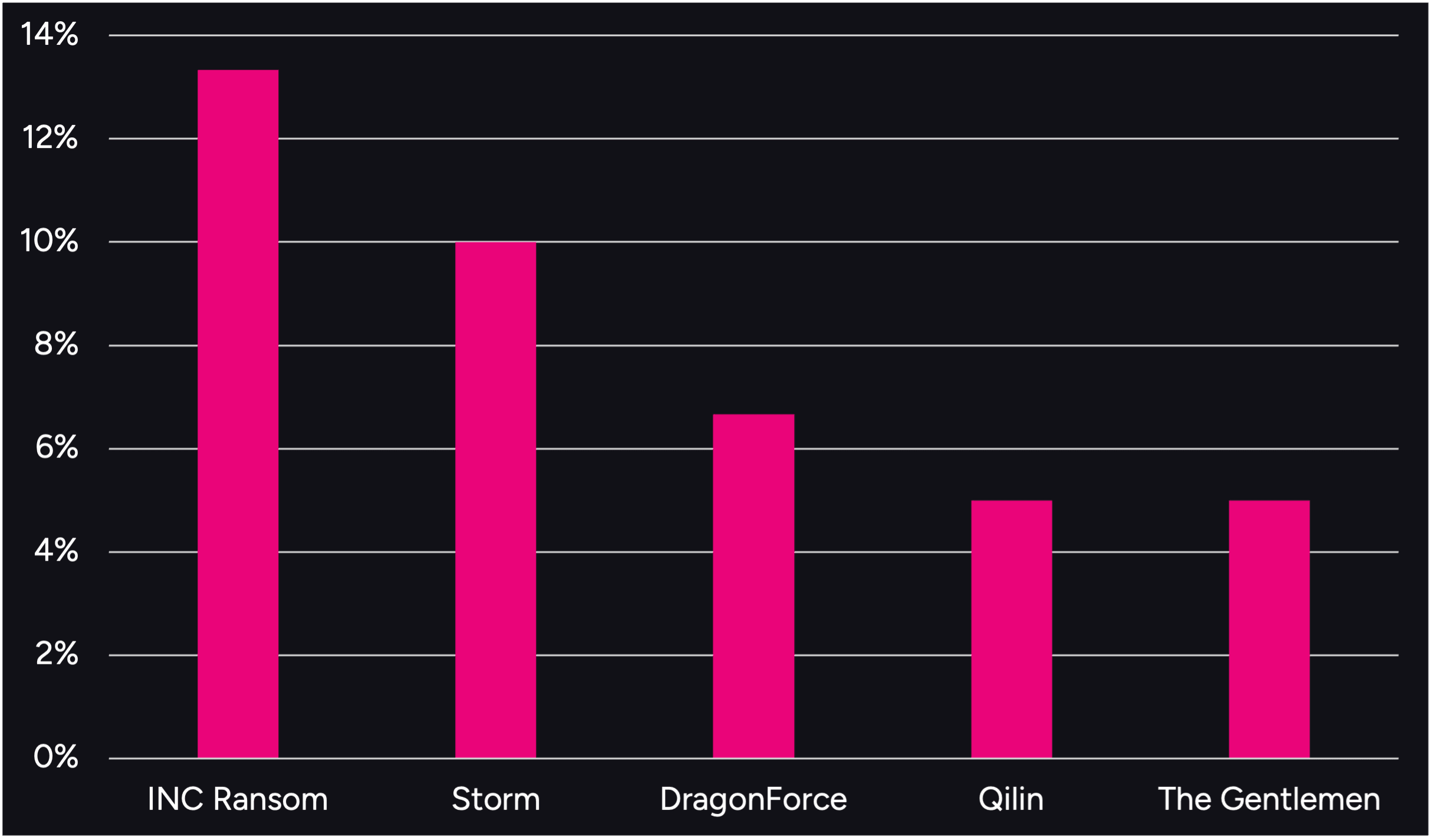
Figure 1. Activity from the top 5 threat groups in August 2026
Throughout the month, analysts at Arete identified several trends behind the threat actors perpetrating cybercrime activities:
August 2026 was a significant month for the emergence of new threat actors, with Arete identifying several previously untracked ransomware groups, including Storm, Dark Project, DireWolf, Morpheus, Orova, Spirals, Wallstreet Team, and Zawoo Team. This trend underscores the ongoing evolution of the threat landscape and the low barriers to entry for new cybercriminal operations.
Arete observed a continued use of AI-enabled capabilities across the ransomware ecosystem during August. Similar to Fulcrumsec and Setra, the newly emerged Zawoo Team appears to leverage AI-assisted analysis of stolen data, publishing highly structured and detailed victim assessments on its data leak site (DLS). Additionally, both the Aurora and Storm ransomware groups have been observed utilizing AI-driven or AI-assisted chat representatives during victim communications. These developments suggest that threat actors are increasingly incorporating AI to enhance data analysis, automate victim engagement, and improve the effectiveness and scalability of extortion operations.
In August, Arete also observed that despite sustained law enforcement disruption efforts, LockBit continues to demonstrate operational resilience, likely through the expansion of its affiliate ecosystem and the evolution of its tactics. Recent activity indicates an increased reliance on data theft and exfiltration-only operations, with observed victimology suggesting a notable focus on organizations within the financial sector.
Sources
Arete Internal

Report
Arete's H1 2026 Crimeware Report
Explore intelligence and operational data from the frontlines of ransomware and extortion response as we detail the most significant trends and developments in the cyber threat landscape in the first half (H1) of 2026.

Article
WinRAR Path-Traversal Vulnerability Exploited in Ransomware Attacks
CISA has warned that CVE-2025-8088, a path-traversal vulnerability in WinRAR, is being exploited in ransomware attacks. The vulnerability allows attackers to use specially crafted archive files to place malicious executables in locations such as the Windows Startup folder, enabling code execution when the system restarts. WinRAR addressed this vulnerability in version 7.13, but exploitation has continued due to challenges in updating the software. CISA's updated KEV entry now specifically identifies the vulnerability as being used in ransomware attacks.
What’s Notable and Unique
The vulnerability was initially exploited as a zero-day by the Russia-linked RomCom group, enabling malware execution at user logon and supporting credential theft, cyberespionage, and ransomware-related activities.
CVE-2025-8088 continues to be actively exploited by both government-backed and financially motivated threat actors. Observed campaigns have been attributed to Russian- and Chinese-linked groups targeting several organizations.
Phishing campaigns leveraging weaponized RAR attachments exploited CVE-2025-8088 to silently place malicious payloads in autorun locations using directory traversal and Alternate Data Streams (ADS).
The widespread exploitation of CVE-2025-8088 highlights strong demand for effective WinRAR exploits, with multiple underground vendors previously supplying exploit capabilities to a diverse range of threat actors. One such vendor, zeroplayer, advertised a WinRAR exploit in July 2025.
Analyst Comments
Organizations should immediately upgrade WinRAR to version 7.13 or later and conduct an enterprise-wide inventory to identify unmanaged installations. Given that WinRAR lacks automatic updates, Group Policy support, and integration with common enterprise patch management platforms, manual verification and remediation may be required to ensure all vulnerable instances are addressed. Security teams should also enhance defenses against archive-based phishing attacks by blocking or scrutinizing unsolicited compressed files, monitoring for suspicious file creation in Windows Startup directories, and detecting abuse of ADS. With CISA now linking CVE-2025-8088 to ransomware activity, organizations should treat remediation as a high priority and actively monitor for indicators of WinRAR-based exploitation across their environments.
Sources
CISA Adds Three Known Exploited Vulnerabilities to Catalog
WinRAR vulnerability being exploited in ransomware attacks, CISA warns

Report
Malware Spotlight: Qilin Ransomware
Executive Summary
Over the past few years, Arete’s Incident Response (IR) team has responded to more than one hundred incidents attributed to the Qilin ransomware group. Active since October 2022 under a different name (Agenda), the group had an increase in activity at the beginning of 2025, especially during the second quarter, when it was the most active threat group. Notably, most of its activity came in June 2025, as the group exploited vulnerabilities in Fortinet’s FortiGate appliances and reportedly attempted to recruit ex-RansomHub affiliates. In the first quarter of 2026, the group remained the second most active extortion group behind Akira and actively targeted WatchGuard Firebox devices for initial access, particularly those vulnerable to CVE-2025-14733, a critical vulnerability in WatchGuard Fireware OS that allows a remote, unauthenticated threat actor to execute arbitrary code.
This spotlight explores the ransomware group’s observed behavior, background information on the threat actor, and statistics from Incident Response engagements, along with a technical analysis of Qilin’s ransomware executable. Finally, we discuss security recommendations to better defend against this evolving cyber threat and mitigate the risk of financial and reputational losses. For more insights and data on Qilin and other top threat groups, explore Arete’s Q1 2026 Crimeware Report.
Incident Response Data on the Qilin Ransomware Group
The information below is based on Arete engagements attributed to Qilin since August 2023. Our IR, Threat Intelligence, and Data Analytics teams work together to analyze key data points during every ransomware engagement and form real-time threat actor (TA) insights.
Impacted sectors include professional services, public services, healthcare, financial services, manufacturing, high technology, retail, and hospitality.
The median initial ransom demand is $400,000.
Tools observed during investigations include Mimikatz, Lazagne, FGDump, PsExec, Splashtop, Mesh Agent, Atera, ScreenConnect Client, AnyDesk, SoftPerfect Network Scanner (Netscan), Advanced Port Scanner, WinRAR, WinSCP, FileZilla, Putty, Rclone, and MEGAsync.
Qilin-affiliated actors often exploit edge device vulnerabilities or use legitimate credentials.
The group operates a TOR data leak site (DLS), where it self-identifies as Qilin and commonly threatens to release stolen data if a payment is not made.
The ransom note identifies the group as Qilin and contains links to its data leak and chat negotiation sites. To initiate negotiations, login credentials are included in the ransom note. Part of the ransom note filename matches the encrypted file extension as a naming convention.
In addition to encrypting files and creating a ransom note, the Qilin ransomware requires a password to execute properly, supports various command-line arguments, deletes volume shadow copies, clears the Windows Event Logs, and creates a desktop wallpaper displaying information about the encryption event.
Background
Arete first observed Qilin in incident response engagements in 2023. Over time, the group evolved into an increasingly sophisticated and notable ransomware operation, becoming the top threat group in Q2 of 2025 and the second-most active, after Akira, in Q3 and Q4 of 2025 and Q1 of 2026.
TOP THREAT GROUPS OBSERVED BY QUARTER

Figure 1: Top threat groups observed by Arete by quarter
Qilin impacts a broad range of organizations throughout North America and often lists victims that fail to reach a negotiation agreement on its data leak site. The group maintains Windows and Linux versions of its ransomware, and the most recently observed Windows-based version was developed in the Rust programming language. Qilin has been observed exploiting vulnerabilities in Fortinet appliances as an initial access vector.
In 2025, Qilin broadened its RaaS platform by introducing a “Call Lawyer” negotiation-support feature, through which affiliates can request assistance from individuals that Qilin portrays as an internal legal team when victims delay or resist negotiations. The goal is to provide affiliates with tactics that pressure victims into believing that non-compliance could lead to regulatory scrutiny, fines, or even criminal exposure. Additionally, the platform offers affiliates more aggressive coercion methods, such as launching distributed denial of service (DDoS) attacks against victim websites.
Technical Analysis
Malware analysis revealed that Qilin ransomware:
Supports multiple command-line arguments.
Requires the correct password to fully encrypt files.
Appends a file extension to all encrypted files; however, the extension is not static. Instead, it is randomly generated for each incident. As an example, this report uses the extension XXXXXXXXX (e.g., file.docx.XXXXXXXXX).
Generates a ransom note with a filename that incorporates the same randomized extension value used during encryption. Continuing the example above, the ransom note was named README-RECOVER-XXXXXXXXXX.txt, where XXXXXXXXXX corresponds to the unique extension assigned in this incident.
Self-identifies the group as Qilin in the ransom note.
References a data leak site in the ransom note that, when accessed, also self-identifies the group as Qilin.
Kills a list of processes and services.
Clears Windows event logs.
Maintains a list of whitelisted files and directories to ensure the system does not become unusable, preventing recovery when running a decryptor.
Attempts to prevent system recovery by deleting the system's volume shadow copies.
Creates a mutex during execution.
Creates an image file in the %Temp% directory and later modifies a registry key to change the desktop wallpaper.
Creates log files in a QLOG directory created in %TEMP% (e.g., ThreadId(1).LOG).
Has a well-defined ransomware configuration with various fields like company_id, accounts, note, password_hash, directory_black_list, file_ black_list, process_black_list, and file_pattern_black_list.
Execution Pattern/Arguments
Qilin ransomware will not execute in the system without the correct “--password” argument.
Example of the command to run the executable:
Qilin.exe --password XXXXXXXXXXXXX --no-admin |
Screenshot of the ransomware execution in the command prompt with the password argument redacted:
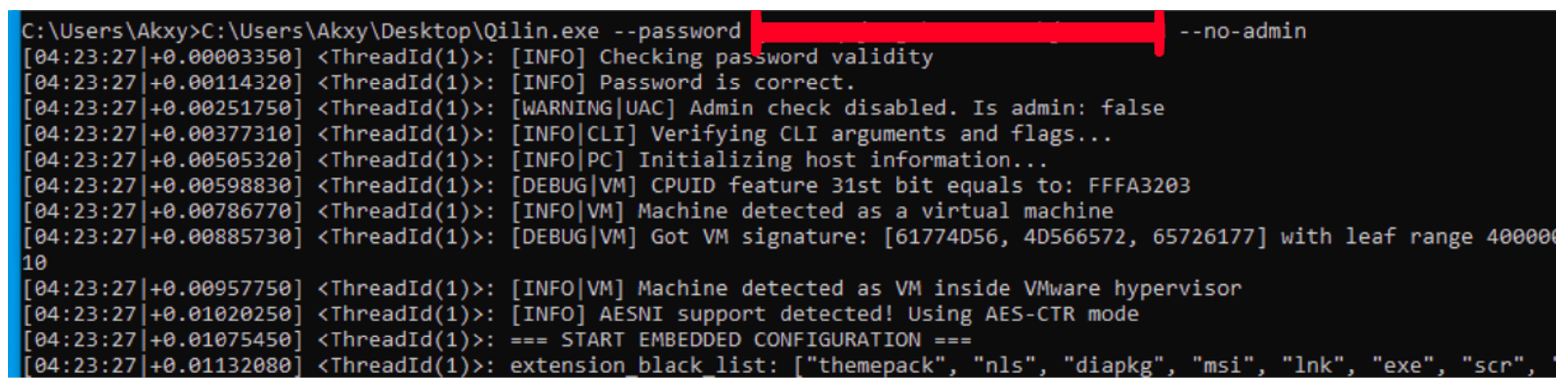
Figure 2. Ransomware execution in command prompt
List commands supported by the Qilin ransomware analyzed:
Command Line Parameters | Description |
|---|---|
--password | Required to start program. Reads password from password.txt. |
--spread | Spreads to Windows hosts using login credentials. Does not encrypt local machine. |
--spread-vcenter | Distributes payload to ESXi/vCenter hosts and installs modules. No local encryption. |
--no-admin | Disables admin rights check. |
--no-priority | Disables CPU and IO priority settings. |
--no-extension | Prevents file extension change during encryption. |
--no-note | Disables ransom note saving in folders. |
--timer | Delays execution by specified seconds. |
--paths | Encrypts only specified paths/directories. |
--ips | Encrypts only network resources on specified IPs or hosts. |
--no-ef | Disables file extension filtering. |
--no-ff | Disables file name/type filtering. |
--no-df | Disables directory filtering. |
--no-proc | Disables process killer functionality. |
--no-services | Disables service killer functionality. |
--no-vm | Disables virtual machine detection and related kills. |
--no-sandbox | Disables sandbox detection logic. |
--kill-cluster | Enables destruction of cluster environments. |
--safe | Reboots to safe mode, enables autologin, and begins encryption. |
--no-autostart | Prevents self-autostart configuration. |
--no-wallpaper | Prevents wallpaper or lockscreen changes. |
--no-destruct | Prevents self-destruction after execution. |
--no-zero | Disables wiping of free disk space post-encryption. |
--no-local | Skips encryption of local volumes. |
--no-mounted | Skips encryption of mounted shares and network shortcuts. |
--no-domain | Skips host discovery in domain networks. |
--no-network | Skips host discovery in the entire subnet. |
--exclude | Skips specified hosts/IPs from encryption and scanning. |
--print-image | Prints a message to all available printers post-encryption. |
--print-delay | Sets delay before printing with --print-image. |
--force | Allows multiple instances by skipping mutex creation. |
--no-logs | Disables writing of log files. |
--logs | Collects and archives logs to local directory. |
--dry-run | Runs encryption simulation without modifying files. |
Stop Services and Processes
Before file encryption, the ransomware terminates a pre-determined list of processes and services to encrypt as many files as possible.
Process names:
vmms, vmwp, vmcompute, agntsvc, dbeng50, dbsnmp, encsvc, excel, firefox, infopath, isqlplussvc, sql, msaccess, mspub, mydesktopqos, mydesktopservice, notepad, ocautoupds, ocomm, ocssd, onenote, oracle, outlook, powerpnt, sqbcoreservice, steam, synctime, tbirdconfig, thebat, thunderbird, visio, winword, wordpad, xfssvccon, bedbh, vxmon, benetns, bengien, pvlsvr, beserver, raw_agent_svc, vsnapvss, cagservice, qbidpservice, qbdbmgrn, qbcfmonitorservice, sap, teamviewer_service, teamviewer, tv_w32, tv_x64, cvmountd, cvd, cvfwd, cvods, saphostexec, saposcol, sapstartsrv, avagent, avscc, dellsystemdetect, enterpriseclient, veeamnfssvc, veeamtransportsvc, veeamdeploymentsvc, mvdesktopservice |
Service names:
vmms, mepocs, memtas, veeam, backup, vss, sql, msexchange, sophos, msexchange, msexchange\\$, wsbexchange, pdvfsservice, backupexecvssprovider, backupexecagentaccelerator, backupexecagentbrowser, backupexecdivecimediaservice, backupexecjobengine, backupexecmanagementservice, backupexecrpcservice, gxblr, gxvss, gxclmgrs, gxcvd, gxcimgr, gxmmm, gxvsshwprov, gxfwd, sapservice, sap, sap\\$, sapd\\$, saphostcontrol, saphostexec, qbcfmonitorservice, qbdbmgrn, qbidpservice, acronisagent, veeamnfssvc, veeamdeploymentservice, veeamtransportsvc, mvarmor, mvarmor64, vsnapvss, acrsch2svc, (.*?)sql(.*?) |
File and Directory Exclusions
The ransomware excludes system-related files and folders, ransomware-related files, and whitelisted extensions during encryption.
Excluded file extensions:
themepack, nls, diapkg, msi, lnk, exe, scr, bat, drv, rtp, msp, prf, msc, ico, key, ocx, diagcab, diagcfg, pdb, wpx, hlp, icns, rom, dll, msstyles, mod, ps1, ics, hta, bin, cmd, ani, 386, lock, cur, idx, sys, com, deskthemepack, shs, theme, mpa, nomedia, spl, cpl, adv, icl, msu, XXXXXXXXXX |
Excluded directories:
windows, system volume information, intel, admin$, ipc$, sysvol, netlogon, $windows.~ws, application data, mozilla, program files (x86), program files, $windows.~bt, msocache, tor browser, programdata, boot, config.msi, google, perflogs, appdata, windows.old, appdata, .., ., boot, windows, windows.old, $recycle.bin, admin$ |
Excluded files:
desktop.ini, autorun.ini, ntldr, bootsect.bak, thumbs.db, boot.ini, ntuser.dat, iconcache.db, bootfont.bin, ntuser.ini, ntuser.dat.log, autorun.inf, bootmgr, bootmgr.efi, bootmgfw.efi, #recycle, autorun.inf, boot.ini, bootfont.bin, bootmgr, bootmgr.efi, bootmgfw.efi, desktop.ini, iconcache.db, ntldr, ntuser.dat, ntuser.dat.log, ntuser.ini, thumbs.db, #recycle, bootsect.bak |
Inhibit System Recovery
Windows operating systems contain features that can help fix corrupted system files, including shadow copies, which are backups of files created by the Volume Shadow Copy Service (VSS). By deleting shadow copies, the ransomware can prevent victims from restoring files from backups, making it more difficult for them to recover their data without paying the ransom.
The ransomware deletes volume shadow copies and disables the Windows Volume Shadow Copy Service (VSS) before file encryption by starting the following processes:
wmic service where name='vss' call ChangeStartMode Manual |
System Network Connections Discovery
Qilin ransomware can enumerate network-mounted shares by scanning the network interfaces.
Data Encrypted for Impact
The ransomware initially finds available drives, then loads the files one by one using the Windows APIs “FindFirstFileW“ and “FindNextFileW”. The ransomware generates random AES keys to encrypt the files, then encrypts the AES keys using a public RSA key. The resulting key is placed at the end of the file.
The ransomware encrypts files, adds a randomized extension to the encrypted files, and appends the following bytes towards the end of each file.
-----END CIPHERTEXT BLOCK----- |
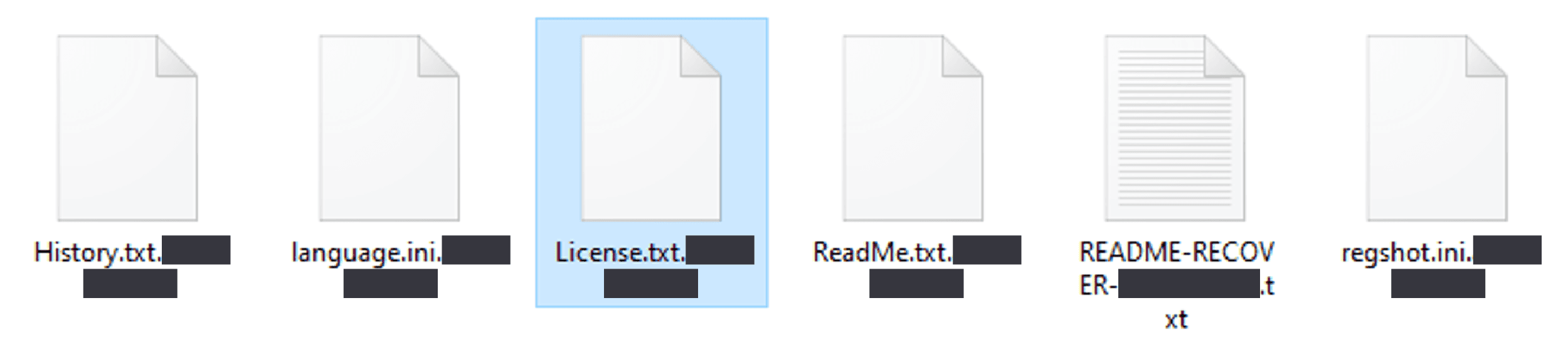
Figure 3. “.XXXXXXXXXX” extension added to the encrypted files
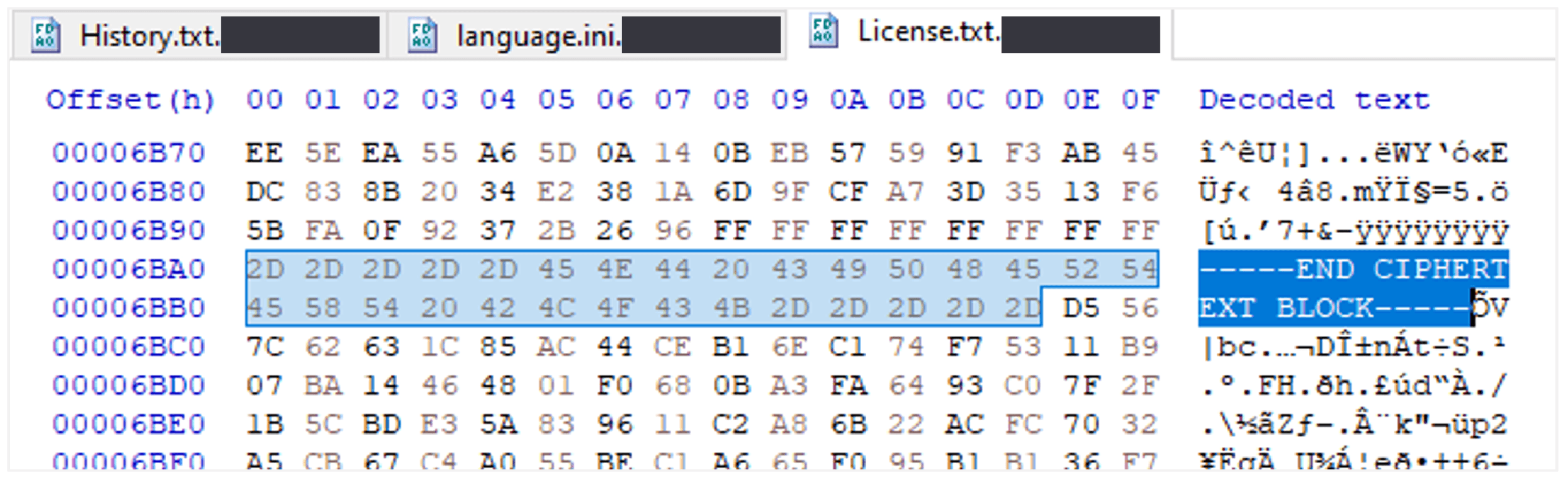
Figure 4. Encrypted file padding bytes followed by encrypted AES keys
Upon successful execution, the ransomware creates a ransom note with the file name README-XXXXXXX-XXXXXXXXXX.txt.
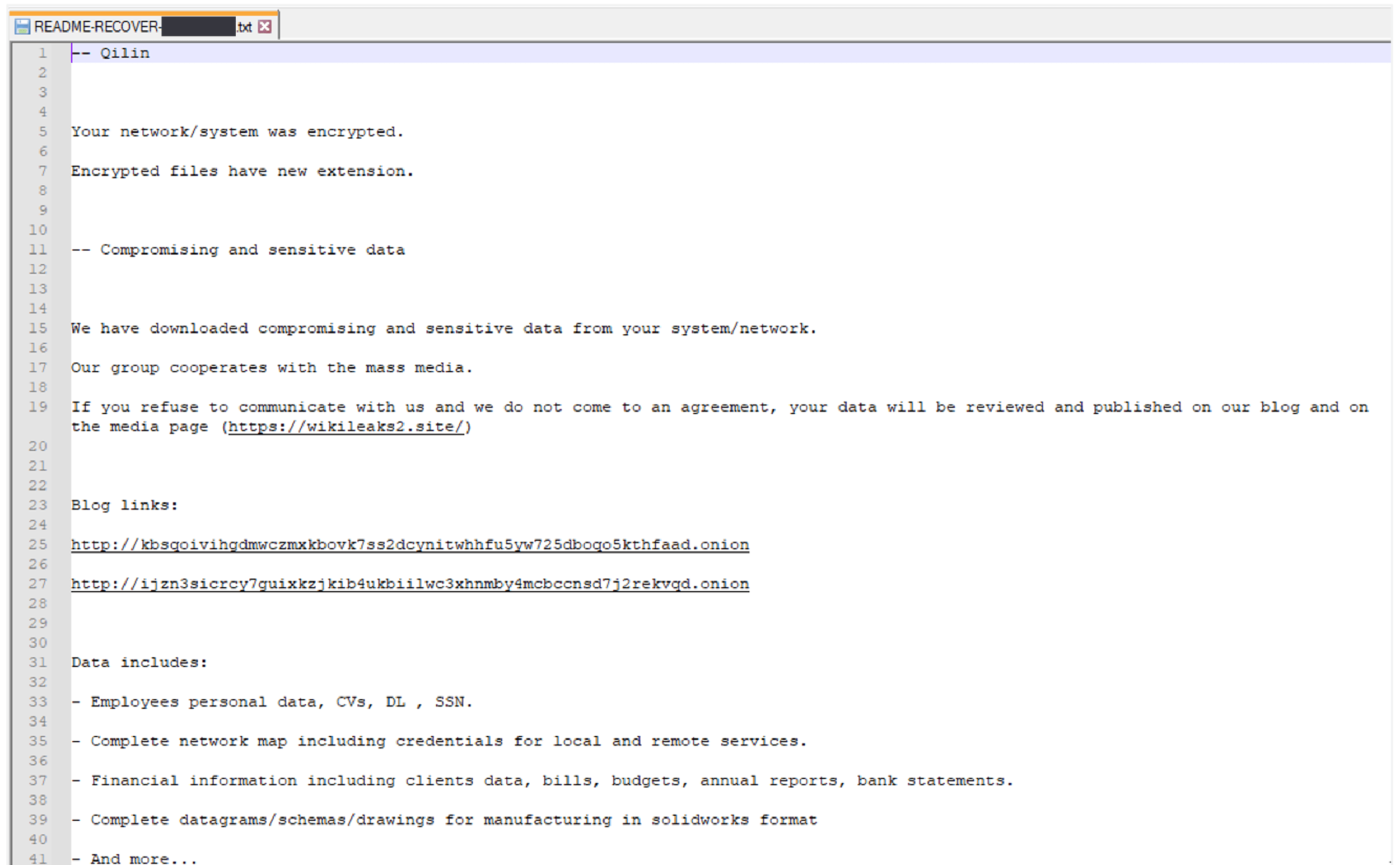
Figure 5. Screenshot showing a portion of the Qilin ransom note
Ransom note content:
-- Qilin Your network/system was encrypted. -- Compromising and sensitive data We have downloaded compromising and sensitive data from your system/network. Blog links: Data includes: -- Warning 1) If you modify files - our decrypt software won't able to recover data -- Recovery 1) Download tor browser: https://www.torproject[.]org/download/ Please note that communication with us is only possible via the website in the Tor browser, which is specified in this note. -- Credentials Extension: XXXXXXXXXX |
Modify Registry
The Windows registry is a database that stores configuration settings and values for the Windows operating system. It manages user preferences, installed software, system configurations, and more. Malware abuses the Windows registry to maintain persistence, hide its presence, disable security settings, and launch malicious scripts.
The QIlin ransomware performs a registry key modification to change the desktop wallpaper.
Registry Key | Value Name | Value Data |
|---|---|---|
Computer\HKEY_CURRENT_USER\SOFTWARE\Microsoft\Windows\CurrentVersion\Explorer\Wallpapers | BackgroundHistoryPath0 | C:\Users\Akxy\AppData\Local\Temp\jjAJrgQA.jpg |

Figure 6. Screenshot showing the registry modification
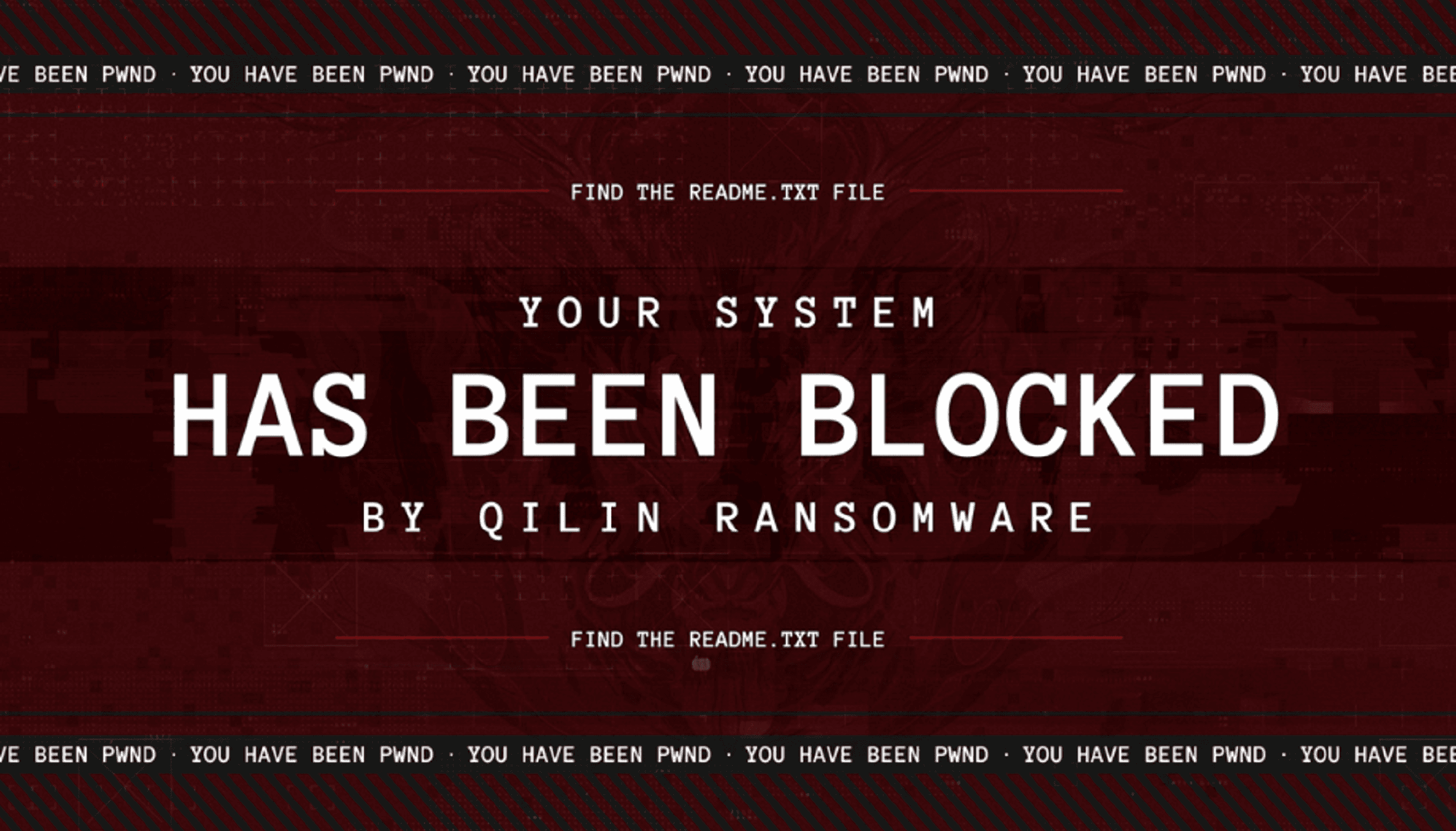
Figure 7. Wallpaper image content from the C:\Users\%USERNAME%\AppData\Local\Temp\jjAJrgQA.jpg file
The ransomware performs the following registry key modification to achieve persistence:
Registry Key | Value Name | Value Data |
|---|---|---|
Computer\HKEY_LOCAL_MACHINE\SOFTWARE\Microsoft\Windows\CurrentVersion\Run | *zgngnt | Qilin.exe --password XXXXXXXXXXXXX --no-admin --no-admin |

Figure 8. Screenshot showing the registry modification
Mutex
The mutex is the fundamental tool for managing shared resources between multiple threads or processes. Typically, malware uses a mutex to avoid reinfecting the victim system and causing multiple layers of encryption. The ransomware creates the following mutex value: c4eed3e3a7e1114c2864980024a9c68f88e647866a180835afafd5ef80da1afe

Figure 9. Screenshot of the mutex value created while debugging the ransomware
Network Activity
The ransomware did not try to communicate with a remote server other than encrypting data from mounted shares.
Indicator Removal
Windows Event Logs keep a record of a computer's alerts and notifications, and the ransomware clears these logs to hide its malicious activity. The following command was executed to clear the logs:
"powershell" $logs = Get-WinEvent -ListLog * | Where-Object {$_.RecordCount} | Select-Object -ExpandProperty LogName ; ForEach ( $l in $logs | Sort | Get-Unique ) {[System.Diagnostics.Eventing.Reader.EventLogSession]::GlobalSession.ClearLog($l)} |
File and Directory Modification
The ransomware uses the fsutil tool to redirect file system access to a different location after gaining access to compromised networks by executing the following commands:
"cmd" /C fsutil behavior set SymlinkEvaluation R2R:1 |
Indicators of Compromise
Indicator | Type | Context |
|---|---|---|
8d608d85e4785592857988c0cd749881a5e888e49e30b80ea90d214792547135 f910b2a6d84d0677cda9aefabfa4a45863ba51a8831588e3b527e8e1d3a9927c | SHA256 hash | Qilin ransomware |
C:\README-RECOVER-XXXXXXXXXX.txt | File path | Qilin ransom note |
.XXXXXXXXXX | Extension | Encrypted file extension example |
"cmd" /C vssadmin.exe delete shadows /all /quiet | Process | Volume Shadow Copy deletion and disabling of the Volume Shadow Copy (VSS) service |
"powershell" $logs = Get-WinEvent -ListLog * | Where-Object {$_.RecordCount} | Select-Object -ExpandProperty LogName ; ForEach ( $l in $logs | Sort | Get-Unique ) {[System.Diagnostics.Eventing.Reader.EventLogSession]::GlobalSession.ClearLog($l)} | Process | Clearing Windows event logs |
"cmd" /C fsutil behavior set SymlinkEvaluation R2R:1 | Process | File and directory permissions modification |
Key: Computer\HKEY_CURRENT_USER\SOFTWARE\Microsoft\Windows\CurrentVersion\Explorer\Wallpapers\ Name: BackgroundHistoryPath0 Data: C:\Users\%USERNAME%\AppData\Local\Temp\jjAJrgQA.jpg | Registry | Registry modification to display the Qilin ransomware desktop wallpaper image |
Key: Computer\HKEY_LOCAL_MACHINE\SOFTWARE\Microsoft\Windows\CurrentVersion\Run Name: *zgngnt Data: "C:\Users\%USERNAME%\Desktop\Qilin.exe" --password XXXXXXXXXXXXX --no-admin --no-admin | Registry | Registry modification to achieve persistence |
http://kbsqoivihgdmwczmxkbovk7ss2dcynitwhhfu5yw725dboqo5kthfaad[.]onion | URL | TA data leak site (DLS) |
Ransomware Configuration
=== START EMBEDDED CONFIGURATION === extension_black_list: ["themepack", "nls", "diapkg", "msi", "lnk", "exe", "scr", "bat", "drv", "rtp", "msp", "prf", "msc", "ico", "key", "ocx", "diagcab", "diagcfg", "pdb", "wpx", "hlp", "icns", "rom", "dll", "msstyles", "mod", "ps1", "ics", "hta", "bin", "cmd", "ani", "386", "lock", "cur", "idx", "sys", "com", "deskthemepack", "shs", "theme", "mpa", "nomedia", "spl", "cpl", "adv", "icl", "msu", "XXXXXXXXXX"] extension_white_list: ["mdf", "ldf", "bak", "vib", "vbk", "vbm", "vrb", "vmdk", "abk", "bkz", "sqb", "trn", "backup", "bkup", "old", "tibx", "pfi", "pvhd", "pbf", "dim", "gho", "vpcbackup", "arc", "mtf", "bkf", "dr"] filename_black_list: ["desktop.ini", "autorun.ini", "ntldr", "bootsect.bak", "thumbs.db", "boot.ini", "ntuser.dat", "iconcache.db", "bootfont.bin", "ntuser.ini", "ntuser.dat.log", "autorun.inf", "bootmgr", "bootmgr.efi", "bootmgfw.efi", "#recycle", "autorun.inf", "boot.ini", "bootfont.bin", "bootmgr", "bootmgr.efi", "bootmgfw.efi", "desktop.ini", "iconcache.db", "ntldr", "ntuser.dat", "ntuser.dat.log", "ntuser.ini", "thumbs.db", "#recycle", "bootsect.bak"] directory_black_list: ["windows", "system volume information", "intel", "admin$", "ipc$", "sysvol", "netlogon", "$windows.~ws", "application data", "mozilla", "program files (x86)", "program files", "$windows.~bt", "msocache", "tor browser", "programdata", "boot", "config.msi", "google", "perflogs", "appdata", "windows.old", "appdata", "..", ".", "boot", "windows", "windows.old", "$recycle.bin", "admin$"] win_services_black_list: ["vmms", "mepocs", "memtas", "veeam", "backup", "vss", "sql", "msexchange", "sophos", "msexchange", "msexchange\\$", "wsbexchange", "pdvfsservice", "backupexecvssprovider", "backupexecagentaccelerator", "backupexecagentbrowser", "backupexecdivecimediaservice", "backupexecjobengine", "backupexecmanagementservice", "backupexecrpcservice", "gxblr", "gxvss", "gxclmgrs", "gxcvd", "gxcimgr", "gxmmm", "gxvsshwprov", "gxfwd", "sapservice", "sap", "sap\\$", "sapd\\$", "saphostcontrol", "saphostexec", "qbcfmonitorservice", "qbdbmgrn", "qbidpservice", "acronisagent", "veeamnfssvc", "veeamdeploymentservice", "veeamtransportsvc", "mvarmor", "mvarmor64", "vsnapvss", "acrsch2svc", "(.*?)sql(.*?)"] |
Data Leak Site
The ransom note contains a data leak site (DLS) that, when accessed, displayed the following page, self-identifying the group as Qilin:
TOR DLS: ijzn3sicrcy7guixkzjkib4ukbiilwc3xhnmby4mcbccnsd7j2rekvqd[.]onion
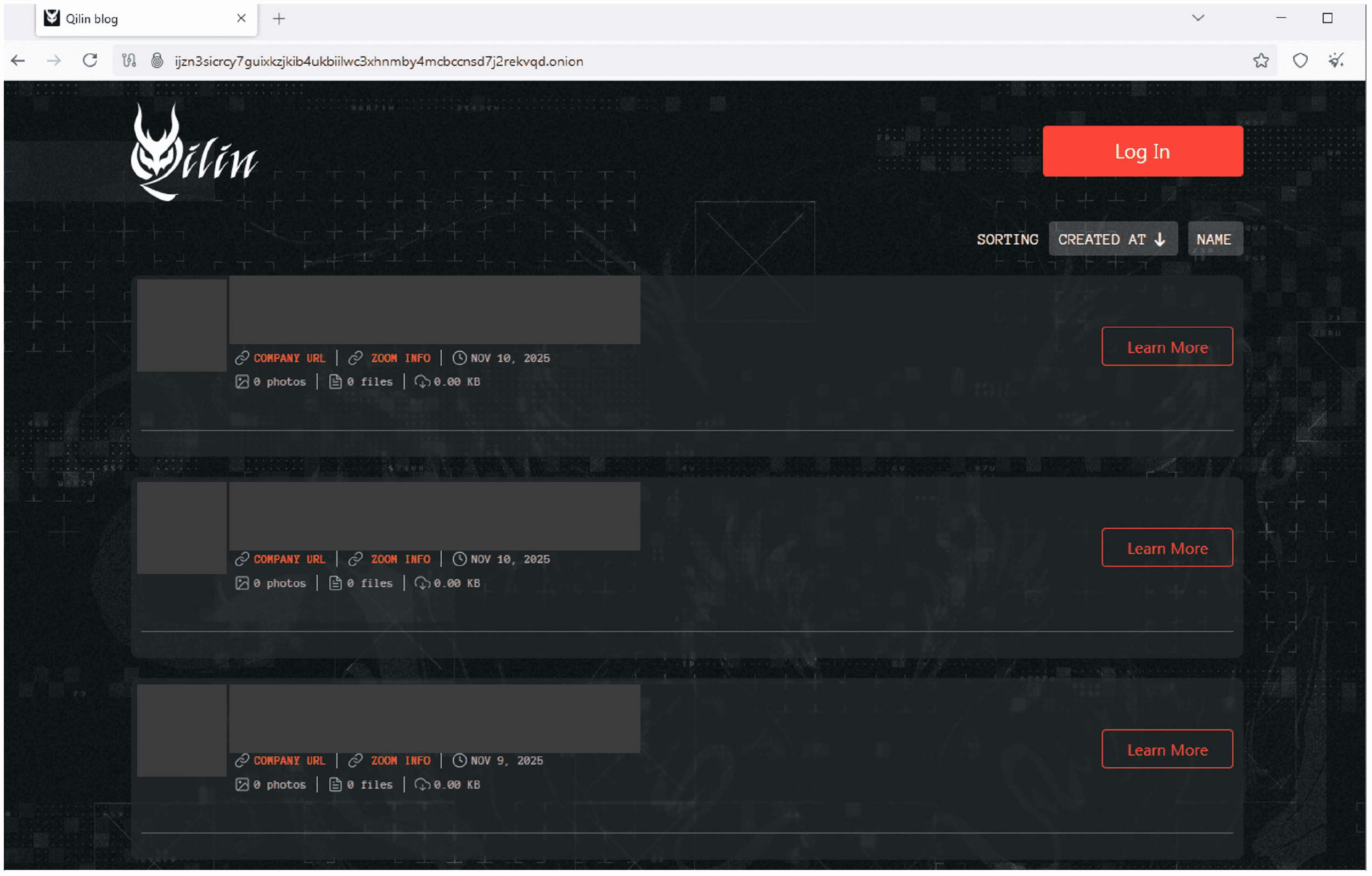
Figure 10. Tor DLS
Detection Mechanisms
Arete Bloktd℠ Rules
Arete Bloktd℠ includes expert threat analysis, crafted threat hunting queries, and active deployment of preventive rules for adversarial behaviors on SentinelOne® protected assets monitored by Arete.
SentinelOne® S1QL 2.0 Query Syntax
Qilin Ransomwareendpoint.os = 'windows' and event.category = 'process' and event.type = 'Process Creation' and src.process.cmdline matches '\\.exe {1,4}--password {1,4}[a-zA-Z0-9-]{32} {1,4}--no-admin' Note: This threat hunting query may need to be tuned for your specific network environment. |
|---|
Yara
rule Qilin_ransomware_executable strings: condition: |
|---|
Recommended Mitigations
Utilize an endpoint detection and response (EDR) solution with the capability to halt detected processes and isolate systems on the network based on identified conditions.
Block any known attacker C2s in the firewall.
Implement multi-factor authentication on RDP and VPN to restrict access to critical network resources.
Eliminate unnecessary RDP ports exposed to the internet.
Block a high number of SMB connection attempts from one system to others in the network over a short period of time.
Perform periodic dark web monitoring to verify if data is available for sale on the black market.
Perform penetration tests.
Periodically patch systems and update tools.
Monitor connections to the network from suspicious locations.
Monitor downloads and uploads of files to file-sharing services outside standard work hours.
Monitor file uploads from domain controllers to the internet.
Monitor network scans from uncommon servers (e.g., RDP server).
Organizations can find the full list of US government-recommended ransomware prevention and mitigation guidance here: https://www.cisa.gov/stopransomware/ransomware-guide.
Arete Advisors, LLC makes no claims, promises or guarantees about the accuracy, completeness, or adequacy of the contents of this report and expressly disclaims liability for errors and omissions in the content. Neither Arete Advisors, LLC, nor its employees and contractors make any warranty, express or implied or statutory, including but not limited to the warranties of non-infringement of third-party rights, title, and the warranties of merchantability and fitness for a particular purpose, with respect to content available from this report. Arete Advisors, LLC assumes no liability for any direct, indirect, or any other loss or damage of any kind for the accuracy, completely, or usefulness of any information, product, or process disclosed herein, and does not represent that the use of such information, product, or process would not infringe on privately owned rights. Information contained in this report is provided for educational purposes only and should not be considered as legal advice.
Article
Critical Vulnerability in Progress Kemp LoadMaster Exploited
Researchers have identified active exploitation of CVE-2026-8037, a critical unauthenticated remote code execution vulnerability affecting Progress Kemp LoadMaster. The vulnerability affects LoadMaster GA versions 7.2.63.1 and earlier and LTSF versions 7.2.54.17 and earlier and can allow a remote adversary to execute commands on an affected appliance without valid credentials when the vulnerable API is exposed. Progress has released updates addressing CVE-2026-8037 and CVE-2026-33691, a separate Web Application Firewall security control bypass, in GA 7.2.63.2 and LTSF 7.2.54.18.
The exploitation of this vulnerability reflects a broader trend of threat actors targeting internet-facing enterprise technologies. For example, Progress MOVEit Transfer experienced significant scanning and exploitation activity in 2025 involving CVE-2023-34362 and CVE-2023-36934, as well as the 2023 exploitation of CVE-2023-34362 by the Cl0p ransomware group for large-scale data theft and extortion. More recently, CISA confirmed the exploitation of SonicWall SMA1000 vulnerabilities, CVE-2026-15409 and CVE-2026-15410, by ransomware groups. Collectively, these incidents demonstrate the continued targeting of perimeter-facing enterprise technologies as high-value entry points into corporate environments.
What’s Notable and Unique
Public exploit research, observed exploitation attempts, and CISA KEV inclusion indicate that CVE-2026-8037 has progressed into an active operational threat, increasing urgency for organizations with exposed and unpatched LoadMaster systems.
Internet-facing infrastructure can be rapidly identified through automated scanning, enabling threat actors to quickly identify vulnerable systems and capitalize on newly disclosed vulnerabilities and publicly available exploit techniques.
Analyst Comments
CVE-2026-8037 is significant not only for its severity but also because it affects infrastructure positioned between the internet and critical enterprise applications. The combination of external exposure, unauthenticated exploitation, and public exploit research lowers the barrier for threat actors seeking initial access, and the broader threat landscape reinforces this concern. The exploitation of Progress MOVEit by Cl0p, continued scanning activity against MOVEit, and recent ransomware exploitation of SonicWall SMA1000 vulnerabilities demonstrate sustained adversarial interest in perimeter-facing enterprise technologies. These incidents indicate that such infrastructure should be treated as high-value assets within enterprise security programs.
Sources
Surge in MOVEit Transfer Scanning Could Signal Emerging Threat Activity
LoadMaster Critical Security Bulletin – June 2026 – (CVE-2026-8037, CVE-2026-33691)
Enterprise Tech In, Shell Out (Progress Kemp LoadMaster Uninitialized Heap to Pre-Auth RCE CVE-2026-8037)
CISA: SonicWall SMA1000 flaws now exploited by ransomware gangs

Podcast
Blockchain Unmasked: The Role of Cryptocurrency in Cybercrime and Threat Intelligence
In this episode of Bytes of Insight, host Vinny Sakore sits down with John Morrissey, Arete’s Director of Cryptocurrency Operations and Sanctions Compliance, and Trenton Howard, Arete’s Lead Threat Intelligence Consultant, to discuss cryptocurrency and blockchain technology. They explore the impact of cryptocurrency on both innovation and cybercrime, threat actors’ use of the blockchain for ransom payments, and Arete’s patent-pending Compliance and Sanctions Analysis Process.

Article
ClickFix Evolves in Server-Side Polymorphic Malware Delivery Campaigns
The ClickFix social engineering technique has significantly evolved from a relatively simple malware delivery mechanism into a highly sophisticated, evasive attack framework. Initially relying on straightforward PowerShell downloaders and disk-based payloads, the campaign now employs fileless execution, advanced obfuscation techniques, and server-side polymorphism to evade traditional security controls.
What’s Notable and Unique
ClickFix primarily relies on social engineering, as victims are presented with fake CAPTCHA verification pages that imitate trusted services such as Cloudflare or Google reCAPTCHA. Users are instructed to copy and execute a PowerShell command, believing they are completing a legitimate verification process. Instead, the command initiates the malware infection chain.
To bypass traditional security tools, threat actors transitioned to fileless techniques. Instead of downloading scripts directly to disk, newer variants execute malicious code entirely in memory. The most notable recent advancement in ClickFix is the adoption of server-side polymorphism. Unlike traditional malware that delivers a static payload, the threat actor's server dynamically generates unique payloads for each victim request. This approach undermines signature-based detection methods because each delivered payload appears unique, preventing defenders from relying solely on file hashes or static indicators.
The campaign was observed beginning around March 25, 2026, with a significant increase in activity thereafter, indicating that the techniques are proving effective against many organizations' defenses.
Analyst Comments
ClickFix social engineering campaigns continue to evolve in 2026, becoming more sophisticated and expanding across multiple operating systems. Organizations should focus on behavioral detection, browser isolation, endpoint monitoring, and user awareness training rather than relying solely on indicators such as hashes or blocklists. The campaign's use of fake CAPTCHA prompts also reinforces the importance of educating users never to execute commands from websites.
Sources
The Evolution of ClickFix: From Cleartext to Server Side Polymorphism
Article
Adversarial AI Evolves from Prompting to Autonomous Attack Workflows
Cybercriminals and state-linked threat actors are increasingly incorporating artificial intelligence (AI) into multiple stages of offensive operations. Rather than relying on AI only for content generation or research, threat actors are now consistently using it to support reconnaissance, vulnerability discovery, credential theft, malware development, social engineering, and activities following initial compromise. The growing use of automated and agent-based workflows is allowing adversaries to coordinate offensive malicious activities with less manual involvement, potentially increasing the speed, scale, and efficiency of future campaigns.
What’s Notable and Unique
In one observed campaign, threat actors used AI to plan, build, and conduct an automated credential-harvesting operation within just several hours, demonstrating how compromised infrastructure can be rapidly repurposed to support larger-scale malicious activity.
Arete has observed several threat groups using AI-assisted capabilities to facilitate the analysis of data obtained during exfiltration so far this year, including INC Ransom, FulcrumSec, and Settra.
Attackers are also attempting to reproduce proprietary AI capabilities. Large-scale automated prompting campaigns have been used to extract information about the behavior and capabilities of proprietary AI models. The use of numerous accounts and intermediary infrastructure can make these activities more difficult to identify and attribute.
Analyst Comments
AI is increasingly becoming an operational component in the threat landscape rather than simply a tool that improves attacker productivity. By connecting reconnaissance, development, credential operations, and other activities through automated workflows, threat actors can conduct campaigns more quickly and reduce reliance on continuous human input. This trend also impacts security requirements for organizations deploying AI technologies. AI models, development environments, cloud resources, identities, repositories, and automated workflows should increasingly be considered interconnected elements of the enterprise attack surface, and organizations should maintain visibility across these areas and ensure that security controls account for both conventional threats and AI-enabled attack techniques.
Sources
GTIG AI Threat Tracker: From Prompting to Autonomy – The Evolution of Adversarial AI
Article
Top 9 Security Controls for SMBs
In today’s complex cyber threat landscape, small and medium-sized businesses (SMBs) should implement a layered, multi-pronged approach to security. Here are some proven, effective controls to consider:
1. Implement MFA for All Users
Multi-factor authentication (MFA) is an effective and accessible way to protect sensitive data, comply with regulatory standards, and prevent unauthorized access to critical systems. By ensuring that users not only use a password but also a secure token, an organization can significantly reduce phishing attempts, credential stuffing attacks, and ransomware incidents. MFA should be enabled for email, VPN, and critical system access.
2. Update Patch Management Programs
A modern patching program should include policies and mechanisms to manage software updates in a timely manner. Patching efforts should address not just operating system updates, but also commonly utilized software within the environment. An active patching plan aims to reduce the mean time to patch and provide metrics on existing patch efforts. In the event of a high-severity vulnerability, a mature patching program should also be able to identify the risks and exposure for a given set of systems based on the average time to patch. This helps stakeholders make informed decisions when a new exploit is released.
3. Leverage a Properly Managed Endpoint Detection and Response (EDR) Tool
With real-time threat detection and advanced visibility, endpoint detection and response (EDR) solutions can enhance an organization’s ability to detect and investigate potential malicious activity, including ransomware, lateral movement, fileless attacks, and more. Effective management of EDR should include proper configuration, regular agent updates, and established procedures for responding to alerts.
4. Enhance EDR with Frontline Incident Intelligence
While EDR solutions are an important component of a security program, threat actors are continually adapting their techniques to evade detection, and as a result, standard detection methods may not always identify emerging threats or novel attack behaviors. To strengthen protection, organizations can supplement EDR tools with custom detection rules informed by incident response data. These rules can help identify indicators of compromise observed during cyber incidents, providing an additional layer of visibility beyond traditional detections.
Arete Bloktd℠ illustrates this approach by transforming threat intelligence and malware analysis into curated detection rules for EDR tools. Applying frontline intelligence to security tools can result in earlier detection, less investigative burden, and a more confident response.
5. Create and Continuously Test an Incident Response (IR) Plan
An incident response plan can help an organization effectively identify, respond to, and recover from a cybersecurity incident while minimizing disruption and downtime. An IR plan defines clear roles, escalation paths, communication strategies, and decision frameworks for both internal and external teams. To be effective, these plans should be regularly tested with post-incident reviews or tabletop exercises involving key stakeholders.
6. Maintain Encrypted and Tested Data Backups
In the case of a cyberattack, backups can help organizations maintain business continuity, support ransom negotiations with threat actors, and contribute to a timely and successful recovery. Encrypting backups makes it more difficult for threat actors to access or alter them, and regular testing ensures they remain accessible during a security incident.
7. Conduct Employee Security Awareness Training
Human error is a leading cause of cybersecurity incidents, and an organization’s employees are its first line of defense against cyber threats. Security awareness training reinforces the importance of data confidentiality, supports regulatory compliance, and helps employees recognize and understand red flags such as suspicious emails, malicious links, and social engineering attempts.
8. Assess and Address Existing Risk and Vulnerabilities
To maintain a proactive approach to risk management and improve resilience, organizations should regularly assess existing vulnerabilities through expert-led Vulnerability Assessments, Penetration Testing, and Threat Hunting Assessments. These exercises can help identify security gaps, support regulatory compliance, and prevent potential incidents. During remediation, prioritize high-impact vulnerabilities and make a plan for periodic assessments.
9. Apply Least-Privilege Access Controls
Employees should have access only to the systems, applications, and data necessary to perform their jobs. By removing unnecessary administrative privileges and regularly reviewing user permissions, organizations can reduce the risk of unauthorized access and limit the damage caused by compromised accounts or insider threats.
Organizations should regularly review their cybersecurity programs, stay informed about emerging threats, and evaluate whether their security controls are adapting to the evolving threat landscape.
Article
Ransomware Trends & Data Insights: August 2026
Although INC Ransom was the most active ransomware threat group observed in August 2026, overall activity remained relatively distributed across the threat landscape, with approximately 30 unique ransomware and extortion groups, including both established and newly emerged actors, observed during the month. Alongside INC Ransom, Storm, DragonForce, Qilin, and The Gentlemen were among the top five most active threat groups, underscoring the continued diversity and competitiveness of the ransomware ecosystem.
Figure 1. Activity from the top 5 threat groups in August 2026
Throughout the month, analysts at Arete identified several trends behind the threat actors perpetrating cybercrime activities:
August 2026 was a significant month for the emergence of new threat actors, with Arete identifying several previously untracked ransomware groups, including Storm, Dark Project, DireWolf, Morpheus, Orova, Spirals, Wallstreet Team, and Zawoo Team. This trend underscores the ongoing evolution of the threat landscape and the low barriers to entry for new cybercriminal operations.
Arete observed a continued use of AI-enabled capabilities across the ransomware ecosystem during August. Similar to Fulcrumsec and Setra, the newly emerged Zawoo Team appears to leverage AI-assisted analysis of stolen data, publishing highly structured and detailed victim assessments on its data leak site (DLS). Additionally, both the Aurora and Storm ransomware groups have been observed utilizing AI-driven or AI-assisted chat representatives during victim communications. These developments suggest that threat actors are increasingly incorporating AI to enhance data analysis, automate victim engagement, and improve the effectiveness and scalability of extortion operations.
In August, Arete also observed that despite sustained law enforcement disruption efforts, LockBit continues to demonstrate operational resilience, likely through the expansion of its affiliate ecosystem and the evolution of its tactics. Recent activity indicates an increased reliance on data theft and exfiltration-only operations, with observed victimology suggesting a notable focus on organizations within the financial sector.
Sources
Arete Internal
Report
Arete's H1 2026 Crimeware Report
Explore intelligence and operational data from the frontlines of ransomware and extortion response as we detail the most significant trends and developments in the cyber threat landscape in the first half (H1) of 2026.
Article
WinRAR Path-Traversal Vulnerability Exploited in Ransomware Attacks
CISA has warned that CVE-2025-8088, a path-traversal vulnerability in WinRAR, is being exploited in ransomware attacks. The vulnerability allows attackers to use specially crafted archive files to place malicious executables in locations such as the Windows Startup folder, enabling code execution when the system restarts. WinRAR addressed this vulnerability in version 7.13, but exploitation has continued due to challenges in updating the software. CISA's updated KEV entry now specifically identifies the vulnerability as being used in ransomware attacks.
What’s Notable and Unique
The vulnerability was initially exploited as a zero-day by the Russia-linked RomCom group, enabling malware execution at user logon and supporting credential theft, cyberespionage, and ransomware-related activities.
CVE-2025-8088 continues to be actively exploited by both government-backed and financially motivated threat actors. Observed campaigns have been attributed to Russian- and Chinese-linked groups targeting several organizations.
Phishing campaigns leveraging weaponized RAR attachments exploited CVE-2025-8088 to silently place malicious payloads in autorun locations using directory traversal and Alternate Data Streams (ADS).
The widespread exploitation of CVE-2025-8088 highlights strong demand for effective WinRAR exploits, with multiple underground vendors previously supplying exploit capabilities to a diverse range of threat actors. One such vendor, zeroplayer, advertised a WinRAR exploit in July 2025.
Analyst Comments
Organizations should immediately upgrade WinRAR to version 7.13 or later and conduct an enterprise-wide inventory to identify unmanaged installations. Given that WinRAR lacks automatic updates, Group Policy support, and integration with common enterprise patch management platforms, manual verification and remediation may be required to ensure all vulnerable instances are addressed. Security teams should also enhance defenses against archive-based phishing attacks by blocking or scrutinizing unsolicited compressed files, monitoring for suspicious file creation in Windows Startup directories, and detecting abuse of ADS. With CISA now linking CVE-2025-8088 to ransomware activity, organizations should treat remediation as a high priority and actively monitor for indicators of WinRAR-based exploitation across their environments.
Sources
CISA Adds Three Known Exploited Vulnerabilities to Catalog
WinRAR vulnerability being exploited in ransomware attacks, CISA warns
Report
Malware Spotlight: Qilin Ransomware
Executive Summary
Over the past few years, Arete’s Incident Response (IR) team has responded to more than one hundred incidents attributed to the Qilin ransomware group. Active since October 2022 under a different name (Agenda), the group had an increase in activity at the beginning of 2025, especially during the second quarter, when it was the most active threat group. Notably, most of its activity came in June 2025, as the group exploited vulnerabilities in Fortinet’s FortiGate appliances and reportedly attempted to recruit ex-RansomHub affiliates. In the first quarter of 2026, the group remained the second most active extortion group behind Akira and actively targeted WatchGuard Firebox devices for initial access, particularly those vulnerable to CVE-2025-14733, a critical vulnerability in WatchGuard Fireware OS that allows a remote, unauthenticated threat actor to execute arbitrary code.
This spotlight explores the ransomware group’s observed behavior, background information on the threat actor, and statistics from Incident Response engagements, along with a technical analysis of Qilin’s ransomware executable. Finally, we discuss security recommendations to better defend against this evolving cyber threat and mitigate the risk of financial and reputational losses. For more insights and data on Qilin and other top threat groups, explore Arete’s Q1 2026 Crimeware Report.
Incident Response Data on the Qilin Ransomware Group
The information below is based on Arete engagements attributed to Qilin since August 2023. Our IR, Threat Intelligence, and Data Analytics teams work together to analyze key data points during every ransomware engagement and form real-time threat actor (TA) insights.
Impacted sectors include professional services, public services, healthcare, financial services, manufacturing, high technology, retail, and hospitality.
The median initial ransom demand is $400,000.
Tools observed during investigations include Mimikatz, Lazagne, FGDump, PsExec, Splashtop, Mesh Agent, Atera, ScreenConnect Client, AnyDesk, SoftPerfect Network Scanner (Netscan), Advanced Port Scanner, WinRAR, WinSCP, FileZilla, Putty, Rclone, and MEGAsync.
Qilin-affiliated actors often exploit edge device vulnerabilities or use legitimate credentials.
The group operates a TOR data leak site (DLS), where it self-identifies as Qilin and commonly threatens to release stolen data if a payment is not made.
The ransom note identifies the group as Qilin and contains links to its data leak and chat negotiation sites. To initiate negotiations, login credentials are included in the ransom note. Part of the ransom note filename matches the encrypted file extension as a naming convention.
In addition to encrypting files and creating a ransom note, the Qilin ransomware requires a password to execute properly, supports various command-line arguments, deletes volume shadow copies, clears the Windows Event Logs, and creates a desktop wallpaper displaying information about the encryption event.
Background
Arete first observed Qilin in incident response engagements in 2023. Over time, the group evolved into an increasingly sophisticated and notable ransomware operation, becoming the top threat group in Q2 of 2025 and the second-most active, after Akira, in Q3 and Q4 of 2025 and Q1 of 2026.
TOP THREAT GROUPS OBSERVED BY QUARTER
Figure 1: Top threat groups observed by Arete by quarter
Qilin impacts a broad range of organizations throughout North America and often lists victims that fail to reach a negotiation agreement on its data leak site. The group maintains Windows and Linux versions of its ransomware, and the most recently observed Windows-based version was developed in the Rust programming language. Qilin has been observed exploiting vulnerabilities in Fortinet appliances as an initial access vector.
In 2025, Qilin broadened its RaaS platform by introducing a “Call Lawyer” negotiation-support feature, through which affiliates can request assistance from individuals that Qilin portrays as an internal legal team when victims delay or resist negotiations. The goal is to provide affiliates with tactics that pressure victims into believing that non-compliance could lead to regulatory scrutiny, fines, or even criminal exposure. Additionally, the platform offers affiliates more aggressive coercion methods, such as launching distributed denial of service (DDoS) attacks against victim websites.
Technical Analysis
Malware analysis revealed that Qilin ransomware:
Supports multiple command-line arguments.
Requires the correct password to fully encrypt files.
Appends a file extension to all encrypted files; however, the extension is not static. Instead, it is randomly generated for each incident. As an example, this report uses the extension XXXXXXXXX (e.g., file.docx.XXXXXXXXX).
Generates a ransom note with a filename that incorporates the same randomized extension value used during encryption. Continuing the example above, the ransom note was named README-RECOVER-XXXXXXXXXX.txt, where XXXXXXXXXX corresponds to the unique extension assigned in this incident.
Self-identifies the group as Qilin in the ransom note.
References a data leak site in the ransom note that, when accessed, also self-identifies the group as Qilin.
Kills a list of processes and services.
Clears Windows event logs.
Maintains a list of whitelisted files and directories to ensure the system does not become unusable, preventing recovery when running a decryptor.
Attempts to prevent system recovery by deleting the system's volume shadow copies.
Creates a mutex during execution.
Creates an image file in the %Temp% directory and later modifies a registry key to change the desktop wallpaper.
Creates log files in a QLOG directory created in %TEMP% (e.g., ThreadId(1).LOG).
Has a well-defined ransomware configuration with various fields like company_id, accounts, note, password_hash, directory_black_list, file_ black_list, process_black_list, and file_pattern_black_list.
Execution Pattern/Arguments
Qilin ransomware will not execute in the system without the correct “--password” argument.
Example of the command to run the executable:
Qilin.exe --password XXXXXXXXXXXXX --no-admin |
Screenshot of the ransomware execution in the command prompt with the password argument redacted:
Figure 2. Ransomware execution in command prompt
List commands supported by the Qilin ransomware analyzed:
Command Line Parameters | Description |
|---|---|
--password | Required to start program. Reads password from password.txt. |
--spread | Spreads to Windows hosts using login credentials. Does not encrypt local machine. |
--spread-vcenter | Distributes payload to ESXi/vCenter hosts and installs modules. No local encryption. |
--no-admin | Disables admin rights check. |
--no-priority | Disables CPU and IO priority settings. |
--no-extension | Prevents file extension change during encryption. |
--no-note | Disables ransom note saving in folders. |
--timer | Delays execution by specified seconds. |
--paths | Encrypts only specified paths/directories. |
--ips | Encrypts only network resources on specified IPs or hosts. |
--no-ef | Disables file extension filtering. |
--no-ff | Disables file name/type filtering. |
--no-df | Disables directory filtering. |
--no-proc | Disables process killer functionality. |
--no-services | Disables service killer functionality. |
--no-vm | Disables virtual machine detection and related kills. |
--no-sandbox | Disables sandbox detection logic. |
--kill-cluster | Enables destruction of cluster environments. |
--safe | Reboots to safe mode, enables autologin, and begins encryption. |
--no-autostart | Prevents self-autostart configuration. |
--no-wallpaper | Prevents wallpaper or lockscreen changes. |
--no-destruct | Prevents self-destruction after execution. |
--no-zero | Disables wiping of free disk space post-encryption. |
--no-local | Skips encryption of local volumes. |
--no-mounted | Skips encryption of mounted shares and network shortcuts. |
--no-domain | Skips host discovery in domain networks. |
--no-network | Skips host discovery in the entire subnet. |
--exclude | Skips specified hosts/IPs from encryption and scanning. |
--print-image | Prints a message to all available printers post-encryption. |
--print-delay | Sets delay before printing with --print-image. |
--force | Allows multiple instances by skipping mutex creation. |
--no-logs | Disables writing of log files. |
--logs | Collects and archives logs to local directory. |
--dry-run | Runs encryption simulation without modifying files. |
Stop Services and Processes
Before file encryption, the ransomware terminates a pre-determined list of processes and services to encrypt as many files as possible.
Process names:
vmms, vmwp, vmcompute, agntsvc, dbeng50, dbsnmp, encsvc, excel, firefox, infopath, isqlplussvc, sql, msaccess, mspub, mydesktopqos, mydesktopservice, notepad, ocautoupds, ocomm, ocssd, onenote, oracle, outlook, powerpnt, sqbcoreservice, steam, synctime, tbirdconfig, thebat, thunderbird, visio, winword, wordpad, xfssvccon, bedbh, vxmon, benetns, bengien, pvlsvr, beserver, raw_agent_svc, vsnapvss, cagservice, qbidpservice, qbdbmgrn, qbcfmonitorservice, sap, teamviewer_service, teamviewer, tv_w32, tv_x64, cvmountd, cvd, cvfwd, cvods, saphostexec, saposcol, sapstartsrv, avagent, avscc, dellsystemdetect, enterpriseclient, veeamnfssvc, veeamtransportsvc, veeamdeploymentsvc, mvdesktopservice |
Service names:
vmms, mepocs, memtas, veeam, backup, vss, sql, msexchange, sophos, msexchange, msexchange\\$, wsbexchange, pdvfsservice, backupexecvssprovider, backupexecagentaccelerator, backupexecagentbrowser, backupexecdivecimediaservice, backupexecjobengine, backupexecmanagementservice, backupexecrpcservice, gxblr, gxvss, gxclmgrs, gxcvd, gxcimgr, gxmmm, gxvsshwprov, gxfwd, sapservice, sap, sap\\$, sapd\\$, saphostcontrol, saphostexec, qbcfmonitorservice, qbdbmgrn, qbidpservice, acronisagent, veeamnfssvc, veeamdeploymentservice, veeamtransportsvc, mvarmor, mvarmor64, vsnapvss, acrsch2svc, (.*?)sql(.*?) |
File and Directory Exclusions
The ransomware excludes system-related files and folders, ransomware-related files, and whitelisted extensions during encryption.
Excluded file extensions:
themepack, nls, diapkg, msi, lnk, exe, scr, bat, drv, rtp, msp, prf, msc, ico, key, ocx, diagcab, diagcfg, pdb, wpx, hlp, icns, rom, dll, msstyles, mod, ps1, ics, hta, bin, cmd, ani, 386, lock, cur, idx, sys, com, deskthemepack, shs, theme, mpa, nomedia, spl, cpl, adv, icl, msu, XXXXXXXXXX |
Excluded directories:
windows, system volume information, intel, admin$, ipc$, sysvol, netlogon, $windows.~ws, application data, mozilla, program files (x86), program files, $windows.~bt, msocache, tor browser, programdata, boot, config.msi, google, perflogs, appdata, windows.old, appdata, .., ., boot, windows, windows.old, $recycle.bin, admin$ |
Excluded files:
desktop.ini, autorun.ini, ntldr, bootsect.bak, thumbs.db, boot.ini, ntuser.dat, iconcache.db, bootfont.bin, ntuser.ini, ntuser.dat.log, autorun.inf, bootmgr, bootmgr.efi, bootmgfw.efi, #recycle, autorun.inf, boot.ini, bootfont.bin, bootmgr, bootmgr.efi, bootmgfw.efi, desktop.ini, iconcache.db, ntldr, ntuser.dat, ntuser.dat.log, ntuser.ini, thumbs.db, #recycle, bootsect.bak |
Inhibit System Recovery
Windows operating systems contain features that can help fix corrupted system files, including shadow copies, which are backups of files created by the Volume Shadow Copy Service (VSS). By deleting shadow copies, the ransomware can prevent victims from restoring files from backups, making it more difficult for them to recover their data without paying the ransom.
The ransomware deletes volume shadow copies and disables the Windows Volume Shadow Copy Service (VSS) before file encryption by starting the following processes:
wmic service where name='vss' call ChangeStartMode Manual |
System Network Connections Discovery
Qilin ransomware can enumerate network-mounted shares by scanning the network interfaces.
Data Encrypted for Impact
The ransomware initially finds available drives, then loads the files one by one using the Windows APIs “FindFirstFileW“ and “FindNextFileW”. The ransomware generates random AES keys to encrypt the files, then encrypts the AES keys using a public RSA key. The resulting key is placed at the end of the file.
The ransomware encrypts files, adds a randomized extension to the encrypted files, and appends the following bytes towards the end of each file.
-----END CIPHERTEXT BLOCK----- |
Figure 3. “.XXXXXXXXXX” extension added to the encrypted files
Figure 4. Encrypted file padding bytes followed by encrypted AES keys
Upon successful execution, the ransomware creates a ransom note with the file name README-XXXXXXX-XXXXXXXXXX.txt.
Figure 5. Screenshot showing a portion of the Qilin ransom note
Ransom note content:
-- Qilin Your network/system was encrypted. -- Compromising and sensitive data We have downloaded compromising and sensitive data from your system/network. Blog links: Data includes: -- Warning 1) If you modify files - our decrypt software won't able to recover data -- Recovery 1) Download tor browser: https://www.torproject[.]org/download/ Please note that communication with us is only possible via the website in the Tor browser, which is specified in this note. -- Credentials Extension: XXXXXXXXXX |
Modify Registry
The Windows registry is a database that stores configuration settings and values for the Windows operating system. It manages user preferences, installed software, system configurations, and more. Malware abuses the Windows registry to maintain persistence, hide its presence, disable security settings, and launch malicious scripts.
The QIlin ransomware performs a registry key modification to change the desktop wallpaper.
Registry Key | Value Name | Value Data |
|---|---|---|
Computer\HKEY_CURRENT_USER\SOFTWARE\Microsoft\Windows\CurrentVersion\Explorer\Wallpapers | BackgroundHistoryPath0 | C:\Users\Akxy\AppData\Local\Temp\jjAJrgQA.jpg |
Figure 6. Screenshot showing the registry modification
Figure 7. Wallpaper image content from the C:\Users\%USERNAME%\AppData\Local\Temp\jjAJrgQA.jpg file
The ransomware performs the following registry key modification to achieve persistence:
Registry Key | Value Name | Value Data |
|---|---|---|
Computer\HKEY_LOCAL_MACHINE\SOFTWARE\Microsoft\Windows\CurrentVersion\Run | *zgngnt | Qilin.exe --password XXXXXXXXXXXXX --no-admin --no-admin |
Figure 8. Screenshot showing the registry modification
Mutex
The mutex is the fundamental tool for managing shared resources between multiple threads or processes. Typically, malware uses a mutex to avoid reinfecting the victim system and causing multiple layers of encryption. The ransomware creates the following mutex value: c4eed3e3a7e1114c2864980024a9c68f88e647866a180835afafd5ef80da1afe
Figure 9. Screenshot of the mutex value created while debugging the ransomware
Network Activity
The ransomware did not try to communicate with a remote server other than encrypting data from mounted shares.
Indicator Removal
Windows Event Logs keep a record of a computer's alerts and notifications, and the ransomware clears these logs to hide its malicious activity. The following command was executed to clear the logs:
"powershell" $logs = Get-WinEvent -ListLog * | Where-Object {$_.RecordCount} | Select-Object -ExpandProperty LogName ; ForEach ( $l in $logs | Sort | Get-Unique ) {[System.Diagnostics.Eventing.Reader.EventLogSession]::GlobalSession.ClearLog($l)} |
File and Directory Modification
The ransomware uses the fsutil tool to redirect file system access to a different location after gaining access to compromised networks by executing the following commands:
"cmd" /C fsutil behavior set SymlinkEvaluation R2R:1 |
Indicators of Compromise
Indicator | Type | Context |
|---|---|---|
8d608d85e4785592857988c0cd749881a5e888e49e30b80ea90d214792547135 f910b2a6d84d0677cda9aefabfa4a45863ba51a8831588e3b527e8e1d3a9927c | SHA256 hash | Qilin ransomware |
C:\README-RECOVER-XXXXXXXXXX.txt | File path | Qilin ransom note |
.XXXXXXXXXX | Extension | Encrypted file extension example |
"cmd" /C vssadmin.exe delete shadows /all /quiet | Process | Volume Shadow Copy deletion and disabling of the Volume Shadow Copy (VSS) service |
"powershell" $logs = Get-WinEvent -ListLog * | Where-Object {$_.RecordCount} | Select-Object -ExpandProperty LogName ; ForEach ( $l in $logs | Sort | Get-Unique ) {[System.Diagnostics.Eventing.Reader.EventLogSession]::GlobalSession.ClearLog($l)} | Process | Clearing Windows event logs |
"cmd" /C fsutil behavior set SymlinkEvaluation R2R:1 | Process | File and directory permissions modification |
Key: Computer\HKEY_CURRENT_USER\SOFTWARE\Microsoft\Windows\CurrentVersion\Explorer\Wallpapers\ Name: BackgroundHistoryPath0 Data: C:\Users\%USERNAME%\AppData\Local\Temp\jjAJrgQA.jpg | Registry | Registry modification to display the Qilin ransomware desktop wallpaper image |
Key: Computer\HKEY_LOCAL_MACHINE\SOFTWARE\Microsoft\Windows\CurrentVersion\Run Name: *zgngnt Data: "C:\Users\%USERNAME%\Desktop\Qilin.exe" --password XXXXXXXXXXXXX --no-admin --no-admin | Registry | Registry modification to achieve persistence |
http://kbsqoivihgdmwczmxkbovk7ss2dcynitwhhfu5yw725dboqo5kthfaad[.]onion | URL | TA data leak site (DLS) |
Ransomware Configuration
=== START EMBEDDED CONFIGURATION === extension_black_list: ["themepack", "nls", "diapkg", "msi", "lnk", "exe", "scr", "bat", "drv", "rtp", "msp", "prf", "msc", "ico", "key", "ocx", "diagcab", "diagcfg", "pdb", "wpx", "hlp", "icns", "rom", "dll", "msstyles", "mod", "ps1", "ics", "hta", "bin", "cmd", "ani", "386", "lock", "cur", "idx", "sys", "com", "deskthemepack", "shs", "theme", "mpa", "nomedia", "spl", "cpl", "adv", "icl", "msu", "XXXXXXXXXX"] extension_white_list: ["mdf", "ldf", "bak", "vib", "vbk", "vbm", "vrb", "vmdk", "abk", "bkz", "sqb", "trn", "backup", "bkup", "old", "tibx", "pfi", "pvhd", "pbf", "dim", "gho", "vpcbackup", "arc", "mtf", "bkf", "dr"] filename_black_list: ["desktop.ini", "autorun.ini", "ntldr", "bootsect.bak", "thumbs.db", "boot.ini", "ntuser.dat", "iconcache.db", "bootfont.bin", "ntuser.ini", "ntuser.dat.log", "autorun.inf", "bootmgr", "bootmgr.efi", "bootmgfw.efi", "#recycle", "autorun.inf", "boot.ini", "bootfont.bin", "bootmgr", "bootmgr.efi", "bootmgfw.efi", "desktop.ini", "iconcache.db", "ntldr", "ntuser.dat", "ntuser.dat.log", "ntuser.ini", "thumbs.db", "#recycle", "bootsect.bak"] directory_black_list: ["windows", "system volume information", "intel", "admin$", "ipc$", "sysvol", "netlogon", "$windows.~ws", "application data", "mozilla", "program files (x86)", "program files", "$windows.~bt", "msocache", "tor browser", "programdata", "boot", "config.msi", "google", "perflogs", "appdata", "windows.old", "appdata", "..", ".", "boot", "windows", "windows.old", "$recycle.bin", "admin$"] win_services_black_list: ["vmms", "mepocs", "memtas", "veeam", "backup", "vss", "sql", "msexchange", "sophos", "msexchange", "msexchange\\$", "wsbexchange", "pdvfsservice", "backupexecvssprovider", "backupexecagentaccelerator", "backupexecagentbrowser", "backupexecdivecimediaservice", "backupexecjobengine", "backupexecmanagementservice", "backupexecrpcservice", "gxblr", "gxvss", "gxclmgrs", "gxcvd", "gxcimgr", "gxmmm", "gxvsshwprov", "gxfwd", "sapservice", "sap", "sap\\$", "sapd\\$", "saphostcontrol", "saphostexec", "qbcfmonitorservice", "qbdbmgrn", "qbidpservice", "acronisagent", "veeamnfssvc", "veeamdeploymentservice", "veeamtransportsvc", "mvarmor", "mvarmor64", "vsnapvss", "acrsch2svc", "(.*?)sql(.*?)"] |
Data Leak Site
The ransom note contains a data leak site (DLS) that, when accessed, displayed the following page, self-identifying the group as Qilin:
TOR DLS: ijzn3sicrcy7guixkzjkib4ukbiilwc3xhnmby4mcbccnsd7j2rekvqd[.]onion
Figure 10. Tor DLS
Detection Mechanisms
Arete Bloktd℠ Rules
Arete Bloktd℠ includes expert threat analysis, crafted threat hunting queries, and active deployment of preventive rules for adversarial behaviors on SentinelOne® protected assets monitored by Arete.
SentinelOne® S1QL 2.0 Query Syntax
Qilin Ransomwareendpoint.os = 'windows' and event.category = 'process' and event.type = 'Process Creation' and src.process.cmdline matches '\\.exe {1,4}--password {1,4}[a-zA-Z0-9-]{32} {1,4}--no-admin' Note: This threat hunting query may need to be tuned for your specific network environment. |
|---|
Yara
rule Qilin_ransomware_executable strings: condition: |
|---|
Recommended Mitigations
Utilize an endpoint detection and response (EDR) solution with the capability to halt detected processes and isolate systems on the network based on identified conditions.
Block any known attacker C2s in the firewall.
Implement multi-factor authentication on RDP and VPN to restrict access to critical network resources.
Eliminate unnecessary RDP ports exposed to the internet.
Block a high number of SMB connection attempts from one system to others in the network over a short period of time.
Perform periodic dark web monitoring to verify if data is available for sale on the black market.
Perform penetration tests.
Periodically patch systems and update tools.
Monitor connections to the network from suspicious locations.
Monitor downloads and uploads of files to file-sharing services outside standard work hours.
Monitor file uploads from domain controllers to the internet.
Monitor network scans from uncommon servers (e.g., RDP server).
Organizations can find the full list of US government-recommended ransomware prevention and mitigation guidance here: https://www.cisa.gov/stopransomware/ransomware-guide.
Arete Advisors, LLC makes no claims, promises or guarantees about the accuracy, completeness, or adequacy of the contents of this report and expressly disclaims liability for errors and omissions in the content. Neither Arete Advisors, LLC, nor its employees and contractors make any warranty, express or implied or statutory, including but not limited to the warranties of non-infringement of third-party rights, title, and the warranties of merchantability and fitness for a particular purpose, with respect to content available from this report. Arete Advisors, LLC assumes no liability for any direct, indirect, or any other loss or damage of any kind for the accuracy, completely, or usefulness of any information, product, or process disclosed herein, and does not represent that the use of such information, product, or process would not infringe on privately owned rights. Information contained in this report is provided for educational purposes only and should not be considered as legal advice.
Article
Critical Vulnerability in Progress Kemp LoadMaster Exploited
Researchers have identified active exploitation of CVE-2026-8037, a critical unauthenticated remote code execution vulnerability affecting Progress Kemp LoadMaster. The vulnerability affects LoadMaster GA versions 7.2.63.1 and earlier and LTSF versions 7.2.54.17 and earlier and can allow a remote adversary to execute commands on an affected appliance without valid credentials when the vulnerable API is exposed. Progress has released updates addressing CVE-2026-8037 and CVE-2026-33691, a separate Web Application Firewall security control bypass, in GA 7.2.63.2 and LTSF 7.2.54.18.
The exploitation of this vulnerability reflects a broader trend of threat actors targeting internet-facing enterprise technologies. For example, Progress MOVEit Transfer experienced significant scanning and exploitation activity in 2025 involving CVE-2023-34362 and CVE-2023-36934, as well as the 2023 exploitation of CVE-2023-34362 by the Cl0p ransomware group for large-scale data theft and extortion. More recently, CISA confirmed the exploitation of SonicWall SMA1000 vulnerabilities, CVE-2026-15409 and CVE-2026-15410, by ransomware groups. Collectively, these incidents demonstrate the continued targeting of perimeter-facing enterprise technologies as high-value entry points into corporate environments.
What’s Notable and Unique
Public exploit research, observed exploitation attempts, and CISA KEV inclusion indicate that CVE-2026-8037 has progressed into an active operational threat, increasing urgency for organizations with exposed and unpatched LoadMaster systems.
Internet-facing infrastructure can be rapidly identified through automated scanning, enabling threat actors to quickly identify vulnerable systems and capitalize on newly disclosed vulnerabilities and publicly available exploit techniques.
Analyst Comments
CVE-2026-8037 is significant not only for its severity but also because it affects infrastructure positioned between the internet and critical enterprise applications. The combination of external exposure, unauthenticated exploitation, and public exploit research lowers the barrier for threat actors seeking initial access, and the broader threat landscape reinforces this concern. The exploitation of Progress MOVEit by Cl0p, continued scanning activity against MOVEit, and recent ransomware exploitation of SonicWall SMA1000 vulnerabilities demonstrate sustained adversarial interest in perimeter-facing enterprise technologies. These incidents indicate that such infrastructure should be treated as high-value assets within enterprise security programs.
Sources
Surge in MOVEit Transfer Scanning Could Signal Emerging Threat Activity
LoadMaster Critical Security Bulletin – June 2026 – (CVE-2026-8037, CVE-2026-33691)
Enterprise Tech In, Shell Out (Progress Kemp LoadMaster Uninitialized Heap to Pre-Auth RCE CVE-2026-8037)
CISA: SonicWall SMA1000 flaws now exploited by ransomware gangs
Podcast
Blockchain Unmasked: The Role of Cryptocurrency in Cybercrime and Threat Intelligence
In this episode of Bytes of Insight, host Vinny Sakore sits down with John Morrissey, Arete’s Director of Cryptocurrency Operations and Sanctions Compliance, and Trenton Howard, Arete’s Lead Threat Intelligence Consultant, to discuss cryptocurrency and blockchain technology. They explore the impact of cryptocurrency on both innovation and cybercrime, threat actors’ use of the blockchain for ransom payments, and Arete’s patent-pending Compliance and Sanctions Analysis Process.
Article
ClickFix Evolves in Server-Side Polymorphic Malware Delivery Campaigns
The ClickFix social engineering technique has significantly evolved from a relatively simple malware delivery mechanism into a highly sophisticated, evasive attack framework. Initially relying on straightforward PowerShell downloaders and disk-based payloads, the campaign now employs fileless execution, advanced obfuscation techniques, and server-side polymorphism to evade traditional security controls.
What’s Notable and Unique
ClickFix primarily relies on social engineering, as victims are presented with fake CAPTCHA verification pages that imitate trusted services such as Cloudflare or Google reCAPTCHA. Users are instructed to copy and execute a PowerShell command, believing they are completing a legitimate verification process. Instead, the command initiates the malware infection chain.
To bypass traditional security tools, threat actors transitioned to fileless techniques. Instead of downloading scripts directly to disk, newer variants execute malicious code entirely in memory. The most notable recent advancement in ClickFix is the adoption of server-side polymorphism. Unlike traditional malware that delivers a static payload, the threat actor's server dynamically generates unique payloads for each victim request. This approach undermines signature-based detection methods because each delivered payload appears unique, preventing defenders from relying solely on file hashes or static indicators.
The campaign was observed beginning around March 25, 2026, with a significant increase in activity thereafter, indicating that the techniques are proving effective against many organizations' defenses.
Analyst Comments
ClickFix social engineering campaigns continue to evolve in 2026, becoming more sophisticated and expanding across multiple operating systems. Organizations should focus on behavioral detection, browser isolation, endpoint monitoring, and user awareness training rather than relying solely on indicators such as hashes or blocklists. The campaign's use of fake CAPTCHA prompts also reinforces the importance of educating users never to execute commands from websites.
Sources
The Evolution of ClickFix: From Cleartext to Server Side Polymorphism
Contact Arete 911
EXPLORE